
© Andrew Brown/2024/China
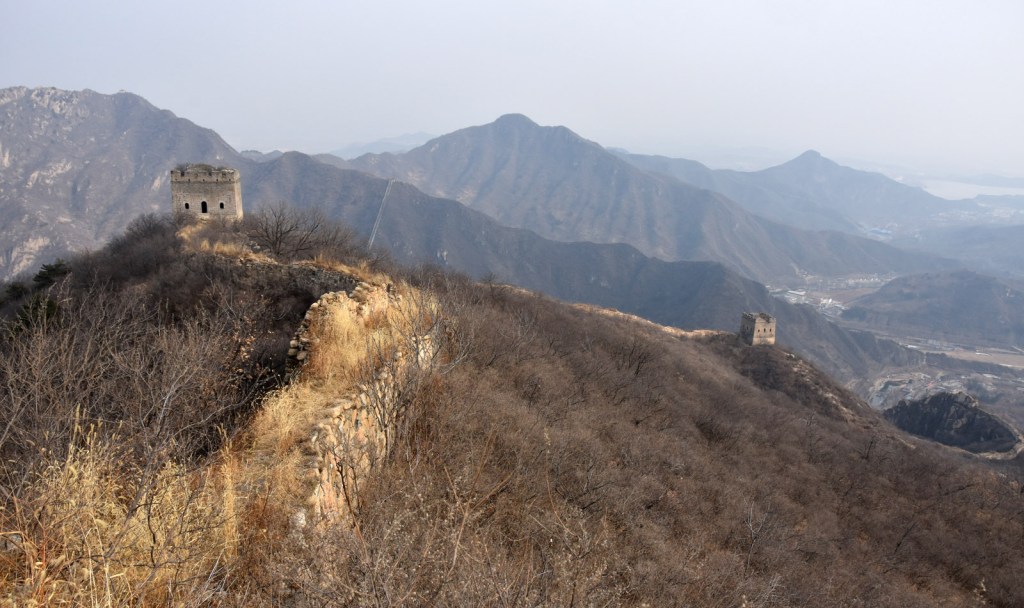
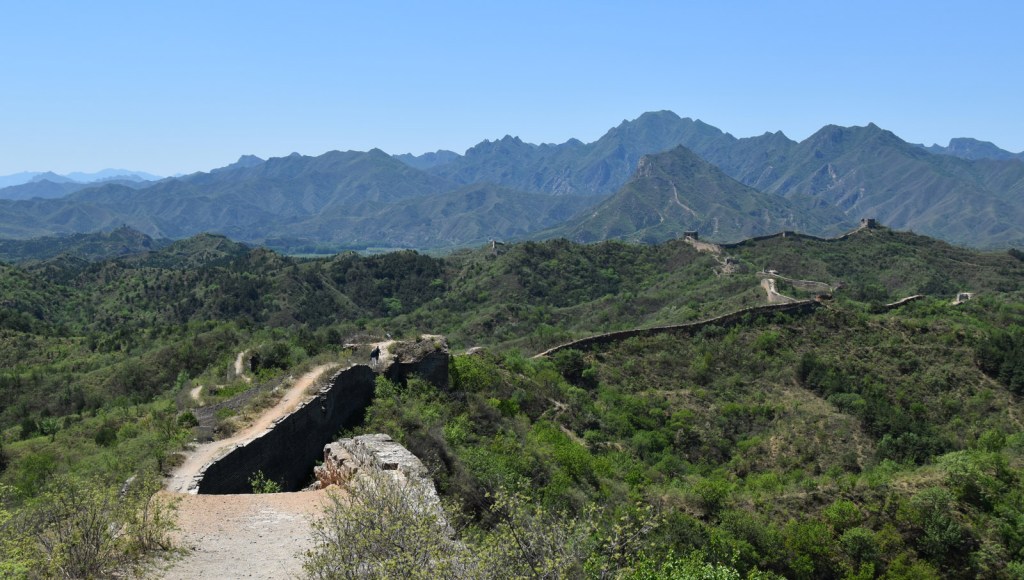
It was an unusally warm day in February, when I arrived at Chongbian, north of Beijing, to hike the “wrong Great Wall.” We started climbing up through terraced farmland, along the way greeting some locals on a motorbike pulling a farm cart. On reaching the Wall, we turned right and hiked along a mountain ridge to the east. The watchtowers had been renovated with new cement but there were no stairs, so we had to climb up precarious piles of rocks to reach the doorways and rooftop – in Imperial times, there would have been wooden ladders here. In between the watchtowers was “wild wall,” crumbling masonry that was wide enough for two people to walk along safely. The trees were bare from winter, but long yellow grass still grew along the top of the wall, glowing in the afternoon sunshine.
It’s a myth that the Great Wall of China is a single structure. In fact, it was a series of smaller fortifications that were joined up by the first Emperor of China Qin Shi Huang, around 220 BC. That’s why, when we reached the final watchtower, the wall divided in two. The main part continued to the north, past Shentangyu village. Another section, meanwhile, looped south to merge with a natural rock formation, encircling the village to provide extra defense. Our guide, Steven, gave us the choice of waiting in the watchtower or continuing on to the rock wall. I choose the latter.
From the watchtower, the wall became much steeper and narrower, clinging to the top of a slender ridge. On the north side, there was now a steep drop to the valley floor, hundreds of metres below. Although it was relatively warm in the sunshine on the mountainside, the bottom of the valley was in shade and the river was frozen solid, a motionless blue-white snake lying between steep cliffs. The wall ended at the rocky outcrop, which we climbed onto for a final viewpoint. I took a quick photo on top with the other hikers and headed straight back. The views were spectacular, but it was a relief to return to the solid masonry of the watchtower.


© Andrew Brown/2024/China
I’ve been hiking the Great Wall of China, on and off, for the last 20 years. It began in 2002, when I came to China on a fundraising challenge with ActionAid. Around a decade later, I moved to Bangkok to work for UNICEF’s Asia-Pacific regional office. China was one of my priority countries, and I came for several extended visits between 2011 and 2015 to work on digital communications. On the weekends, I signed up with a local hiking group, Beijing Hikers, and headed back out to the Wall. Finally, after another decade, I moved to Beijing with my family in 2023 to work for UNICEF China as Chief of Communication. Although the Wall itself had changed very little in the intervening years, in Beijing and China as a whole, the change was much more dramatic.
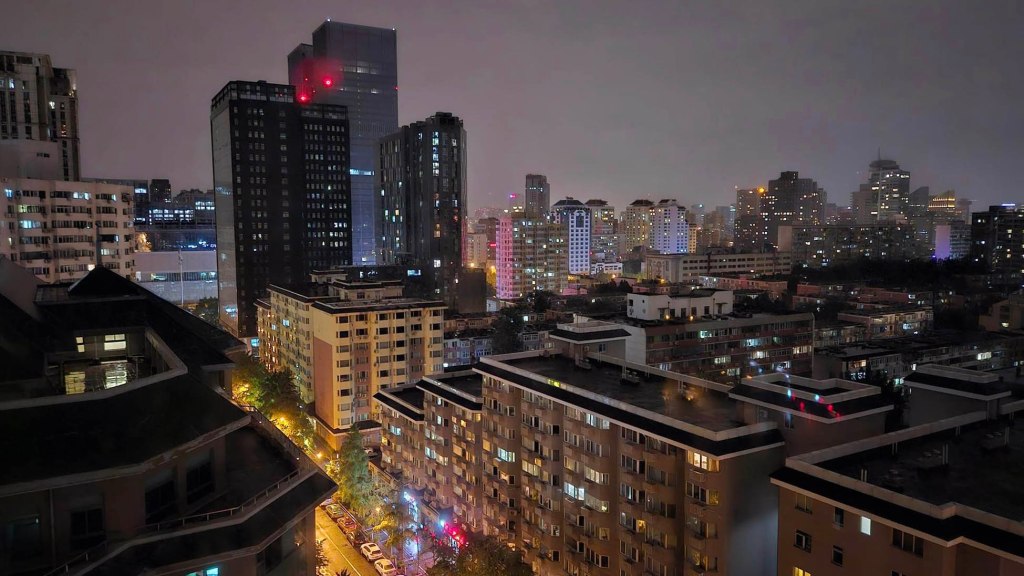
Coming from Kenya, my previous duty station, Beijing seemed extremely urban. We stayed initially at East Gate Plaza in Dongzhimen district, a short bike ride from the UNICEF office in Sanlitun. We were on the 15th floor, and at night, the skyline lit up like a scene from the sci-fi movie Bladerunner. I missed having a garden, but there was a large paved area downstairs, and in the evenings, local people would come out with their kids to skateboard and play. In the mornings, when we took our kids to the school bus, the same area was used by a group of old people doing Tai Chi with ceremonial swords. During the mid-autumn festival, a giant inflatable rabbit appeared outside the building, reclining on a surprisingly realistic blue moon, complete with craters. We were unsure whether the rabbit referred to the Year of the Rabbit or the rabbit in the moon – a Chinese equivalent of the Western man in the moon.

© Andrew Brown/2023/China
My immediate challenge was not so much the language barrier, which I’d anticipated, but the digital ecosystem. Since the last time I was in China, everything had moved to mobile apps – a process accelerated by COVID-19. Now, Beijingers do everything on their phones: communicate with people (Weixin), call a taxi (Didi), navigate (Baidu Maps) order food (Meituan), shop online (TaoBao), book a restaurant (Dianping) and pay for all of the above (Weixin or AliPay). This is very convenient once it’s all set up, and you’ve learned where to click for what, but that takes time, and it was very disorientating for my first few weeks. It made me realise how dependent I was on WhatsApp, Uber, Google Maps and others apps that don’t work in China. We’d brought cash with us, but most shopkeepers looked at us like time travellers from the 19th Century when we attempted to use it.
Once my Chinese apps were up and running, I discovered the best way to travel round town. There are now dozens of public bicycles on every street corner. These come in blue, green and yellow, each linked to a different app. You scan the bike to unlock it, ride wherever you want, and scan again to lock. It cost just 1.5 yuan (20p) per ride. The principle is the same as London’s “Boris bikes”, but without the risk of dying in a collision with a double decker bus. In Beijing, there are wide cycle lanes on all the main roads, separated from the traffic. The main risk was people on e-motorbikes, coming down the lanes in the wrong direction. I soon realised that many Beijing drivers feel free to break any traffic rules they like, as long as they beep while doing it.
Another big change since my last visit was the relative lack of pollution. In 2012, I remember skyscrapers disappearing beneath a yellow haze: a mixture of vehicle exhaust, industrial smoke, and sand blown in from the Gobi Desert. Thanks to a major shift to electric vehicles, closure of inner-city factories, and replanting of trees to form a “Great Green Wall”, the sky was blue and clear on at least as many days as it was hazy. On a good day, we could see all the way to the mountains to the north of Beijing.
Hutong district



© Andrew Brown/2024/China
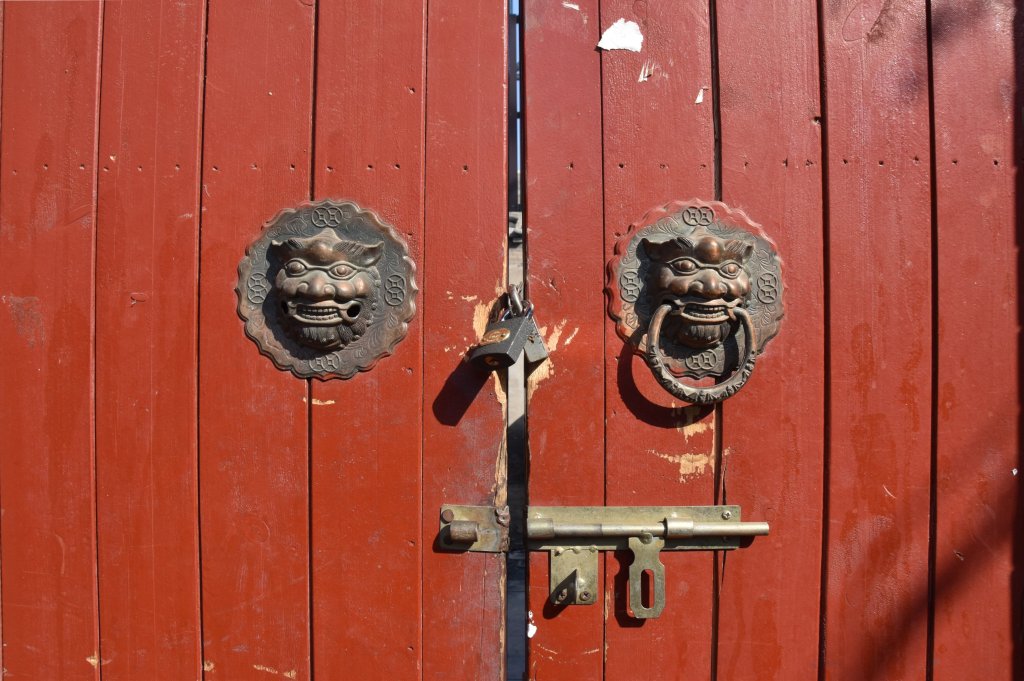
I also revisited Beijing’s historic hutongs (alleyways) in Jiaodaokou neighbourhood, north of the Forbidden City, and Liulichang to the south. Originally built by the Mongolian Yuan Dynasty in the Thirteenth Century, the alleyways are filled with stone and tiled courtyard houses that once housed servants of the imperial palace and their families. In Liulichan, we walked down narrow alleyways where plain grey brick walls were interspersed with bright red doors with grinning lion head knockers, banners with good luck sayings on them in elegantly-painted Chinese characters (such as “This house is full of joy/blessed with a lot of money”). Old men watched us impassively from their doorways and brightly coloured birds chirped from overhead cages, hung below the eaves of houses.
There are different theories on the origin of the word hutong, but the most commonly accepted is that it derives from the Mongolian word for well, and indicates that the alleyway once led to water – a scarce resource in Beijing’s dry and dusty climate. Once at risk of disappearing during Beijing’s 1990s and 2000s construction boom, the hutongs have been preserved by tourism, with many now converted into cafes, bars and antique shops.
Liulichang is my favourite hutong district so far. It’s just outside Zhengyangmen, old Beijing’s Main Gate, which used to divide the city into Mongolian and Chinese districts. Since the Ming Dynasty, it has been famous for scholars, painters and calligraphers, with different streets home to merchants catering to each. This trade has continued to this day and we met one of the last craftsmen, Hu Cheng Ming, who still makes calligraphy brushes in the traditional way. He was much friendlier that the old men outside. At a cramped workstation inside his tiny shop, he showed Zefi and Ayla how he makes the brushes from fox and civet tails.
In an interview with our tour guides, Beijing Postcards, Hu Cheng Ming said: “I was six years old when I made my first brush. My father taught me. In 1956, he was one of the first workers at the state-owned Lifushou brush making factory. And I ended up being the last one. At our peak, we had 800 workers at the factory. But through the 1990s, it became harder for our handmade brushes to compete with the cheaper, machine-made ones. Finally I was the only one left. What saved my position for so long is that I can make a brush from top-to-bottom, not just different parts. When I retired, all production stopped at the factory. But I still make brushes. Making brushes is my life.”
The hutongs also abound with small historical details. I asked our guide about the lion head door knockers. “Lions have been used since ancient times as guardians on doors of temples, houses and shops, to protect against evil spirits,” he explained. “The red doors are newer. It used to be a colour that only the royal family could use, so the hutongs were all grey. But since the end of the Imperial era, anyone can use red.” I also saw lots of bird cages. These are usually kept by older residents, hanging from their front porch, which has been a tradition in Beijing since the Qing Dynasty.
Jazz night

© Andrew Brown/2023-24/China
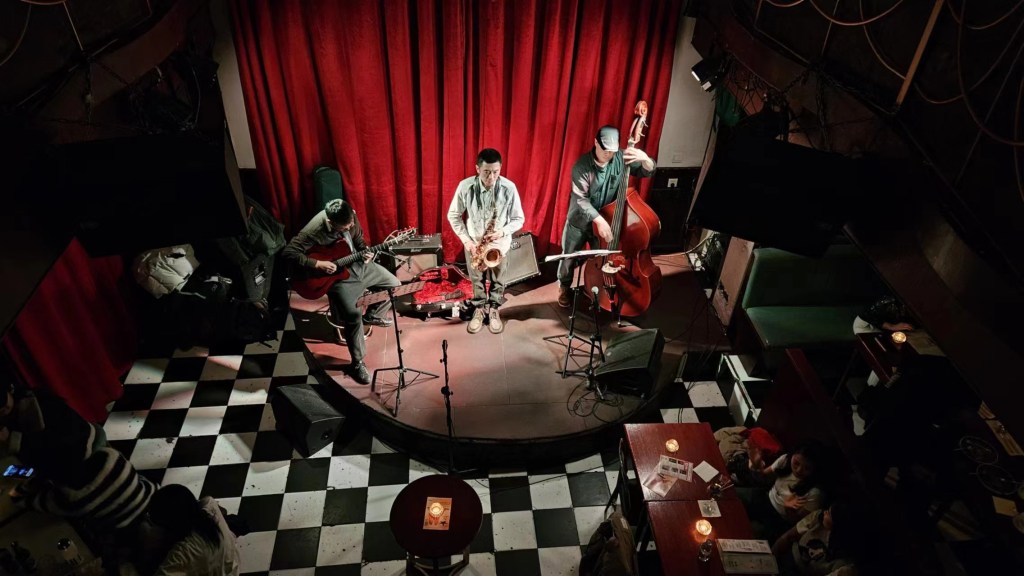
In the evenings, the hutongs are transformed yet again, and become the unlikely venue for jazz, rock and pop music. One of my favourite spots is Modernista, a 1930s-style small club in the heart of the hutong district that hosts regular jazz nights. I went twice with friends from work to see the Victor Bastidas Quintet and Shi Yuji Jazz Trio, both of which were excellent. With its red curtains and black-and-white checkered floor, I also enjoyed the visual resemblance to the Black Lodge from Twin Peaks.
While I was revisiting Beijing, I was also revisiting my old blog posts from 2011-12. I previously had two blog sites, one from my time in Asia (Siamese Dream) and one from Africa (Beneath the Baobab). Now that I’ve returned to Asia, I decided to merge the two. This gave me the chance to add more photos to the older posts, but also reminded me of things that attracted my interest ten years ago. So I rediscovered Namo Band, a fascinating Chinese rock/funk/hip hop/traditional Buddhist band that I first saw at Mao Livehouse in 2011. I was pleased to find that they were still going and apparently shooting music videos in Chaoyang Park near my apartment.
I also came across a post about meeting Maggie Cheung in Beijing. Cindy Xu, who features in this story, left UNICEF China in 2012 but later returned and now leads the marketing team. I asked her why she came back. “I left to pursue my master degree in journalism and work in the private sector,” she explained. “Five years later, I returned to UNICEF because it’s a meaningful job for me to put my best talents into something bigger than my personal gains and to make a lasting impact for the world.”
“I come from a low-income rural family and experienced deprivations in my childhood,” she continued. “I’m grateful that my parents tried their best to support my education so that I had a chance to break the cycle. I hope that more children will be able to have fair opportunities to overcome adversities and become the person they want to be.”

© Andrew Brown/2023/China
World Children’s Day
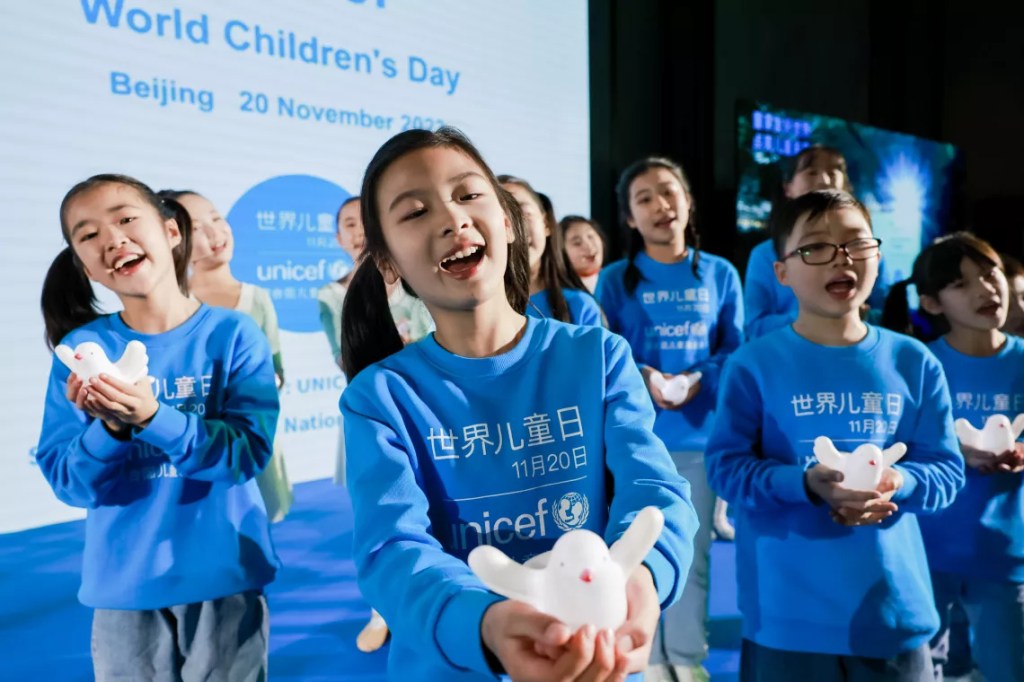
One of my favourite UNICEF activities is visiting projects on the ground for children. In China, it’s not easy to do this as an international (although I did later manage to get out to Sichuan and Shandong provinces), so my interaction with children in the first six months was at events in Beijing, especially around World Children’s Day. UNICEF celebrates this day on 20 November every year with a campaign and event. Our theme for 2023 was “building a child friendly society for all,” and we held workshops with children where they drew pictures of what this meant to them. Together with national colleagues, I interviewed children about their artwork.
One of them was 10-year-old Bai Yuetong. “This girl has yellow hair,” she told us. “She’s different, and the other children don’t want to play with her. I drew her because I want to be her friend.” Meanwhile, 7-year-old Lu Xiangyi said: “I want to live in the place I drew because there are mountains and playgrounds.”
I also roped in my son Zefi, 8, to provide a quote about our main video for the campaign. “It was good. I liked the girl’s drawings,” he said. “I think the world could make food and water cheaper for children from poorer families because they need it to survive.”
Another nice moment at work was getting my Chinese name, 柏安哲, which is now on my office door and business cards. In pinyin, this is Bai An Jer, which is based phonetically on Brown, Andy (in China, you put the surname first). This was one of several options provided by my team, with the final choice made by Joyce’s Dad. I was told afterwards that this is a very auspicious name. The first character is a tree with highly prized wood, the second is peace, and the third is a philosopher.


Various photographers.
Winter is coming
Another huge difference between China and my previous postings was the weather. Thailand, Malawi and Kenya are all hot countries where the main seasons are rainy and dry, and winter means a few weeks of 20°C degrees instead of 30°C. Beijing, by contrast, has the four seasons I grew up with in the UK (spring, summer, autumn and winter) but more extreme versions. In summer, temperatures can go as high as 40°C degrees, while in winter they plummet to -20°C. Spring and autumn are pleasant but short, with temperatures rising or falling by ten degrees in a matter of weeks.
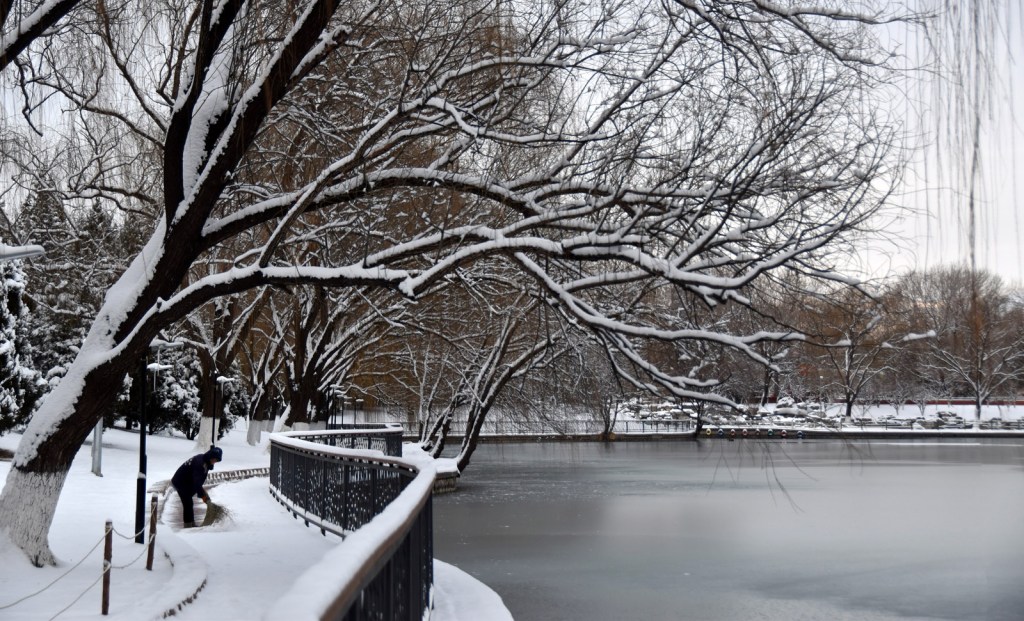
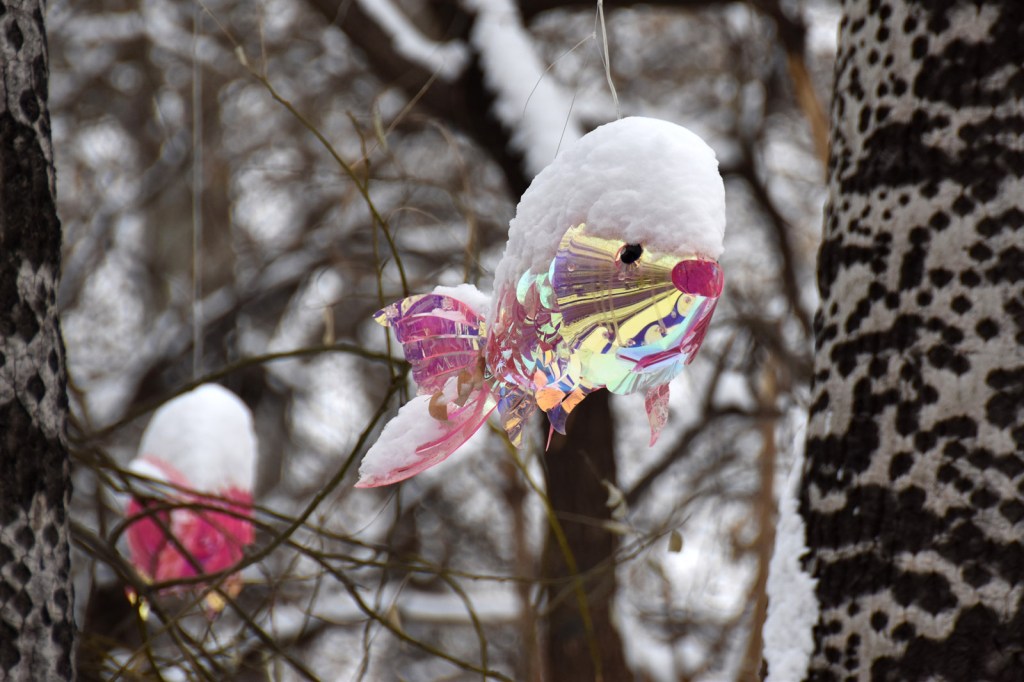
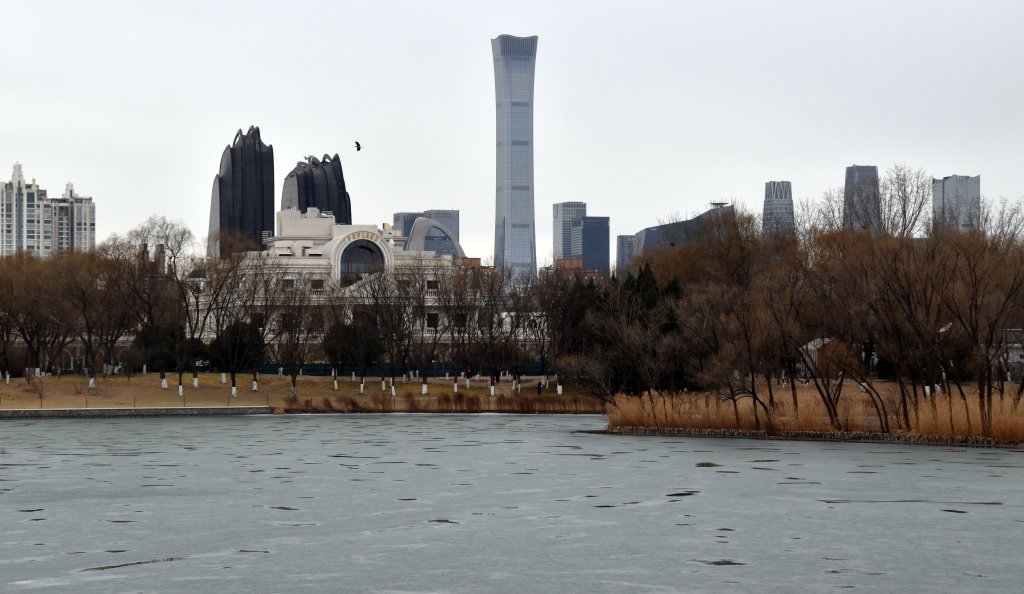
It was fun to watch the seasons change. For Zefi and Ayla, winter provided the first snow they’d experienced in their lives. Ayla had just got into Frozen, so the chance to build a snowman was especially welcome. On the morning after the first snow, I walked them to their schoolbus. They both stood with their tongues out, looking up at the sky and waiting for a snowflake to fall on them (like the fire lizard in Frozen). Ayla, who is six, was a bit disconcerted at first, but Zefi quickly worked out how to make and throw a snowball. Later, I went for a walk around Chaoyang Park, where the lake and river had frozen solid enough to walk on and all the colours had turned brown, beneath a thick coat of white snow.
Although the winter was more severe than in the UK, it didn’t always feel like it. Buildings are much better insulated and the city government provides free heating from November to March. Our longer-term apartment was on the 18th floor with large south-facing windows, so even without the heating on, it was pleasantly warm inside on a sunny day.

© Andrew Brown/2023-24/China
Year of the Dragon
Winter officially ends with Chinese New Year, or Spring Festival. In 2024, it also marked the end of the Year of the Rabbit and the start of the Year of the Dragon. This is a particularly auspicious year in the Chinese calendar. Many people delay or bring forward having a child and try to time things so that it will be born in the year of the dragon. Known as “dragon babies,” these children are supposed to have good fortune in life. Interestingly, recent research shows that this is indeed the case – not because of any supernatural power, but because their parents have higher expectations of them and spend more money on their education and welfare, creating a self-fulfilling prophecy.
As it was our first Chinese New Year in China, we stayed in Beijing and visited Ditan Temple Fair to see the reenactment of a Qing Dynasty ceremony, when the Emperor prayed to the God of the Earth for good harvest and fortune. These days, the ceremony is performed by actors and open to the public, but it gives a sense of what things might have been like in imperial times. Courtiers in blue robes and red conical hats bowed and offered incense sticks to the “Emperor”, who wore shining golden robes.
Most people come for the fair, rather than the ceremony, which is a mixture of food and games. At the food stalls, we tried various hot skewers, including spicy octopus advertised by an enterprising stall holder with a public address system. We had to eat them quickly because it was still cold out. We also lost a fair amount of money on the carnival games, which like their equivalent the world over, are designed to look much easier than they actually are. After several attempts, Zefi finally won a Sonic the Hedgehog toy.


© Andrew Brown/2024/China
On the last day of the Spring Festival, we visited Chaoyang Park, round the corner from our new apartment. After experiencing -10°C, +10°C felt nice and balmy. The lake was still largely frozen but had started to thaw at the edges and black swans were swimming around the opening waterway. I saw one aggressive male swan chase another off a choice piece of thawed marshland.
There was also a miniature fair at nearby Solana shopping mall. We’d failed to see the dragon dance at Ditan Park so I was happy to catch one here, including the moment when the dragon leader stopped to talk to a police officer and handed the dragon’s head to a delighted foreign backpacker, who did a few rounds with the rest of the team.

© Andrew Brown/2024/China

 Beneath the Baobab