©UNICEF/China/2025/Ma Yuyuan
Cao Kun walks up the hillside from a small lake to his family farm in Chengmai, a rural area of China’s southern Hainan Island. It’s sunset and the air is filled with the sounds of birds and crickets. A white egret flies across the sky from the marshland. Cao Kun pushes aside the leaves of a tall maize plant and follows the winding earth path in the fading light. He turns to look back across the valley.
“When I was a boy, this lake was much larger and had lots of fish in it,” he recalls. “But there was a very severe drought a few years ago. The lake became so dry that only the central part had some water left. The mud at the bottom of the lake dried up and cracked because of the sun.”
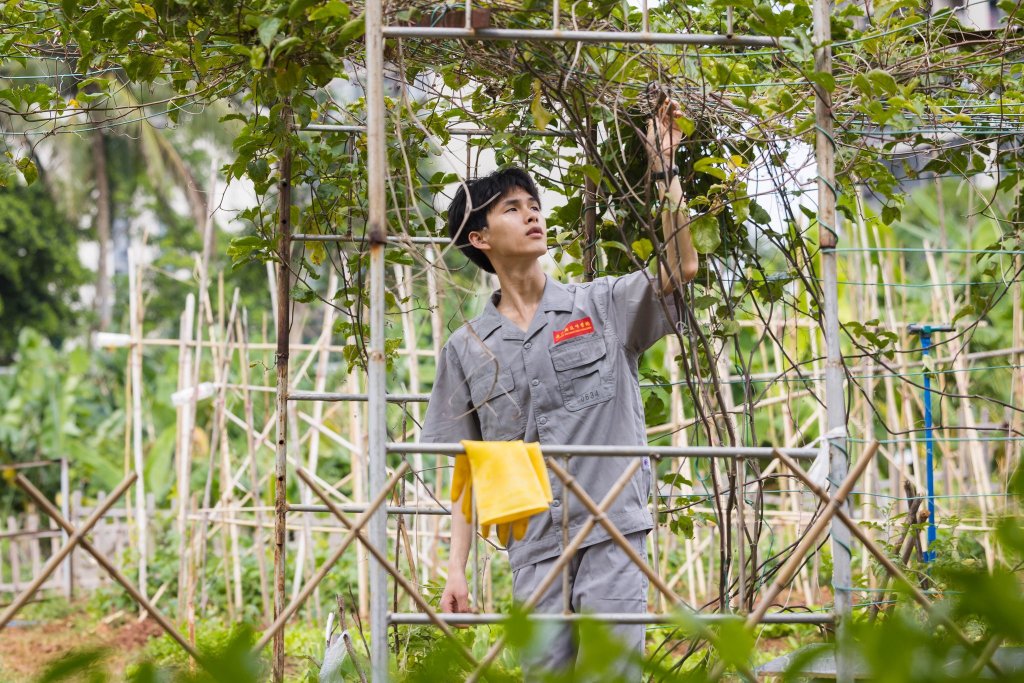
The 21-year-old has spent the last three years learning green skills at Hainan Technician College, as part of his course on electrical automation with support from UNICEF and the Ministry of Education. This includes lessons on water and energy conservation, green manufacturing and agriculture.
Using the skills he learned, Cao Kun and his classmates developed a smart irrigation system to save water. This uses sensors to test temperature and humidity and turns on water sprinklers only when they’re needed. Cao Kun installed the same system on his parent’s farm, a rural collective co-owned with three other families. He also installed solar panels and made a fruit trellis out of recycled bed frames.
“The green skills I learnt are helping me protect the environment,” Cao Kun says. “Growing up on a farm, I saw a lot of wasted water. I want to help my parents save water and relieve them of some of their stress. The training and practice in school helped me a lot. It also gave me a great sense of accomplishment.”

© UNICEF/China/2025/Ma Yuyuan
Sustainable agriculture
The prototype of Cao Kun’s smart irrigation system is installed in a small farm at Hainan Technician College, where it is used to water fields of maize, lettuce and passion fruit. The fields also support farm-based learning, where students from different departments can practice their green skills.
Here, Cao Kun demonstrates the system to his fellow students, all wearing the light grey uniform of the college. Behind him, a group of younger girls in blue uniforms till the adjacent field, or rest in the shade of a large palm tree. He talks the students through the control system. “You can decide how long you want to water and which sprinkler to use,” he tells them. “You can even remote control it from home with your mobile phone.”
Cao Kun shows them the sprinkler system, taking off and replacing the head, which is customized for the different plants in each of the small fields. He digs up a sensor buried in the soil and shows them how this measures temperature and humidity to determine when the plants need watering. “The objective is to better utilize water resources and protect the plants,” he explains. “We can make sure they have adequate water for growth, even during a drought.”
Cao Kun’s teacher Wang Deliu says that the initiative has had a big impact on Kun and his fellow students. “Since the implementation of UNICEF’s green skills programme, our students’ awareness and behaviors have greatly improved,” he says. “For example, when we grew passion fruit, they cut and welded scrap bed frames and made them into trellis. Kun’s water system helps to prevent soil erosion and maintain the environment. As his teacher, I feel happy and proud of him.”

© UNICEF/China/2025/Ma Yuyuan
Climate change
The climate crisis is a child rights crisis. It affects children’s fundamental rights, such as the rights to survival, good health, well-being, education and nutrition.
UNICEF’s global Children’s Climate Risk Index ranks China 40 out of 163 countries in terms of the impact of climate change on children. Children in the country are affected by droughts, typhoons, floods and heatwaves – all of which are becoming more frequent and severe due to climate change.
More than 110 million children in China are now experiencing some degree of water scarcity. Climate change is making droughts longer and more severe, and this is damaging food production and children’s health.
UNICEF is responding to the climate crisis. In China, the organisation is working with the Ministry of Education to integrate green skills into technical and vocational education and training (TVET), via an adolescent life skills development programme. This aims to empower young people with skills to tackle climate change and to work in the emerging green economy.
“UNICEF supports the development of green skills learning materials for TVET institutions,” UNICEF Education Officer Du Wei says. “These include both general green knowledge and transferable skills, values and attitudes such as resilience, problem-solving, critical thinking and creativity.”
“We’re training TVET teachers to embed green skills into their teaching, mentoring, career guidance and student participation. We also support youth-led climate action, to empower young people like Cao Kun to be agents of change.”

© UNICEF/China/2025/Ma Yuyuan
Super Typhoon Yagi
The dried-up lake at Cao Kun’s family farm is not the only sign of the impact of climate change. Hainan is affected by an average of 8-9 typhoons annually, which are becoming stronger and more frequent. In 2024, Super Typhoon Yagi tore through the island. The family farm was directly in its path. Walking through the farm, his mother, Chen Juanjuan, points out the goat sheds that were destroyed. Their roofs are ripped to shreds and the remaining metal sheets hang loose, clattering and clanging in even a light breeze.
“It was most severe typhoon I’ve seen in my lifetime,” Juanjuan says. “We moved to a friend’s house that was stronger, but the building was shaking. We didn’t sleep all night. When we came back to the farm in the morning, I was so shocked by the destruction that my legs went soft.”
Despite the devastating impact of the typhoon, her face lights up when discussing her son and the green skills he’s learned. “After joining the technical college, Kun installed a smart irrigation system on our land. It is convenient for us,” she says. “He told me that I work very hard, and he wanted to build better farm systems to help me. As a mother, I am very happy. He is paying back me and his teachers.”
© UNICEF/China/2025/Ma Yuyuan
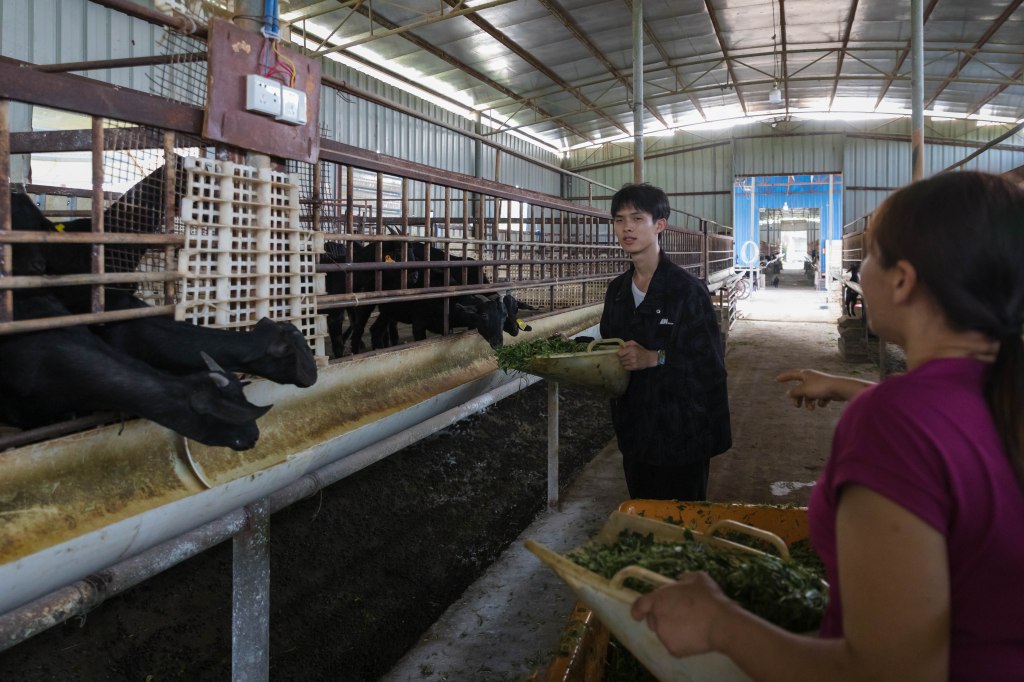
As the afternoon draws to a close, Cao Kun helps his mother shred grass in a large machine and brings it down the hill to feed their remaining goats, in the last surviving barn. As they enter, dozens of goats come running over, their hooves clattering like hail on a metal roof. The larger horned animals shove the smaller ones out of the way to get at the food.
It will take some time for the farm to be restored to normal, so Cao Kun’s mother is delighted that, partly thanks his smart agricultural system, he has recently secured a job in Sichuan Province for when he finishes college.
For Cao Kun, this is only the beginning. “Now that I have learned green skills and put them into practice, I can inspire and mobilize others to take part,” he says. “If everyone can save a bit of resources, then all this accumulated will be a huge treasure for the planet.”

 Beneath the Baobab