
© UNICEF/China/2025/Ma Yuyuan
Early in the morning, 18-year-old graphic design student Huang Lifen walks down a beach at Chengmai on the north coast of Hainan Island, China, with a sketchpad under her arm. The sound of the waves can be heard, rolling gently to the shore. It’s a beautiful sweep of sand but, as she looks out to sea, the horizon is lost in the haze. Lifen walks towards the top of the beach, where she starts finding rubbish left behind by tourists the day before or washed up from the sea.
“When I came here as a child, this beach was much cleaner,” she recalls. “There were no hotels then. The sea was very blue and there was barely any rubbish on the beach. Nowadays, rubbish is everywhere.”
At the high tide mark, Lifen finds a coconut shell in a plastic bag with a plastic straw. She takes out her sketchpad and starts to draw. As the picture develops, she adds monster eyes and teeth to the bag, and a recycling sign in a speech bubble. “Someone left this bag on the beach instead of recycling it,” she explains. “The bag feels that it is causing pollution to the environment. That’s why it got angry.”
“I want more people to understand the importance of environmental protection,” she continues. “If more rubbish flows into the sea, it will threaten the environment of marine life, as well as our own.”
© UNICEF/China/2025/Ma Yuyuan
Sustainable design
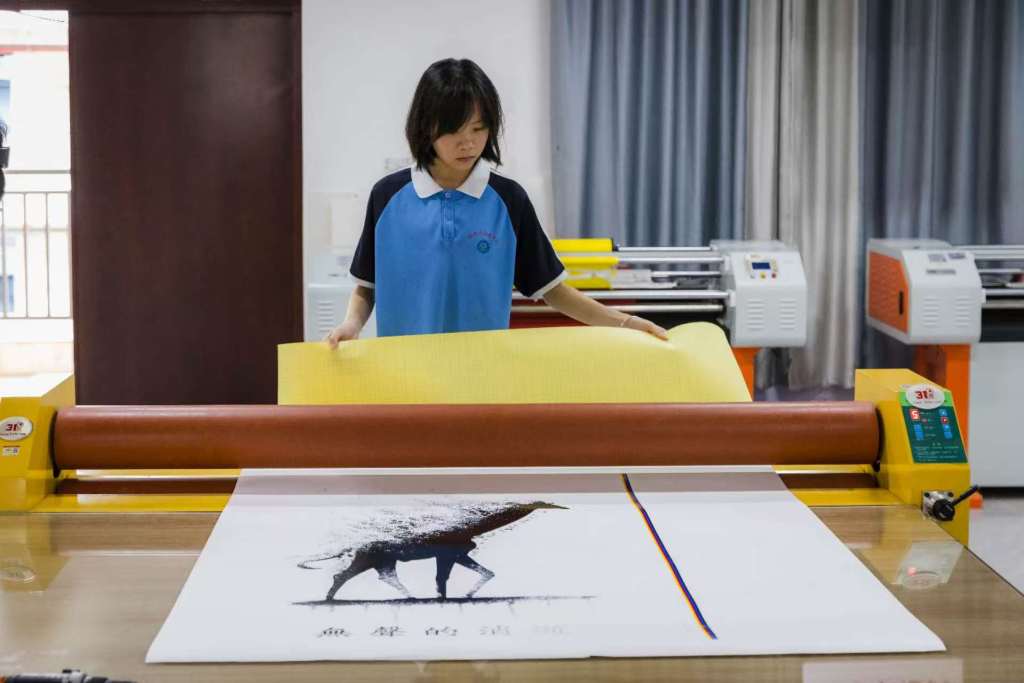
Huang Lifen has a passion for recycling. She has spent the last three years learning green skills at Hainan Technician College, as part of her course on graphic design, with support from UNICEF and the Ministry of Education. The green skills training includes lessons on recycling, water and energy conservation, and green transport.
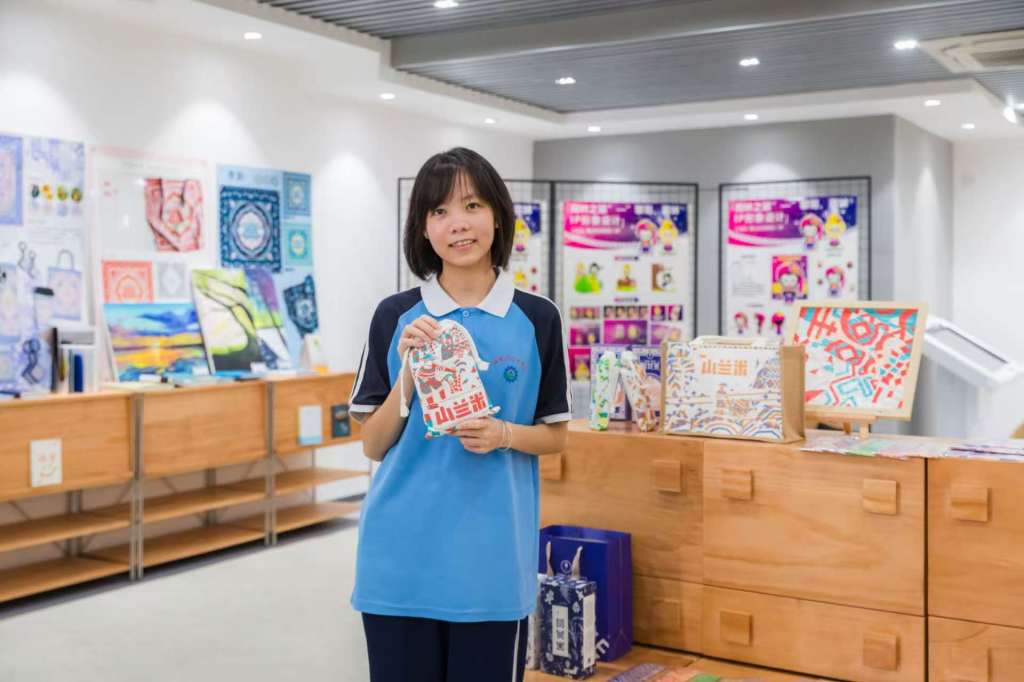
Using the skills she learned, Lifen designed packaging for local rice products with biodegradable materials and created posters of disappearing wildlife to raise public awareness of environmental threats. She also helps collect rubbish around the school campus and teaches recycling to younger children.
“People from Hainan are dependent on the sea,” Lifen says. “Both my parents work in the fishing industry, packaging fish in factories. Climate change is having a significant impact here in Hainan. For example, Super Typhoon Yagi caused a lot of damage to rural areas last year.”
Lifen is a bit shy at first, but as she talks about her projects, her confidence grows. “During the course on green packaging, I learned that the objective is to reduce pollution by using more biodegradable or recyclable materials,” she continues. “That’s why I created environmentally friendly canvas bags for local rice. I also included patterns from the Li ethnic group, who grow the rice, and showed the mountain environment.”
“Through doing this, I realised that designers have a role to play in making consumers and the wider public more aware about environmental protection. I hope that through my designs, I can encourage people to take climate action.”
Lifen’s teacher Mu Hong is also passionate about the environment. Originally from Xinjiang, she was shocked to see less and less snow on the mountain tops every year, when she returns home to visit her family. This prompted her to incorporate more climate change education in her course.
“The impacts of climate change are now very visible and a threat to all of us,” Mu Hong says. “In our design course, we teach students concepts about environmental protection, and they apply these in their study and creative projects. This helps cultivate their sense of social responsibility.”
Mu Hong says that Lifeng has taken these lessons to heart. “I can see this in her assignments, when she uses recyclable materials or promotes green concepts, and her daily life” she says. “Lifeng is an excellent student, and I have full confidence that she will have a successful career in design.”
Climate change
The climate crisis is a child rights crisis. It affects children’s fundamental rights, such as the rights to survival, good health, well-being, education and nutrition.
UNICEF’s global Children’s Climate Risk Index ranks China 40 out of 163 countries in terms of the impact of climate change on children. Children in the country are affected by droughts, typhoons, floods and heatwaves – all of which are becoming more frequent and severe due to climate change.
UNICEF is responding to the climate crisis. In China, the organisation is working with the Ministry of Education to integrate green skills into technical and vocational education and training (TVET), via an adolescent life skills development programme. This aims to empower young people with skills to tackle climate change and to work in the emerging green economy.
Hainan Technician College joined the UNICEF green skills programme in 2022. Since then, green values and awareness have become part of the vision of the college.
“UNICEF supports the development of green skills learning materials for TVET institutions,” UNICEF Education Officer Du Wei says. “These include both general green knowledge and transferable skills, values and attitudes such as resilience, problem-solving, critical thinking and creativity.”
“We’re training TVET teachers to embed green skills into their teaching, mentoring, career guidance and student participation. We also support youth-led climate action, to empower young people like Huang Lifen to be agents of change.”
© UNICEF/China/2025/Ma Yuyuan
Next generation
At the end of the day, Lifen and two classmates walk around the campus collecting plastic bottles left on the basketball court and lawns. Other students jog around the running track, play sports, or hang out by the stands, their shadows lengthening as the sun sinks towards the horizon. Lifen and her classmates fill up a red biodegradable bag with rubbish and return to their classroom.
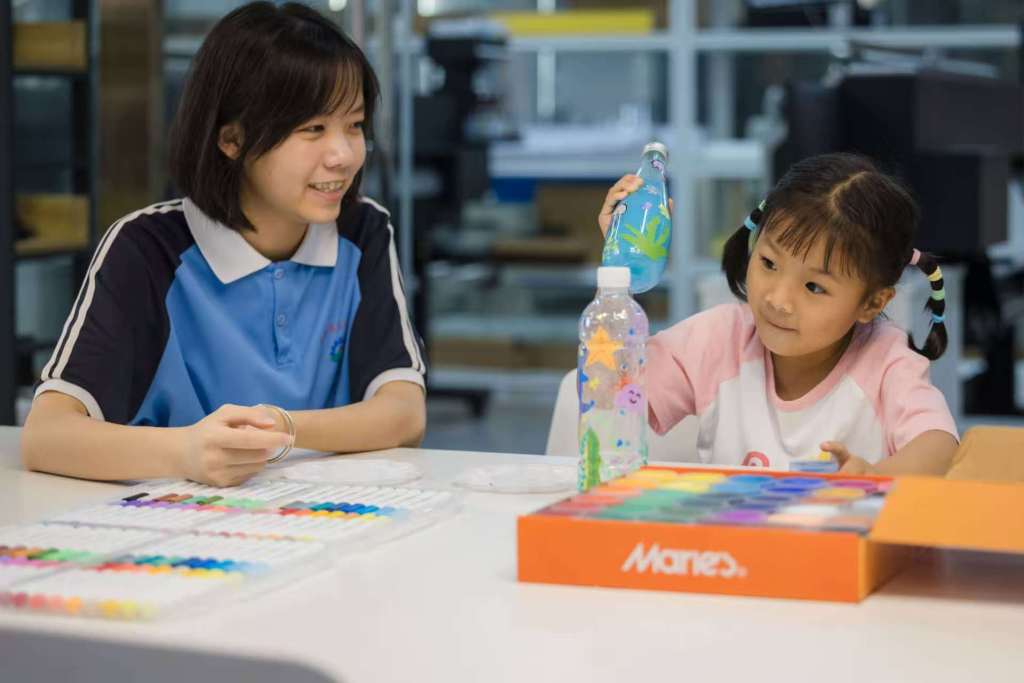
Around 5pm, a group of young children – children of college staff members – arrive for an extra-curricular activity. They sit around a table, while the design students bring out sets of brightly-coloured marker pens and the plastic bottles they collected around the school, now washed clean and dried.
Lifen sits next Xiyuan, a five-year-old girl with her hair tied in pigtails. “What do you want to draw? Do you like the ocean?” she asks. “I want to draw a pink jellyfish!” Xiyuan replies and starts drawing. “It’s beautiful. This is how to do the eyes,” Lifen says.
Once the children have finished decorating their bottles, Lifen demonstrates how to add water in the bottle and blue paint in the cap, then shake it to create blue water that looks like the sea. “Let’s not throw rubbish in the sea and protect animals’ homes,” she says. Xiyuan nods in agreement.
For Lifen, the activity is a chance to pass on what she’s learned to the next generation. “I enjoy working with children,” she says. “I’m happy to share my work with them and help them build environmental awareness from a young age,” she says. “I believe that when they grow up, they can do even more for the environment than I am.”
© UNICEF/China/2025/Ma Yuyuan

 Beneath the Baobab