
© UNICEF China/2025/Lu Yufan
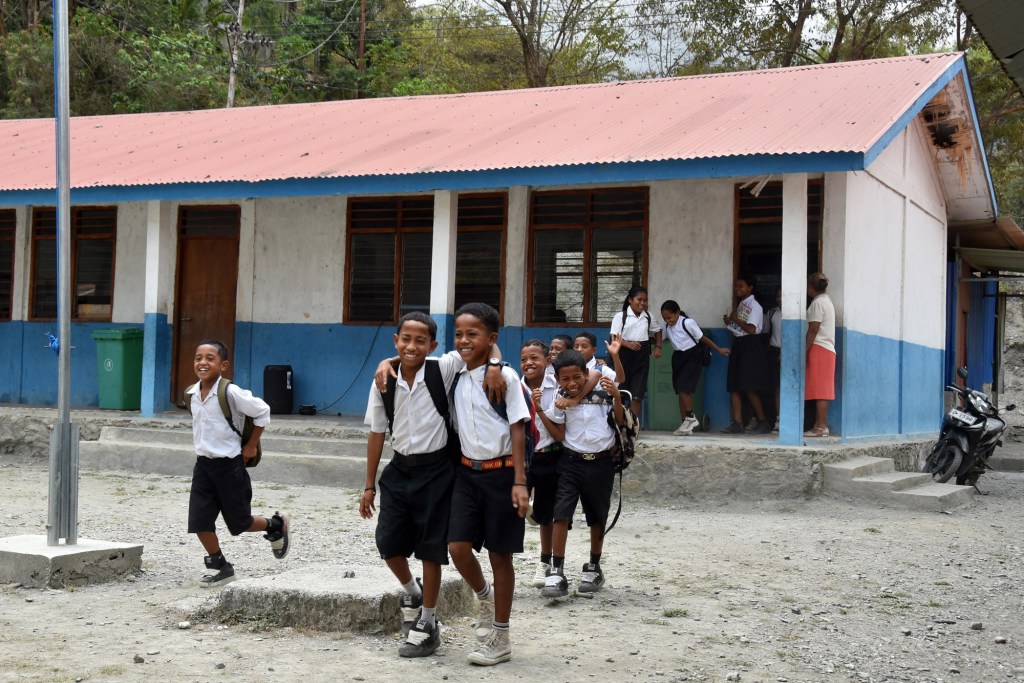
It was a stormy evening when the worst flood in recent memory hit the outskirts of Dili, Timor-Leste. Flood waters swept down the hillside of a steep valley, engulfing Casnafar Basic Education Branch School and houses in nearby villages. People living in the area are used to annual flooding, but this was much worse than usual. They quickly abandoned their belongings and homes and climbed the hillside to find higher ground.
Before the night was over, the water had risen above the metal roof of the school buildings. Many family homes were either swept away or damaged beyond repair. The school buildings, which were stronger, survived but everything inside was swept away. When teachers returned, they found classrooms full of stone and sand left behind by the retreating flood waters. It was another two months before students were able to return to school.
Grade 6 student Nonia Ximenes, 12, remembers it vividly. “Strong winds broke the windows of our school,” she says. “The water carried rubbish and debris until it covered the bridge and overflowed into our school. The flood swept away chairs, tables, cupboards, books, pencils, and then it carried mud and debris until it covered our school. My home was also destroyed.”
“I was very sad, because the floods made us unable to go to school. We had no classes, and no lessons,” Nonia continues. “We had to move to a neighbour’s house further up the hill and stay there for two months, but we came back to school to help clean the debris and fix the broken windows.”
Climate chaos
The climate crisis is a child rights crisis. It affects children’s fundamental rights, such as their rights to survival, good health, well-being, education, and nutrition. Every child in the world is already exposed to increased climate hazards, with children among the most vulnerable to extreme weather and its impacts, such as malnutrition and waterborne diseases.
In Timor-Leste, climate change is driving more frequent and severe extreme weather events. Most years, children like Nonia are affected by floods, droughts or both.
With support from the Government of China, UNICEF is helping schools like Nonia’s prepare for and respond to future climate disasters. This includes information for schools on disaster risk reduction, as well as 2,000 new desks and chairs, and books and other learning materials for over 19,000 learners. The funding is provided by China International Development Cooperation Agency, through the Global Development and South-South Cooperation Fund.
UNICEF Timor-Leste Programme Officer Getrudis Mau says that the project has transformed Casnafar Basic Education Branch School, which now has improved equipment, as well as a better understanding of how to respond to future disasters.
“When floods like this occur, UNICEF works with the Ministry of Education to identify the number of schools affected,” she says. “The goal is to help children recover from the impact of the floods and resume their education.”
“The situation in Casnafar has greatly improved,” Getrudis continues. “Previously, three children had to share one chair and desk. Thanks to the support from the Government of China, now each child has their own chair and desk. This allows them to participate in learning activities comfortably and happily. UNICEF has also shared information on disaster risk reduction with the school.”
Chinese Ambassador to Timor-Leste Wang Wenli also welcomes the investment in children and families. “I believe these projects are highly meaningful and deeply rooted in local social realities,” she says. “They reach communities and schools, to the grassroots level, bringing support to where people need it most.”

© UNICEF China/2025/Lu Yufan
Keep on learning
At home, Nonia sits on a lime green concrete porch outside her partially rebuilt family home, together with her mother Veronica Soares. She lays out her schoolbooks on a round table and starts doing her homework, writing a story about a boy called Joey and his boat. Behind Nonia’s house, storm clouds are building again over the hillside. The sky darkens ominously and distant thunder rumbles. Soon, it begins raining, with drops splashing in puddles on the ground and tap-tapping on a tarpaulin stretched over a gap in the roof.
Veronica remembers how Nonia was determined to keep studying during the floods. “School was closed, but Nonia was still studying at home,” she says. “I asked her, ‘school isn’t open, so why are you studying?’ She replied, “Mom, even if school hasn’t started, we still need to study so our hands don’t forget how to write. We have to keep learning at home.”
Nonia is happy to be back in school and enjoying it even more now that she has new equipment. She sits behind her own desk in a renovated classroom. There is a bookcase full of new books in one corner, with a globe on top. At the front of the class is a new whiteboard with a digital projector, the first time the school has had such IT equipment.
Today’s lesson is on disaster risk reduction. “When there is flooding, what should you do?” her teacher asks. Nonia raises her hand and stands up to answer. “We should save ourselves,” she replies. “Go to higher ground and avoid falling trees.”
“I feel very happy and proud to be back at school with furniture and textbooks,” Nonia says after the lesson. “The new chairs and tables are very comfortable. I can continue studying and I know what to do next time there’s a flood. When I grow up, I would like to be a police officer. I want to help children, so that floods don’t sweep them away, and I can help them find a safe place to take shelter.”
Veronica is also proud of her daughter and optimistic about her future. “I love my daughter Nonia. She’s a good girl and always listens to me,” she says. “My dream and hope for her is that she grows up to be a good person and contributes to the future of this country.”
© UNICEF China/2025/Andrew Brown

 Beneath the Baobab