©UNICEF/China/2025/Lu Yufan
It’s a hot, dry and dusty afternoon in Bulubai village, in Baucau,Timor-Leste, when a team of health and nutrition workers arrives from the nearby Laga Health Centre. The community has turned out to welcome them. A group of women, children and older people sit on plastic chairs in the shade of a metal roof, surrounded by small village houses. The activities begin with a demonstration of how to cook nutritious meals with locally available ingredients, led by Ana Legita Correia, a local woman from the village, who is also a member of the mothers’ support group.
“Before we begin the cooking demonstration, I would like to talk to you about the different food groups,” Ana says. “If you cook porridge, don’t just use rice, also use vegetables. This helps the immune system of the child.”
Together with other mothers, Ana lights a fire and moves a huge metal cauldron over it, heating up water to begin cooking rice. While they’re doing this, the team from the health Centre sets up an area to assess young children for malnutrition, with UNICEF-provided measuring tapes and weighing scales. Next to these, a table is piled high with education leaflets and sachets of ready-to-use therapeutic food (RUTF).
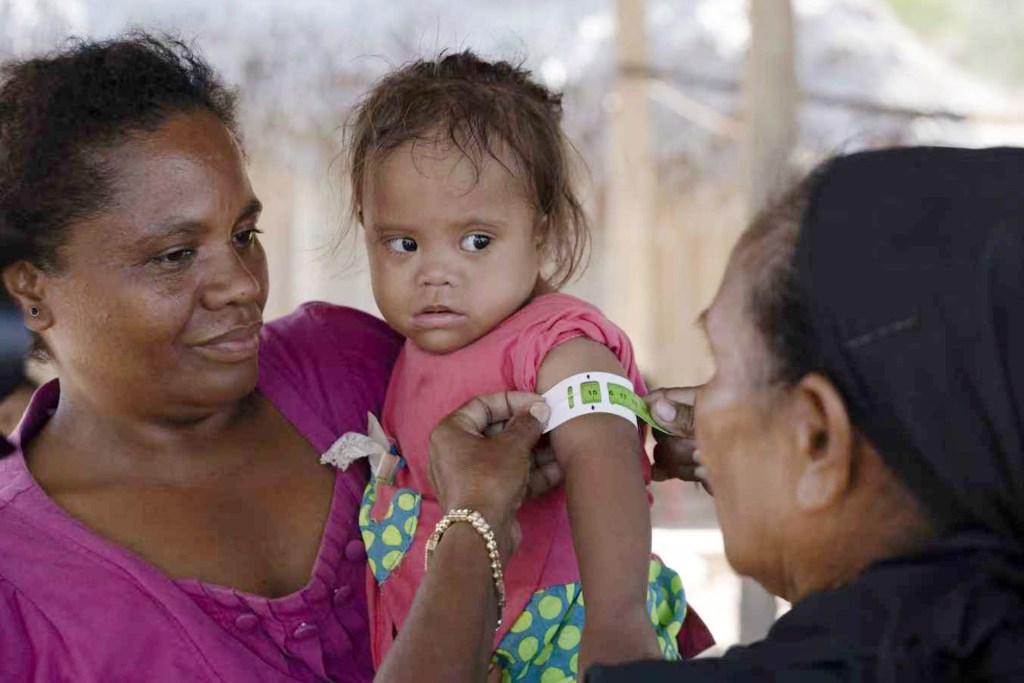
One of the children who comes in is Adriana, a 4-year-old girl with Down syndrome and a history of malnutrition. She sits on her mother Marquita Belo Gaio’s arm, clinging to her shoulder and looking at the visitors with an expression of mixed curiosity and suspicion.
First, a health worker uses a measuring tape to check Adriana’s mid-upper circumference. The tape shows green, indicating a healthy result. Then Marquita holds her daughter on a set of weighing scales. Here the news is not so good – since the last screening, Adriana has fallen below a healthy weight.
“Okay, she passed the arm measurement,” Laga Health Centre nutritionist Sebastião Das Dores Simões tells Marquita. “But her weight falls into the category of malnutrition. Adriana is still malnourished.”
Later, while Adriana is eating some of the rice, eggs and vegetables cooked by the mothers’ support group, Sebastião explains further. “There are many factors that could have caused Adriana’s weight to decrease,” he says. “One is the long dry season, which made it difficult for the family to access enough food and clean water. I’m happy that we’ve provided treatment. Her body is getting stronger, it’s not weak like before.”
Life has been hard for Adriana’s family of six. Her father does occasional work collecting sand from the nearby river to sell to cement makers, while her mother is a subsistence farmer. They own a few chickens and a small field. When the rains and harvest are good, the family can make ends meet. But the increasingly severe dry seasons are tipping them into poverty and their youngest child into malnutrition. Adriana’s disability further complicates the situation, requiring more time and care from her mother.
Marquita is visibly emotional as she tells the family’s story. “When she was younger, my baby was weak and just slept all the time. I didn’t know what was wrong with her. I almost lost hope,” she says, with tears running down her face. “I feel sorry for my daughter, who has suffered for three years. She is now four years old and can sit up better, but she still cannot walk.”

©UNICEF/China/2025/Lu Yufan
Support from China
The climate crisis is a child rights crisis. It affects children’s right to survival, good health, well-being, education and nutrition. Every child in the world is already exposed to increased climate hazards, with children among the most vulnerable to extreme weather and its impacts. In 2020, 2 billion people globally were food insecure and 3 billion people could not afford a healthy diet. In Timor-Leste, over two thirds of people live in rural areas and rely on subsistence farming. Climate change is driving more frequent and severe droughts and floods, making it harder for families to feed their children.
With support from the Government of China, UNICEF is bringing child nutrition screening and education to communities. This includes measuring tapes and weighing scales to identify malnourished children, cooking classes for mothers, and training for health workers and mother support groups.
“We are grateful to the Government of China, which has played such a vital role in reducing malnutrition in Timor-Leste, especially in Baucau,” UNICEF Nutrition Officer, Bendita De Araujo, says. “Marquita is a strong and dedicated mother. She always tries to provide her family with enough food, no matter the hardship she faces.”
Funding for the project was provided by China International Development Cooperation Agency (CIDCA) through the Global Development and South-South Cooperation Fund (GDF).
Wang Wenli, Chinese Ambassador to Timor-Leste, comments: “I believe the joint projects implemented in Timor-Leste with UNICEF are good practices. We hope these projects will continue and bring benefits to the local communities.”
The community outreach has been a lifeline for Marquita. It was Sebastião who first identified that Adriana was suffering from malnutrition, in addition to her disability. He referred her to the Baucau hospital for one month, then continued monitoring her situation in the community, with help from Ana. Thanks to this support, Adriana is now doing much better, despite the recent dip in her weight caused by the dry season.
“I was so happy when Sebastião identified the problem and gave us treatment,” Marquita says. “Since then, Adriana has gained weight and is more active. Now, she can sit up on her own. I hope that she will grow up normally and be able to help me around the house.”

©UNICEF/China/2025/Lu Yufan
Vegetable garden
As the day draws toward sunset, Marquita collects some empty water containers and heads off on foot towards the river that runs through a wide valley. She crosses terraces of dried-out paddy fields where the earth has cracked into tessellating shapes. The river is marked by a line of green palm trees, beyond which mountains rise up to meet the setting sun. “The long dry season makes the land dry and hot, and everything we plant can die,” Marquita comments. “Rain doesn’t fall, and the earth struggles to retain water.”
As she walks, Marquita calls out greetings to the other women and children she passes, all of whom know each other. “¡Boas tardes!” she says to a woman returning from the river with a bucket on her head. “Are you going to water the vegetables?” a boy asks her. “Yes!” she replies.
Eventually, Marquita arrives at the river, where she fills up the water canisters. On the other side is a small garden that Marquita has built to grow vegetables, in order to feed her daughter nutritious food, in line with the recommendations from the cooking class. She uses the water she has collected from the river to water the plants.
Marquita is clearly proud of the garden and what she’s achieved, despite the many challenges. “I collect palm fronds to build and maintain the garden fence,” she explains. “No one helps me, I do everything myself. I feel happy, but life hasn’t always been easy. With this small farm, we are able to get by and grow some vegetables to survive.”

© UNICEF China/2025/Lu Yufan

 Beneath the Baobab