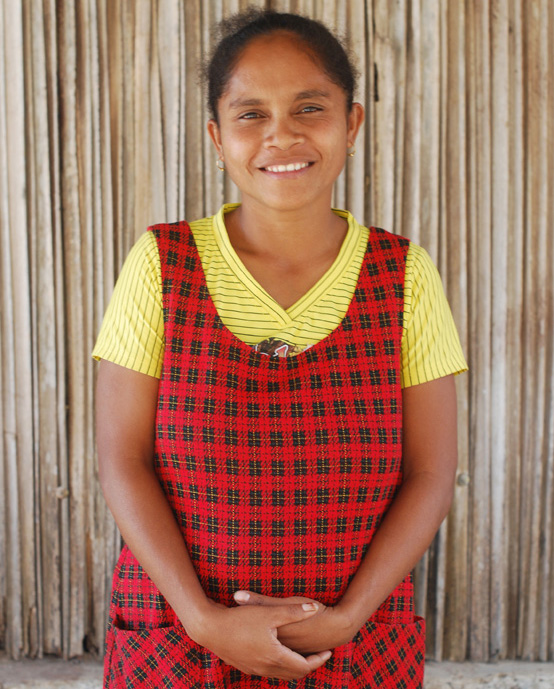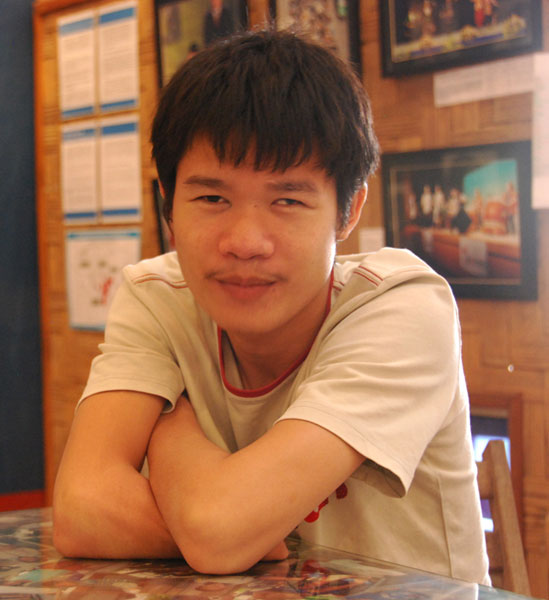
Francisca Martinez lives in Suku (village) Estado, high in the mountains of Ermera district in Timor-Leste. She doesn’t know her age exactly but guesses around 30. She has two teenage children of her own and helps look after her sister’s young children. “All the families round here are coffee farmers,” she says. “We earn up to $500 a year selling sacks of beans to an American company. We also keep pigs and chickens and grow corn to eat.”
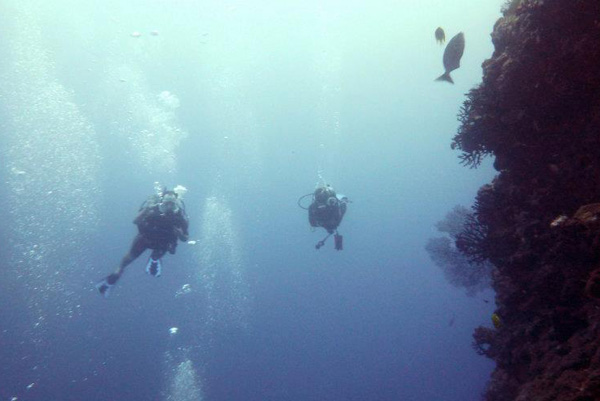
There’s something astonishing about stepping out of one world and into another. I’m reading a book about the moon landings and in many ways it reminds me of diving, the key difference being the speed of the transition. With diving, you kit up and step off the back of a boat, and within minutes you’re weightless and submerged. The world of ocean surface, boats and islands is replaced by an alien, underwater realm of iridescent coral, shoals of brightly coloured fish and – if you’re lucky – a huge thresher shark gliding through the blue haze.
While Aung San Suu Kyi was visiting London for the first time in 24 years, I was in Yangon, Myanmar (previously known as Rangoon, Burma). It was a fascinating time to visit, with the country just starting to open up politically and economically. On the drive from the airport to the hotel, I passed several street vendors openly selling t-shirts of ‘The Lady’, an activity which two years previously would have landed them in jail.
Although it’s less than 600km from Bangkok, Rangoon felt like a different world, or at least a different time. Most people – both men and women – still wear the traditional longhi, a sarong-like wrap-around skirt made from a tube of fabric that you step into. In Thailand, this is now only seen on formal occasions. Women and children also covered their cheeks, nose and forehead in coloured chalk. Initially I assumed this had cultural or religious significance, but I was wrong. “It’s actually cosmetic,” my colleague Ye Lwin explained.
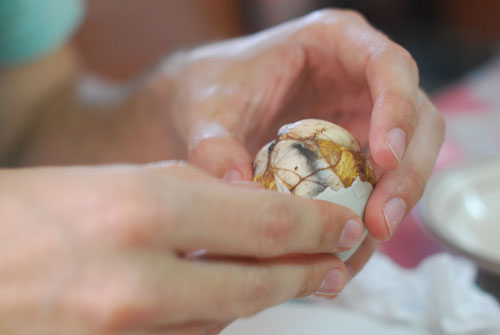
Balut is probably South East Asia’s most gruesome delicacy. It’s a fertilized duck egg with a half-grown embryo that is boiled alive and eaten whole. For Filipinos, balut is a treat. They buy it from street vendors or in local restaurants and bars, where it is served as a drinking snack, much like salted peanuts in British pubs. Inside the shell is a curled up foetus that looks like something out of an Alien horror movie or one of Gunther von Hagens’ Body Worlds exhibitions. Filipino children will cheerfully crunch their way through the foetal bones and feathers but just the thought of it makes me feel ill.
From a European perspective, the history of the Philippines began abruptly in 1521 with the arrival of the Portuguese conquistador Ferdinand Magellan. Like Christopher Columbus before him, Magellan was a mercenary on hire to the King of Spain. His mission was to find a new trade route to the Spice Islands by heading west from Europe via the Spanish colony of Mexico, handily avoiding the Portuguese navy, which controlled the Eastern route around Africa.
Ten-year-old Crizelle Joy lives with her grandfather, sister, two aunts and uncles, and nephew in a small one-room hut at an evacuation centre in Barangay (village) Mandulog in Iligan, the Philippines. The village is right next to the river and was one of the worst affected by the flash floods that followed Tropical Storm Washi in December.
“We were asleep in our house when the flood came,” Joy remembers. “The Barangay Captain woke us up. He was going from house to house in a bamboo boat. We had to leave immediately. My grandfather brought blankets for me and my sister but we left everything else behind. I was very scared. It was dark and the water was rising, and I could hear people crying out for help.
I was in the Philippines recently to see how UNICEF was helping children in the aftermath of Tropical Storm Sendong, which hit the southern island of Mindanao last December. This was the worst storm in the area in modern history, dropping the equivalent of a month’s rainfall in just one day and causing flash floods which left thousands of families homeless.
After my morning visit to Barangay Carmen evacuation centre (see part one of this blog), we returned to ‘Alpha Base’, the temporary UNICEF office in Cagayan de Oro (CdO). In fact it was a rented house in a residential compound, with a UNICEF banner hung from an upstairs balcony. Here I met Phil, a bubbly communications specialist from New Zealand who was my main contact for the trip, as well as Love, a friend of mine from the Manila office who had volunteered to work in CdO, and Rohannie, a child protection officer who I was due to accompany on her afternoon rounds.
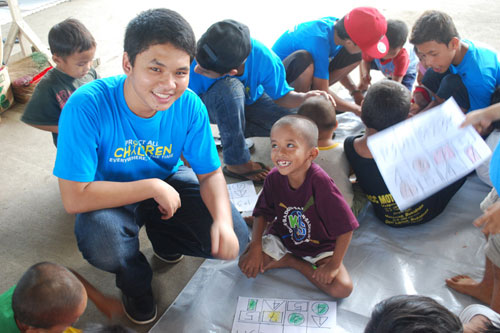
Seventeen year old Kim sits with a group of young children in a child-friendly space at an evacuation centre in Cagayan de Oro, the Philippines, one of the towns worst hit by Tropical Storm Sendong last December. The centre is in a barangay (village) covered court. It’s crowded and humid, with the smell of sweat. Over 130 families live on top of each other with little comfort or privacy – sleeping, cooking and washing in the open.
But this morning an area has been cleared for children, marked out by a UNICEF tarpaulin mat. Here, Kim and other young volunteers are teaching math. “What does five plus two equal?” Kim asks in English, holding up a piece of paper with numbers drawn on it inside different shapes. “Seven!” the children shout happily in unison, before colouring in the right number with a yellow crayon.
Luang Prabang is like a city adrift in space and time. The old royal capital of pre-communist Laos, it now feels like a cross between a suburb of Paris and a rural Thai village. It occupies a peninsular between the Mekong (see part two of this blog) and Nam Khan river, which takes a hairpin bend off the larger waterway. The main roads are lined with French restaurants, cafes and bakeries in colonial era buildings: brightly painted villas with wooden shutters on the windows. French tourists cycle lazily around between the cafes and sights, conversing in Gallic tones.
Sunset at Huay Xai, Laos, looking back over the Mekong river to Thailand. Having lost my camera memory card, this photo is from Lonely Planet
Coming from Thailand (see part one of this blog), Laos is both familiar and subtly different. The people are from the same ethnic group, they have a similar language and the same religion. The streets of a Lao town look very similar to those of a small rural Thai town. They have the same wooden stilt houses with the same spirit shrines in the corner. The shops accept Thai currency and locals sit in cafes watching melodramatic Thai soap operas on TV.
However, there are small but significant differences. Where in Thailand you see yellow royal flags hanging next to the national flag, in Laos their place is taken by red flags bearing the communist hammer and sickle. And where Thailand hustles and bustles, Laos moves at a slow, sleepy pace. Here, roads are often unpaved and bicycles and motorbikes are the main modes of transport. “Thai people view Laos as a backwards province of Thailand,” I was told in Bangkok, and while it’s true that the economic benefits of development were absent, so too were their darker side effects, like pollution, over-population and prostitution. It was in many ways a refreshing change.