 |
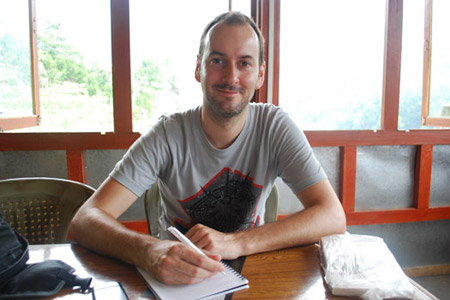
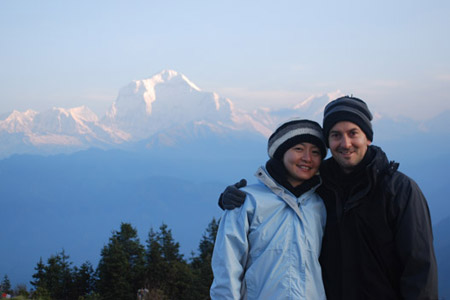
Working on my blog, with four days’ worth of beard.
© Joyce Lee/2011/Nepal |
Our reason for being in Nepal was to hike the Himalayas, so after exploring Kathmandu (see part one of this blog) we took a light aircraft to Pokhara, the starting point of our trek in the Annapurna mountain range. Tourism has saved this region from many of the ills that plague the Kathmandu valley. The streets are cleaner and the buildings in better repair, with even slum houses painted sky blue. There is also 24-hour electricity thanks to locally-produced renewable energy. Solar panels on houses heat people’s water and hydro-power in the valleys provides electricity for the villages. Houses here are painted with the words ‘Never End Peace And Love,’ the first letter of each word spelling out ‘Nepal’. “In Kathmandu, it means: ‘No Electricity Product, Always Load-shedding,” a local woman joked.
We signed up to do a five-day trek through the mountains to Poon Hill, with a local organisation called ‘Three Sisters’ that employs, educates and empowers local women. Our guide, Kamala, had been working with them since 1999. We also had two teenage porters, Manuka and Danu. As soon as we set off, we started feeling guilty about letting the girls carry our heavy backpacks while we carried lightweight daypacks. Every time we stopped, Joyce and I would take something out of their bags and put it into ours. We felt less guilty, however, when we saw the other porters. One Dutch couple had a single 60-year-old man as a porter. Each morning he tied three large backpacks together with rope and attached them to a strap across his forehead. While Manuka and Danu often raced ahead of us, waving cheerfully back from the top of the next hill, the old man struggled along behind his group, taking slow and shaky steps up the steep mountainsides.
The thing that struck me most about the mountains of Nepal is that they are very much lived in, in a way that European mountains no longer are. There are bustling villages all along the trekking trail, where subsistence farming is now combined with tourism. Even the smallest group of stone huts now has a restaurant, a guesthouse, a general store and – bizarrely – a ‘German bakery’. Children in crisp school uniforms run up and down the vertiginous stone steps like nimble mountain goats. Women dressed in bright colours wash clothes in the river, work in the fields with babies strapped to their backs, or dry mushrooms on rooftops in the midday sun. Men drive trains of donkeys (“the mountain car,” Kamala called them) laden with rice sacks across rope and wood bridges over deep gorges. Others carried goods themselves, using the same forehead strap as the old porter. We saw one man carrying a cage of a dozen live chickens in this way. Strings of brightly coloured Buddhist prayer flags were hung in even the most remote locations.
Inevitably, the accommodation in the mountains was basic. On the first night we stayed in a makeshift building that bore a close resemblance to the slum houses I’ve seen on UNICEF project visits in Bangkok and Manila. The ground floor was made of concrete but the first floor, where we slept, was a ramshackle construction made from sheets of metal, wooden planks and plastic windows, all nailed together haphazardly. The room was unfurnished except for two mattresses that were best left unexamined and a couple of Bibles on a concrete shelf. There were gaps in the walls where they failed to meet up and a cold wind blew through. Despite this, both Joyce and I slept soundly for eight hours. Dinner and breakfast, as elsewhere in Nepal, was cooked on a wood stove made from baked earth. In the evening, the guests, guides and porters huddled around a single heater in the dining room, playing cards and chess, reading or discussing the day’s hike.
Politics reached here too. The Annapurna region was a Maoist stronghold during the civil war and several times we saw communist slogans painted on rocks and huts, often accompanied by a Soviet-style hammer and sickle and a clenched fist. In one guesthouse, however, I spotted a faded picture of the former royal family still hanging on a wall in the dining room. In the past Maoist rebels would waylay foreign hikers along this route and demand ‘political contributions’. Now, however, there were official government checkpoints where we paid a pre-arranged fee and had our trekking permits stamped.
 |
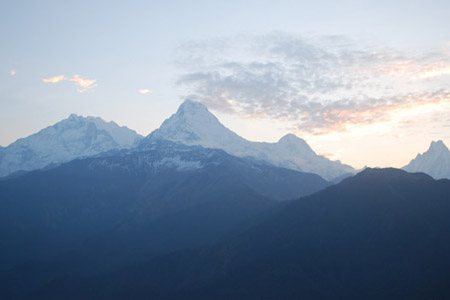
Sunrise from Poon Hill – like this, only much, much bigger.
© Andy Brown/2011/Nepal |
Our destination was the inappropriately named ‘Poon Hill’, which at 3,200 metres is more than twice the height of the UK’s highest mountain, the comparatively puny Ben Nevis (1,340 metres). In fact, it is only a ‘hill’ in comparison to the ice-and-snowbound mountains that tower above it, many of them over 8,000 metres and among the highest in the world. In the evening, I sat on the balcony outside our lodge at Ghorepani on the slopes of Poon Hill and watched the massive stone peaks slip in and out of view as the clouds moved across the valleys. They looked fundamentally wrong so high up in the sky: way above the clouds where millions of tonnes of rock had no right being. It was a bit like looking at skyscrapers in New York – your neck would start aching after a while from being held at such an unusual angle.
We got up at 4am in order to make the final ascent to the summit in time for sunrise. We started off climbing through trees in the pitch black with flashlights. Occasionally, we would see the lights of another group through the trees. As we came out of the forest the sky was lightening and we could see the outline of the mountains, dark blue against a paler sky. There was now enough light to see the path so we turned off the torches. After climbing for about an hour, we reached the summit just before sunrise. The sky was clear and we could see the whole Annapurna range stretched out in front of us along the horizon, as if nature had laid on its most spectacular display for us. The mountains were unfeasibly high, massive pillars of rock punching up through the sparse clouds and rising to over 8,000 metres above sea level. This is the ‘roof of the world’ – the highest point on Earth. It was awe inspiring. The sun was still behind Annapurna South, but it started to light up the top of Dhaulagiri Mountain, turning the peak and ridge pink. Over the next hour, the line of light moved slowly downwards, picking off the ice-bound slopes and ridges one by one. Along the top of Poon Hill, tattered Tibetan prayer flags fluttered in the breeze in faded shades of blue, white, red, green and yellow. “They represent the five elements of sky, air, fire, water and earth,” Kamala said. With the exception of fire, we were visibly surrounded by them all.
One of the things I enjoyed most about being in the mountains was getting up just before dawn and wandering round whatever village we were in with my camera, watching sunrise, visiting temples for the dawn prayers and meeting local people. I’m not religious myself but there was something undeniably magical about watching sunrise from the balcony of Ghandruk Buddhist monastery while old women burned incense, rotated prayer wheels rat-a-tat-tat and banged a gong with a deep, echoing boom. All the while, a tape played a Buddhist chant: “Buddham… saranam… gachhami”. “It means ‘Go pay your respects to the Buddha,” Kamala told me when I played her back a recording on my mobile phone. It sounded trite when I heard it at a souvenir shop but somehow it worked here.
 |
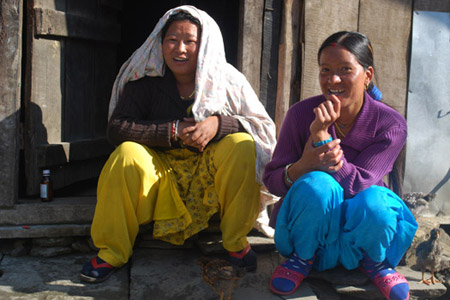
| Nepali women feeding chickens in Tadapani village. |
 |
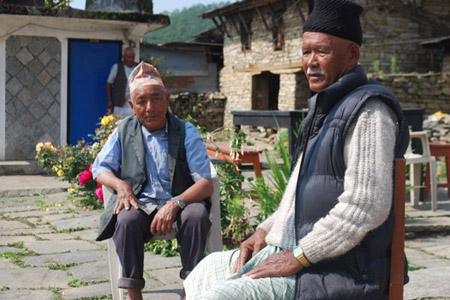
A retired Ghurkha enjoys the early morning mountain views in Ghandruk village.
© Andy Brown/2011/Nepal |
Early one morning I spoke to two friendly women sat outside their house in contrasting blue and yellow trousers, feeding chickens. They smiled broadly as I complemented them on their style and asked if I could take their photo. The next morning, Joyce and I chatted to an ex-Ghurkha soldier, Ramatu Garung, who was sat on a stone terrace in a body warmer and traditional Nepali pointed hat, enjoying the view with a friend. “Where are you from?” he asked. “The UK, Hong Kong,” we replied. He seemed pleased. “I served as a Gurkha from 1945 to 1960,” he explained. “I went to the UK for a week’s training. After that, I was based in Hong Kong, Singapore and Borneo. Then I retired here to Ghandruk – this is my house.”
Nepal has a long history of supplying Gurkhas for the British army. Identified by their curved ‘khukuri’ blades, these fighters are famed for their strength, agility and endurance. Even today, Gurkhas make up some of the army’s elite troops in Afghanistan and elsewhere. For people in Nepal, it’s a prized job with the promise of a comfortable retirement. But it’s not without its risks. “My neighbour is also a Gurkha,” Kamala told us later. “He’s 80 years old. He fought for the British in World War II. There was a big battle and everyone in his regiment died except for him. He only survived by hiding under their bodies and pretending to be dead.”
We finished the trek by paragliding over the hills and lake at Pokhara. I was going to end this blog with a detailed description of the flight, but I’ve tried your patience long enough, so instead here’s a short video which includes the scariest moment: ‘the spiral’. The best part, not captured on film, was when I got to fly the glider myself on the way back down. It was like being a giant bird, soaring high above the lake and treetops, turning into the wind and feeling the tension in the strings as if my arms extended out to the tips of the kite. As we landed, dark clouds bearing monsoon rains rolled down from the mountainside behind us. It was a magnificent end to a memorable trip.



 Beneath the Baobab