Photos: Beijing’s historic hutongs

A classic hutong scene: these red doors and lion-head doorknockers are widespread. People often leave the doors open, allowing you to glimpse the communal courtyard houses inside.
© Andrew Brown/2024/China

My favourite place to photograph in Beijing is the historic hutongs (alleyways) in the old town. Originally built by the Mongolian Yuan Dynasty in the Thirteenth Century, these narrow passages are filled with stone and tiled courtyard houses that once housed servants of the imperial palace and their families. Plain grey brick walls are interspersed with bright red doors with grinning lion head knockers and banners with good luck sayings on them in elegantly-painted Chinese characters. Behind these are courtyard houses, where several families or generations live communally. In the summer, older men hang around the doorways with their t-shirts rolled up over their stomachs in the so-called “Beijing bikini”, while brightly coloured birds chirp from overhead cages, hung below the eaves of houses.

Continue reading “Photos: Beijing’s historic hutongs”

Photos: morning alms giving, Laos

A line of monks pass locals seated outside the entrance to Wat Nong Sikhounmuang temple. Each monk gets a handful of rice in their bowl.
© Andrew Brown/2024/Laos

On my last morning in Laos, my alarm went off at 5am. I’d spent the last week visiting UNICEF nutrition projects in rural Nan District during the hottest month of the year, and I was very tempted to hit snooze and go back to sleep. However, I also knew that if I did, I’d beat myself up about it later. So I dragged myself out of bed, grabbed my camera, and headed out to the front of my hotel, where I got a tuk-tuk through the gradually lightening streets to the main temple district of Luang Prabang. My objective was to see Tak Bat, or the morning alms giving ceremony, which I’d first witnessed a decade before, during my first time living and working in Asia.

Continue reading “Photos: morning alms giving, Laos”

China: another brick in the wall

Hiking the Great Wall of China at Gubeikou (water town) towards the end of spring, May 2024.
© Andrew Brown/2024/China

It was an unusally warm day in February, when I arrived at Chongbian, north of Beijing, to hike the “wrong Great Wall.” We started climbing up through terraced farmland, along the way greeting some locals on a motorbike pulling a farm cart. On reaching the Wall, we turned right and hiked along a mountain ridge to the east. The watchtowers had been renovated with new cement but there were no stairs, so we had to climb up precarious piles of rocks to reach the doorways and rooftop – in Imperial times, there would have been wooden ladders here. In between the watchtowers was “wild wall,” crumbling masonry that was wide enough for two people to walk along safely. The trees were bare from winter, but long yellow grass still grew along the top of the wall, glowing in the afternoon sunshine.

Continue reading “China: another brick in the wall”

Kenya year three: a new normal

Storm clouds roll in from the sea at Diani Beach during rainy season.
© Andrew Brown/2022/Kenya

Aside from the safaris, Diani beach is one of my favourite destinations in Kenya. At low tide it’s hundreds of metres wide and made up of soft, powdery white sand. Early in the morning, translucent white crabs emerge from holes in the ground and scuttle across the sand, looking for food. On our latest visit, I saw three of them clambering across a coconut that had fallen from the palm trees at the top of the beach, snipping off pieces of white flesh with their pincers. The crabs were well camouflaged and hard to spot when they stayed still. It was only the motion that gave them away. But they generally stayed close to their holes and scuttled back in at the first sign of danger.

Continue reading “Kenya year three: a new normal”

Kenya year two: a shot in the arm

At Dandora Health Centre, where we filmed teachers getting their COVID-19 vaccine shots
© UNICEF Kenya/2021/Lameck Orina

In September 2021, after a delay of almost two years caused by COVID-19, I finally made it to the peak of Mount Longonot. This is a 2,780 metre dormant volcano one and a half hour’s drive north of Nairobi, in Kenya. I was hiking with my friends Matthias and Sheila, who I first met in Malawi five years before. It was an overcast day, which kept the temperatures mercifully mild as we followed the steep path up the mountainside. Our first goal was to reach the rim. From here, we could see across the crater, which – unusually for a volcano – was filled with a dense forest, cut off from the outside world by steep cliffs. Its was unclear what wildlife was living down there, although we did see the occasional giraffe on our way up. Great gashes down the mountainsides traced the routes where lava had previously flowed and we found pieces of brittle pumice stone scattered amongst the ash around the crater.

Continue reading “Kenya year two: a shot in the arm”

Kenya year one: an unexpected journey

An early morning view of Mount Kenya from our cabin in the woods outside Nanyuki
© Andrew Brown/2021/Kenya

At 7am the view of Mount Kenya from our holiday cottage was spectacular. The clouds that hide the mountain for most of the day were just starting to form, banking up behind the peak and starting to roll over the shoulder of the hill. The peak seemed higher in the sky than land had any right to be, with white snow lining the crevasses and reflecting the first rays of morning sunshine (I didn’t expect to see snow just a few kilometres from the equator). Far below, the rolling hills were silhouetted in shades of blue, their tree lined ridges marking them out with sharp lines like a theatre backdrop. A flock of small birds wheeled through the sky, heading towards a nearby lake. A deer grazing in the meadow lifted its head to look at me, briefly disturbed by the clicking of my camera lens, then returned to its own business.

Continue reading “Kenya year one: an unexpected journey”

Born to run: chasing the great wildebeest migration

A herd of wildebeest contemplating making the river crossing to the Serengeti
© Andrew Brown/2021/Kenya

In August each year, 2.2 million wildebeest, along with hundreds of thousands of zebra and antelope, migrate from the Serengeti in Tanzania to the Maasai Mara in Kenya, in search of greener pastures. Along the way, they cross the Sand River and then the wide, crocodile infested Mara River. As the rains change, they do the same journey in reverse. These crossings are one of the greatest wildlife spectacles on Earth, as desperate animals fight for survival. After each crossing, there are a few less wildebeest.

This was something my whole family wanted to see while we were living in Kenya. But finding 2.2 million wildebeest in the Maasai Mara was harder than I thought. At 1,500 square kilometres, the Mara is vast, and the Serengeti is even larger. Finding the wildebeest at the exact moment that they decide to cross a river is almost impossible. But not quite.

Continue reading “Born to run: chasing the great wildebeest migration”

Wild thing: visiting the Maasai Mara during a pandemic (pt2)

Moses looks out for wildlife through his binoculars, while Joyce and the kids have a snack
© Andrew Brown/2020/Kenya

The COVID-19 pandemic that swept the world in 2020 seemed to upend everything. Busy city streets became deserted, aeroplanes disappeared from the skies and face masks became ubiquitous. Having spent the first year of the pandemic in Nairobi and Hong Kong, we saw reminders everywhere we looked. But one place at least seemed unaffected: the Maasai Mara. Here, antelopes, giraffes and wildebeests kept grazing the savannah, exactly as before. Lions and cheetahs kept on hunting them, oblivious to our human disease. Even the semi-nomadic Maasai people continued life much as before, herding their cattle across the open plains.

Continue reading “Wild thing: visiting the Maasai Mara during a pandemic (pt2)”

Cheetah kill: visiting the Maasai Mara during a pandemic (pt1)

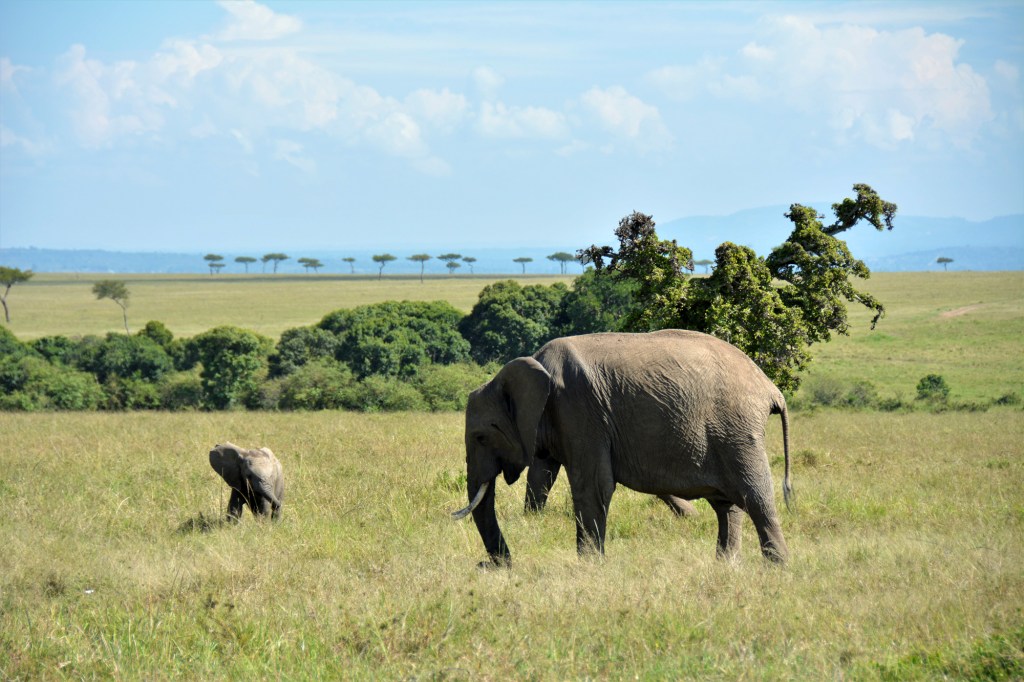
An elephant calf turns to look at its mother, in the Maasai Mara
© Andrew Brown/2020/Kenya

It was a clear November morning on the Maasai Mara. The afternoon storm clouds had not yet arrived, but the grass and trees were lush and green from the previous day’s rain. Wild animals roamed freely along the banks of the Mara River and through the savanna – herds of impala, giraffe and zebra, plus large numbers of wildebeest remaining from the recent ‘great migration’. This being Enonkishu Conservancy rather than the true national park, there were also occasional mud brick villages, schools and churches. Maasai herders, some wearing distinctive red shuka robes, watched herds of cattle or drove down the dirt roads on motorbikes. Continue reading “Cheetah kill: visiting the Maasai Mara during a pandemic (pt1)”

Higher ground: climbing the mountains of Malawi

47689615_10156908322622774_5583932843190386688_o
Matthias and other hiking friends ascending the rocky slopes of Big Mouth Mountain
© Andrew Brown/2018/Malawi

On a crisp, clear and unusually cloudless day during the rainy season, I made the peak of Dedza mountain with my friend Matthias and local guide James. The mountain rises to almost 2,200 metres above sea level. It towers over the nearby town of Dedza, which at 1,600 metres is already the highest town in Malawi. After a tough ascent to two radio towers at the near end of the mountain, we made our way along an indistinct path through scrubland and rocks, climbing a gently sloping plateau to the peak at the far end. Here, we were rewarded with a clear 360-degree view across central Malawi. Continue reading “Higher ground: climbing the mountains of Malawi”