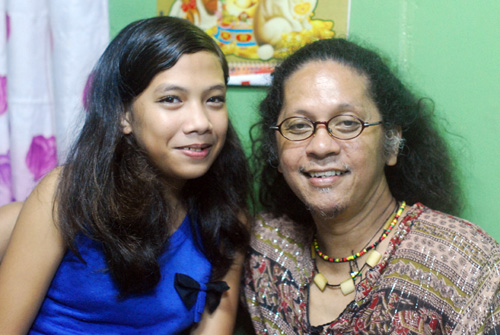
Seven-year-old Ratnasunder lives with her grandparents and pet dogs in a former classroom at an evacuation centre at Bang Krai Nok Temple, in Bangkok. The ground floor of the building is flooded and the only way in or out is by boat. For a child who had to flee her home in the face of rising floodwaters, Ratnasunder seems happy and carefree. She smiles broadly and lifts up one of the dogs, squeezing it tightly.
Her grandmother Tongploen is more sombre. “We used to live in a single story house alongside the canal at Wat Po Ain,” she says. “We went back once and rescued some clothes but it’s now flooded up to the roof so we can’t get in. We’re comfortable living here but it’s hard to get out. We used to have our own boat but it’s broken so now we use the public boat.”
Twelve-year-old Tang sits with his sister Ice, 13, in a ‘child-friendly space’ at Laksi Temple evacuation centre, in Bangkok. The children are making necklaces from beads and thread. They are surrounded by a mixture of squalor and beauty. Dozens of families sleep on mats on the floor of the temple, surrounded by their few possessions, while the stench of contaminated water drifts in through the windows. Yet above them, ornate pillars rise up with elaborate designs etched in green, red and orange, while golden Buddha statues look down from their pedestals, smiling enigmatically.
Tired mother Gaew is one of the thousands of people made homeless by Thailand’s devastating floods. She waits with her chubby five-month-old baby, Peem, outside a makeshift health clinic at Bangkok’s Phranakhon Rajabhat University. “Peem has a stomach ache so we’re waiting to see the doctor,” she says anxiously, holding the boy on her lap. “We’ve been here three days. We left our house in Pathum Thani when the water got waist high.”
Last week, we took a group of popular Thai bloggers to see projects for marginalised children in Thailand’s Chiang Mai district. After two days visiting orchard schools in Fang (see part two of this blog), we returned to Chiang Mai itself to visit a drop-in centre for street children. Run by the Volunteers for Children Development Foundation, the centre focuses on preventing and supporting the victims of sexual abuse. Many of the street children in Chiang Mai were sold to child traffickers at the Burmese border and brought into Thailand to work in the sex industry. Once in Thailand, these children are considered ‘stateless people’ and are not entitled to identity cards. This denies them the right to education, healthcare and – when they grow up – to legal work.
I was in Chiang Mai district last week, introducing a group of Thai bloggers to UNICEF-supported projects for marginalised children. After our visit to the orchard night school (see part one of this blog), we went to see a day school in the same area. We got up early and set off in our vans for an orange orchard outside Fang town. We drove through wide paddy fields, criss-crossed by irrigation canals and filled with a host of yellow grass blades glistening in the morning sun. Here and there, women in straw hats were working in the fields, breaking the earth with wooden hoes. The landscape was layered: beyond the rice fields was a line of low trees that marked the start of the orchards. Behind them, craggy mountains rose up with forested flanks. It was a beautiful scene, but Fang is not a tourist destination. Instead, it’s the centre of a sometimes harsh agricultural industry.
Thailand is rightly famous for the quality of its fruit. The sois (small streets) where I live in Bangkok’s Aree neighbourhood are lined with stalls selling oranges, dragon fruit, mangos and whatever else is in season. The brightly coloured fruit is piled up on mobile trailers: fresh, plentiful and cheap. But this abundance comes at a price. As we discovered during a trip to Chiang Mai province in the north of the country, many of Thailand’s fruit orchards are staffed by low-paid migrant workers, whose children rarely get to go to school.
Last year I visited Manila, capital of the Philippines, with photographer Sharron Lovell to document a day in the life of three children, for the launch of the new UNICEF UK website. One of them was thirteen-year-old Mary (not her real name) who lived with her family on the street outside Starbucks, where her mother ran a cigarette stall. Back then, Mary spent her days working on the stall or looking after her younger sisters, and her nights hanging out on the streets with other street children, many of whom ‘did rugby’ (sniffed solvents).
The Philippines will always have a special place in my heart. I lived and worked here for three months in 2009, following Typhoon Ketsana and the flooding of Manila. It was my first overseas posting and I was captivated by the friendly, outgoing people, the colourful chaos of the cities with their brightly decorated ‘jeepneys’ (public buses made from converted army jeeps), and the unspoilt natural landscapes of the islands and mountains.
One of my tasks back then was to collect photos and stories of children living on the streets of Manila, to feature in UNICEF UK’s ‘Put it Right’ campaign, which aimed to raise awareness of children’s rights and money to protect them. One girl who featured heavily in the final material was three-year-old Sally, along with thirteen-year-old Mary and fifteen-year-old Crisanto (not their real names). Although this time I was in the country to help UNICEF Philippines develop a digital communications strategy, I took the opportunity to revisit the three children and see how they were getting on.
After a morning in the office, I made my way to Childhope Asia Philippines, a local charity supported by UNICEF that works with street children. Childhope is run out of an old Spanish villa in Paco, a district of Manila. The road outside was potholed and lined with posters from local politicians wishing residents a ‘Happy Fiesta’. Inside, the villa was full of faded grandeur – high ceilings, teak wood panels, antiques and oil paintings. An administrator worked on an old typewriter surrounded by paper files, while electric fans thudded rhythmically, moving hot air around the room. Above the bay window hung an alternative take on Da Vinci’s ‘Last Supper’, with the disciples replaced by Filipino street children.
The notion of India as a single country is a relatively modern one, forged in the ashes of British rule in 1947. “India is more of a continent than a country,” my colleague Shweta said. “Most people here identify themselves as Punjabis or Bengalis first, and Indians second.” A quick glance at Wikipedia backed up her assertion. India has 28 states, 21 official languages, nine religions and over 200 ethnic and tribal groups.
After our morning at the culinary training centre (see part one of this blog), we went to Old Delhi to visit a night shelter for street children and a community bank. This time, I was training Lalita, Ruchi and Omesh, from the UNICEF India office, in blogging and online video. The afternoon’s projects were again run by Butterflies, a local charity that UNICEF works with on sport and development, including by provide sporting activities for street children during the Commonwealth Games and Cricket World Cup.