Physical graffiti: Photos from Bangkok’s khlongs

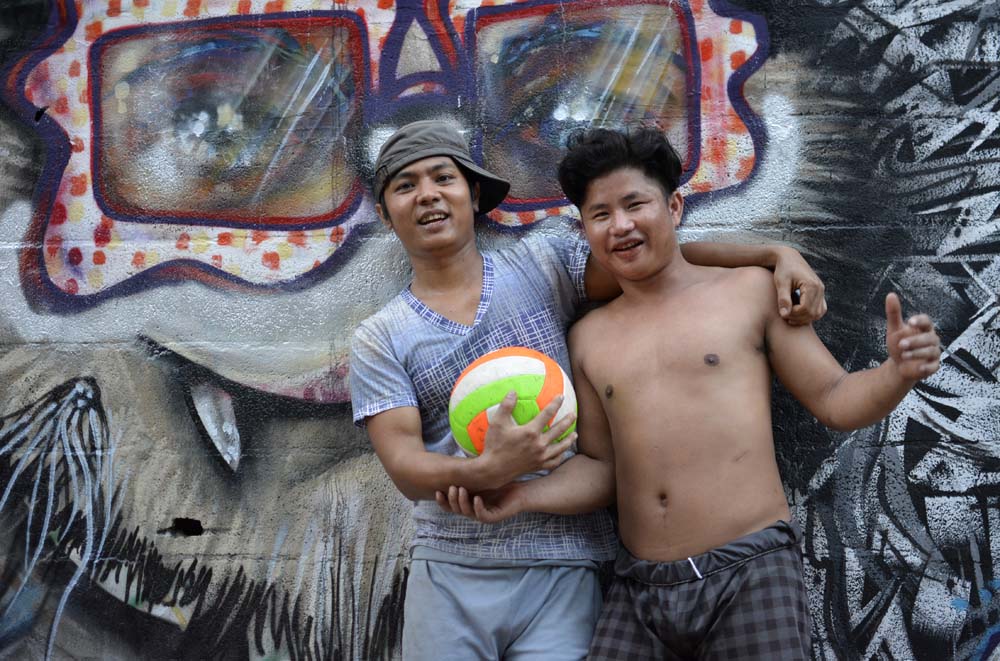
Two young volleyball players pose in front of a graffiti mural beside the canal
© Andrew Brown/2015/Thailand

Another photo project from my time in Thailand (following Ghost Tower). Bangkok used to be known as the ‘Venice of the East’ with canals – or khlongs – providing the main routes through the city. In the Nineteenth Century, wealthy citizens built houses fronting on to the canals, a few of which like Jim Thompson’s House are still there. Times have changed and many of the canals have since been filled in. A few remain and narrow khlong boats provide a faster alternative to congested streets. The only problem is that the khlongs now weave their way through slum districts with poor sanitation, and the waterways double as rubbish dumps and sewers. The smell was unpleasant, to put it mildly. I used to sometimes take the canal boat on my way home from work but I always had to have a scarf handy in case a boat came the other way and I got splashed with a faceful of fetid water.

Continue reading “Physical graffiti: Photos from Bangkok’s khlongs”

Photos: Climbing Bangkok’s Ghost Tower

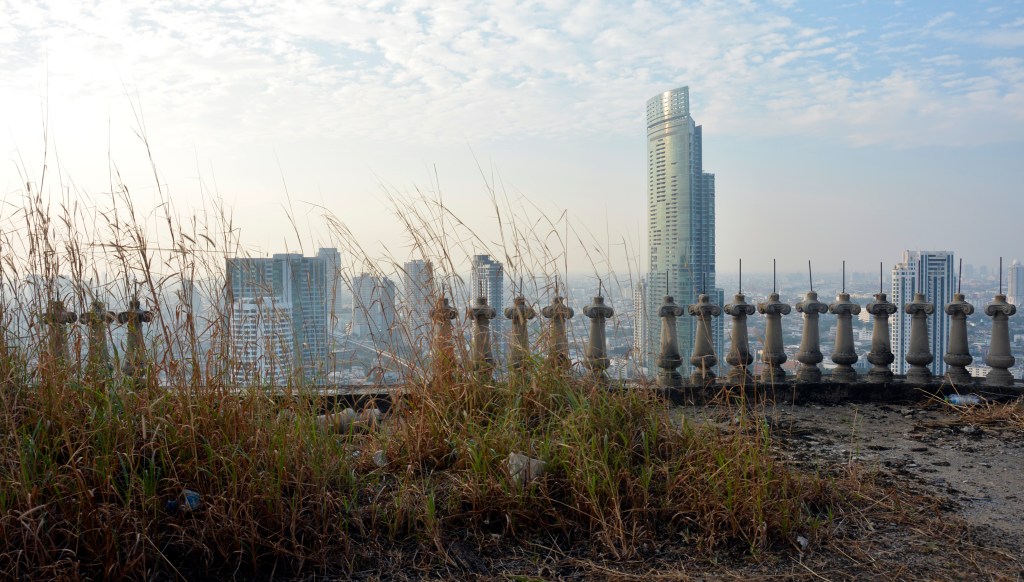
A view of the Bangkok skyline from an overgrown balcony half way up Ghost Tower
© Andrew Brown/2015/Thailand

Sathorn Unique Tower, to give it its official name, is an unfinished skyscraper in Bangkok, Thailand. Originally planned as a high-rise apartment block, construction stopped around the turn of the century, most likely due to the Asian Financial Crisis (accounts vary, others link it to a high-society murder trial). However, it is much better known to locals by the more sinister name of ‘Ghost Tower’, and once you go inside it is clear why. Overgrown and flooded balconies with broken railings contrast with the shiny new skyscrapers opposite, while dark stairwells thread the dingy interior of the building, full of helpful graffiti like: “Abandon hope, all ye who enter here,” (in blood red paint). Sunset creates an even more dystopian mood, with views reminiscent of Blade Runner or The Windup Girl – a science-fiction novel set in a future Bangkok full of abandoned skyscrapers.

Continue reading “Photos: Climbing Bangkok’s Ghost Tower”

Location, location: mobile dating apps and HIV

Nest (right) and friend Jesse look at gay dating apps on a smart phone
© UNICEF EAPRO/2015/Andy Brown

Nest is a 19-year-old living in Bangkok. Like many other gay adolescents, he uses mobile apps to meet up for dates. “I use apps to meet other guys nearby,” he says. “I don’t like to have sex at the first meeting, I prefer to chat and get to know the person first. But some of my friends just meet up for sex.”

A new report, Adolescents: Under the Radar in the Asia-Pacific AIDS Response, shows that the Asia-Pacific region is facing a ‘hidden epidemic’ of HIV among adolescents. Although new HIV infections are falling overall, they are rising among teenagers. In 2014, there were at least 220,000 adolescents aged 10-19 living with HIV in the region, with major cities like Bangkok and Hong Kong hubs of new infections.

Continue reading “Location, location: mobile dating apps and HIV”

People of Bangkok sois

© Andy Brown/Thailand/2014

Over the last few months, I’ve been exploring the backstreets or ‘small sois’ of Banglumphu, the neighbourhood where the UNICEF Asia-Pacific office is based. One of the things I love about Bangkok is this maze of alleys, just wide enough for a motorbike to get down, that exist a few blocks back from the main roads. Here, the din of traffic fades away, and people sit around outside their houses, chatting or playing chess during the ‘cool hours’ before sunset.

Continue reading “People of Bangkok sois”

Young people set the agenda at AIDS congress

A migrant worker activist shares a joke with the HIV virus on the parade
© UNICEF EAPRO/2013/Andy Brown

I’ve been to many international conferences in my time and the word ‘fun’ doesn’t immediately spring to mind. But the 11th International Congress on AIDS in Asia and the Pacific (ICAAP), held in Bangkok, really was fun. This was largely because of the enthusiastic participation of young people and HIV activists from around the region.

Continue reading “Young people set the agenda at AIDS congress”

Shooting Chinatown: the Worldwide Photo Walk

© Andy Brown/2013/Thailand

On Sunday 5 October 2013, nearly 30,000 photographers – myself included – went on over 1,200 photo walks around the world. This is the Scott Kelby Worldwide Photo Walk, and it’s the largest social photography event in the world. After the walk, every photographer is asked to submit one photo for the award. Choosing a single photo was in itself a challenge, and I recruited my Facebook friends to help me decide.

Continue reading “Shooting Chinatown: the Worldwide Photo Walk”

Home and Away: children with disabilities go to a Man Utd match

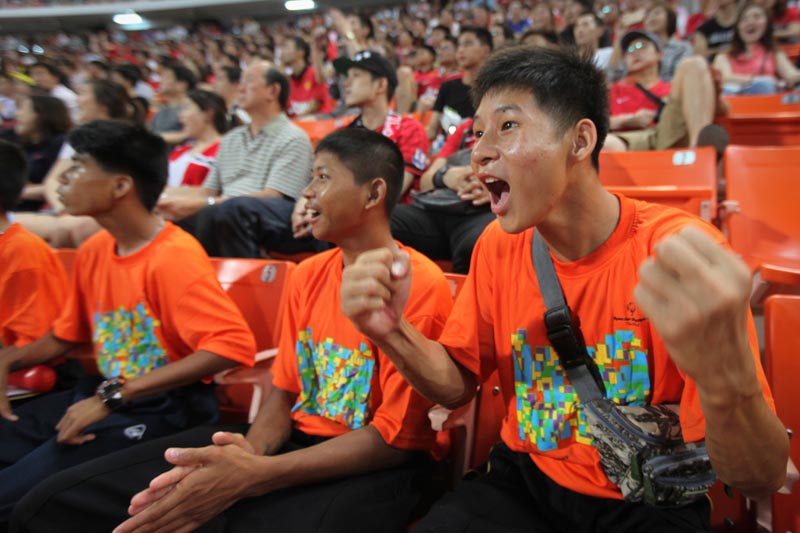
Pichit and other children respond to a near miss by Man Utd
© UNICEF Thailand/2013/Jingjai N.

This article was first published in the Bangkok Post on 23 July 2013.

Among the 60,000 football fans packing out Rajamangala National Stadium for a Manchester United football match last weekend were 36 children with intellectual disabilities. The atmosphere was buzzing. Many fans arrived in the club’s trademark shirts, waving balloons, scarves and banners.  The children, who were invited to the game by the Manchester United Foundation and UNICEF, had only seen the football stars on TV, and were among the most enthusiastic in the audience.

Continue reading “Home and Away: children with disabilities go to a Man Utd match”

A chance for change: young people learn a trade

This article was first published in the Bangkok Post on 19 January 2013.

At a university dormitory in Bangkok, 21 young people from disadvantaged communities line up to pull the name of a top hotel out of a bag. Behind them, teams of hotel staff in uniforms wait to meet their new apprentices. For 19-year-old Daojai, a cabbage farmer from a Mon hill tribe village in Petchaburi province, it’s an exciting moment. She reaches in and pulls out a piece of paper saying ‘JW Marriot’ and her new life begins.

Continue reading “A chance for change: young people learn a trade”

On the waterfront: Songkran in Thailand

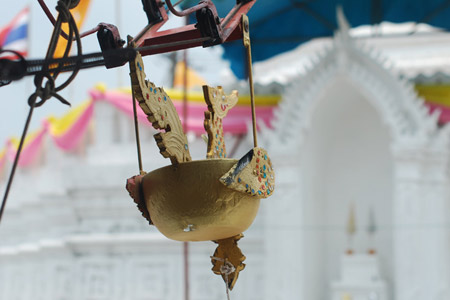
An ingenious variation on the traditional water ceremony at a temple on Koh Kred.
© Andy Brown/2011/Thailand

Water has many associations in Thailand at this time of year. It’s a symbol of devotion to elders and the Buddha. Yet it’s also a sign of youth and anarchy; of childhood and play. This week is Songkran, or Thai New Year, when the entire country marks the anniversary of the Buddha’s birth by staging the world’s largest water fight. According to the traditional Thai calendar, the year is now 2554.

The word Songkran comes from the Sanskrit ‘saṃkrānti’ meaning astrological passage. It lasts for three days, from 13 to 15 April, and falls into two distinct parts. In the mornings, Thais go to visit their elders and pour water on their hands as a sign of respect. Then they go to the temple and wash Buddha statues with water and flower petals from golden bowls.

At work this week, we had a short ceremony where we poured water over Anupama and Tomoo’s hands – the heads of UNICEF’s regional and country offices respectively. We also saw temples where ritual washing was in progress. At one, on the island of Koh Kred in the Chao Praya river, an ingenious contraption had been set up. For a donation, you got a bowl of water that you attached to the claws of a golden bird. By turning a wheel, you activated a series of pulleys that hoisted the bird on a cable up to the top of a temple spire, where its bowl tipped over, pouring water and petals down the side of the building.


Originally, Songkran was all about these devotional activities but, like Christmas in the West, it’s taken on a more secular character over the centuries. Songkran is now primarily about celebrating, with street parties and water fights erupting across the country during the afternoons and evenings. We’d heard that the biggest fights in Bangkok took place on Khao San Road, which runs through the heart of the backpacker district near my office. So after lunch on Wednesday, Joyce and I changed into shorts and T-shirts, with dry clothes and a camera cocooned in layers of plastic bags in a backpack, filled up our super-soaker water pistols and headed out to do battle.

Children guard a water station by Phra Sumen Fort.
© Andy Brown/2011/Thailand

Game on

We didn’t get far before our first water fight. We arrived at the boat pier at Kiak Kai to catch a boat to Banglumphu. An extended family had set up a checkpoint at the entrance to the pier, with a large tank of water and a hosepipe. They weren’t paying attention when we arrived and there was only a small girl at the water tank. Her parents shouted at her to get us but she just looked at me, eyes wide with apprehension. If we thought we were safe, however, we were mistaken. A young man and a middle-aged woman pursued us onto the pier with bowls of water, which they tipped over us. In return, we shot as much water as we could at the young man. The woman made signs not to shoot her, presumably because of her age, but I felt this was a poor excuse given the drenching she’d just dealt out, so I gave her a modest squirt from my gun.

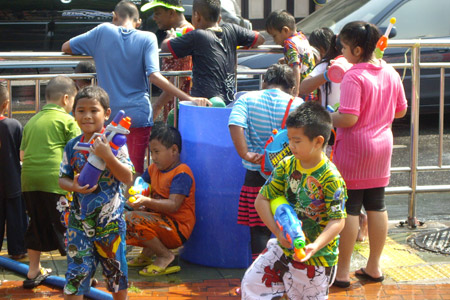
In Banglumphu, we made our way to a small park by Phra Sumen Fort, an old whitewashed fortress on the riverbank. This octagonal brick-and-stucco building was constructed in 1783 to defend against naval invasions and was one of 14 watchtowers that once lined Bangkok’s old city wall. Today, a music stage had been set up here and a band was practicing, with speakers covered in shrink-wrapped plastic. Children were running around with water pistols, shrieking with joy. We had a few fights but invariably ended up coming off worse – the kids had better guns than us and were already soaked, and hence fearless. We shot one small girl with her parents, however, who was so started that she dropped her gun.

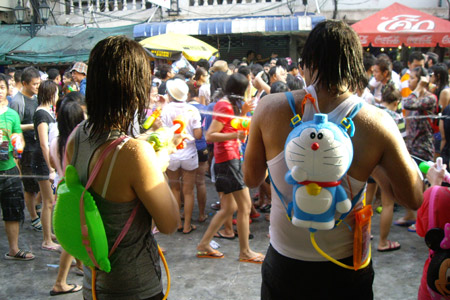
There was a small bridge set up on the pavement where you could fire at passing traffic. Occasionally, a pickup truck would come past with a gang of well-armed teenagers in the back and the fighting would intensify. Occasionally, we fought among ourselves. We got ambushed by a young Thai guy manning the nearby filling station (normally a drinking water fountain). He was wearing a motorcycle helmet and had a plastic backpack in the shape of a Japanese cartoon character, full of water with a hose connecting it to his gun. Afterwards, he raised his visor so we could shoot back, smiled broadly and filled up our guns for us. “Sawatdi pi mai,” he said (Thai for Happy New Year), as he handed them back.

Throughout the day, the atmosphere was incredibly friendly and good natured. We chatted to a Thai couple at the filling station. “You can shoot anyone you like,” the young man said. “But if they’re unwilling you should always apologise first.” Later in the week, when we were dressed up and on our way to the cinema, a teenager cornered us with a bowl of water. “Sorry, sorry,” he said before tipping it over us.

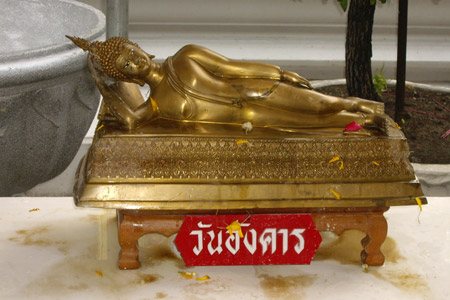
A reclining Buddha statue, still wet from his morning bath.
© Andy Brown/2011/Thailand

Band of brothers

At the park, we met our friends Michael and Kari, a Kiwi-Aussie couple who run a regular yoga and daal night on Tuesdays. They were wearing floral ‘Songkran’ shirts and Michael had two large guns on a strap around his neck, reminding me of a character from a John Woo movie. “It looks cool but they’re a pain to carry after a while,” he said. Both of them were already drenched. “We got a tuk-tuk here and the driver stopped at every water point so they could soak us,” Kari said. “He got wet too of course. It cost 400 baht but it was well worth it.”

Together, we made our way down Phra Athit and into the backpacker district. Some tourists were just arriving, fully dressed with wheelie suitcases, and were very upset about getting their stuff soaked. I felt sorry for them but Kari took a harder line. “They should have done their research properly,” she said. Other, better prepared travellers were indeed wearing waterproofs and had their backpacks wrapped in plastic.

We took a short cut through a temple complex where orange-robed Buddhist monks live in traditional Thai-style wooden houses. Here the fighting eased off as people burned incense sticks and a line of golden Buddha statues stood glistening in the sun, still wet from their morning ablutions. We came out of the temple opposite Khao San Road, where the size of the crowds and intensity of the water battles exceeded anything we had seen so far. It was also a much more adult affair. The road was lined with bars and scantily clad girls danced on top of barrels holding up signs advertising beer prices. Sound systems pumped out dance music and occasional party classics like House of Pain’s ‘Jump Around’, which I remember well from indie discos in the 1990s.

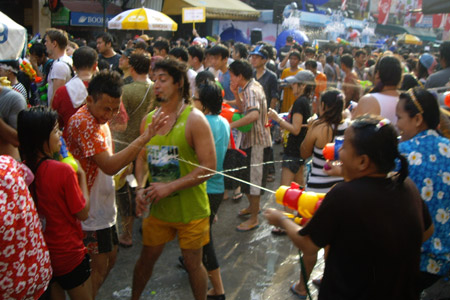
The road was completely rammed and you had to push slowly through a crowd of revellers in varying degrees of drunkenness. The militias that lined the roadside here were more hardcore. They had a new weapon – massive ice blocks that melted to produce freezing cold water. We were already wet but it was like getting soaked all over again. It’s a bit like diving in a brackish lake you come to a point where you suddenly realise that there are two types of water. Water fights here often took the form of locals vs. backpackers but it was hard to say who was winning. We also encountered another feature of Songkran here – teenagers with pots of white clay which they plastered on your face, hair and clothes, usually with a ritual “sorry, sorry”. This practice originates from the chalk that monks use to mark blessings, but now it’s just another part of the general mayhem. At each end of Khao San Road was a mountain of discarded clay pots, and the water underfoot turned white with their run-off.

Locals and tourists face off amid the mayhem of Khao San Road.
The Khao San Road militia, armed with cartoon character water backpacks.
© Andy Brown/2011/Thailand

Time out

Half way down Khao San Road, we escaped down a side alley and ordered pizza and mojitos at a bar. A large, pale American came up to us with a cigarette and lighter. “Can anyone help me light this?” he asked. “I think you need dry hands, or at least a dry thumb.” His hands looked terrible – the fingers were white and puffy like a bloated corpse. Then I looked at my own hands, which were suffering from a milder form of the same condition. At the next table was a Thai nationalist, a rare exception to the civility and friendliness of the day. “America will be destroyed! Britain will be destroyed!” he ranted at an unfortunate pair of tourists. “In Thailand we have a great and powerful King.” The next minute he threw up down the front of his shirt and passed out on the table.

We finally emerged at the far end of Khao San Road by Democracy Monument – the scene of recent political protests by ‘red shirt’ demonstrators, where we jumped in a tuk-tuk and headed home. On the way back, I emptied my water pistol by shooting at passengers in other tuk-tuks whenever we stopped at traffic lights.

Later in the week, I explored our neighbourhood on foot to experience the local side of Songkran. By this point, Joyce had had enough so I headed out on my own with my trusty plastic pistol by my side. There’s a 7-Eleven store on virtually every corner and these were invariably manned by a small mob with a sound system, water tank and hosepipe. In some cases these were family groups, in others teenagers. On one corner there was a group of transvestites in coloured bras and wigs, dancing to kitsch disco music. At another corner a small boy stole my gun, then wrapped his arms around my leg and tried to stop me leaving, to laughter from the adults.

The group nearest our flat were having a street party that had lulled until I arrived. When they saw me coming with my super-soaker, they turned their music back on and began dancing excitedly in the street. After exchanging good-natured waterpower, they poured me a whiskey and ice and refilled my gun. I practiced my conversational Thai and chatted for a while to a young man who spoke broken English. He indicated three girls in the street. “Ladies no man,” he said several times. I didn’t get what he meant at first but when the girls competed to take a photo with me, giggling loudly, the truth dawned. “Sorry, I have lady already,” I apologised.

Songkran was probably the best time I’ve had in Thailand so far. It was a chance to meet local Thais from different social backgrounds, to understand more about their culture and national character, and to take part in one of the biggest and best-natured street parties I’ve ever been to. Perhaps most of all, it was a chance to get in touch with my inner child. As a boy, I’d always dreamed of being able to shoot water pistols indiscriminately at passers-by but it’s not something you can get away with in Britain’s more formal culture. Here, everyone is a child for three days. Adult Thais even talk about themselves as such. On Thursday I turned up for work in a T-shirt and shorts, with dry clothes in my bag as a precaution. “I see you’re ready to play today,” my colleague Pear said with a smile.

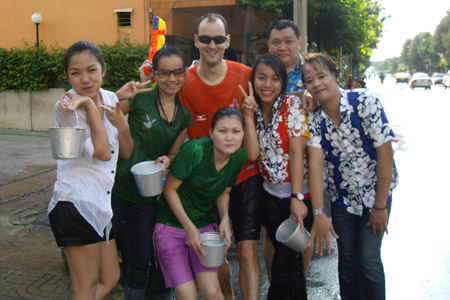
Friendly locals pose for a photo outside a nearby 7-Eleven store.
© Andy Brown/2011/Thailand

Away match: Bryan Robson visits Bangkok shelter

For many people, football is a sport, a passion and a part of their regional identity. For UNICEF, football is a way of keeping children fit and healthy and of teaching them life skills like discipline and teamwork. We also team up with leading football clubs and players to raise awareness and funds for our work on children’s rights.

Manchester United legends Bryan Robson and Andrew Cole were in Bangkok last week as part of a fundraising tour to help the club raise £1 million for UNICEF’s work with children. During their trip, I went with Bryan to visit Baan Phumvej Reception Home for Boys, to learn how UNICEF is supporting children who have been abused or trafficked.

I arrived in Pak Kred an hour ahead of the main group. The boys were practicing for a music class and changing into Man Utd kits, bought specially for the occasion. Bryan arrived later with Alex from UNICEF UK and John Shiels, from the Manchester United Foundation. Also known as ‘Captain Marvel’, Bryan was the longest serving captain in the club’s history and is now manager of the Thailand national team.


We also met Ann and Nang from Peuan Peuan (‘Friends’ in Thai), part of the NGO Friends International, which gets support from UNICEF to work with migrant and trafficked children.

I asked Bryan how the Thailand national team was getting on. “I’m really enjoying the experience and working with the Thai players,” he said. “We’ve done well in one competition, the Asian Games. We didn’t perform as well as I’d hoped in the Suzuki cup but in July we’ve got our first World Cup qualifying game coming up, so for me it’s all about building up for that.”

Pak Kred is a shelter for children who need special protection. Some of the boys are victims of child trafficking or domestic violence, others are former street children. At the shelter, social workers look into each child’s situation. Educational activities prepare them for work or formal school and, where possible, preparations are made to return them to their families or communities.

However, staff at the shelter are not fully equipped to deal with non-Thai children. The shelter is home to 130 boys, around 40 per cent of whom come from the neighbouring countries of Burma, Cambodia and Laos. They arrive with migrant families or through child trafficking. Staff from Friends International visit Pak Kred shelter three times a week to give these children non-formal education in their own language. The organisation also works with NGOs in neighbouring countries to try to trace their families.

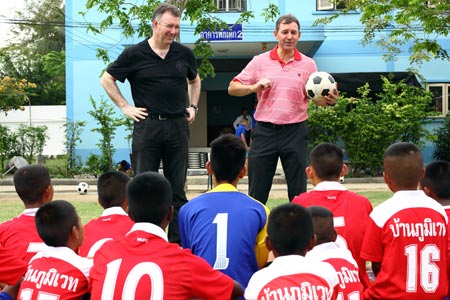
Bryan Robson holds a football coaching session at Pak Kred Reception Home for Boys.
© UNICEF Thailand/2011/Piyanun Kiatnaruyuth

On tour

We took Bryan and John for a tour of the shelter. They saw a hairdressing room with leather chairs lined up before a wall of mirrors, where the trainee barbers practice new haircuts on each other – and on visiting celebrities. Bryan got a quick trim. Next door was a pottery workshop where boys made ceramic animals and flowers from rubber moulds.

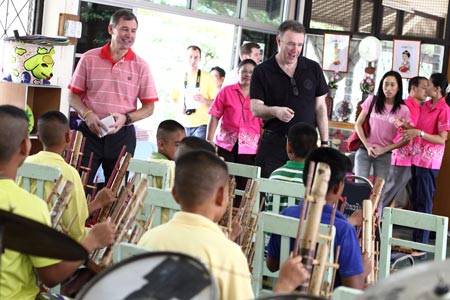
In another room a class was performing music with traditional Thai bamboo instruments called angklung. Each instrument produces one note when shaken, so the melody was determined by the teacher, who conducted the class. Bryan and John joined the orchestra, carefully copying the boys on either side of them. “It’s good for the arms,” Bryan joked afterwards, before giving signed photos to the boys.

After the music class we went out to the centre’s football field, where the boys had assembled in their Manchester United kits. Bryan spotted one boy in a number 7 shirt. “That was my number,” he said. Bryan and John ran a coaching session for the children, teaching them how to score goals. They put them in numbered pairs, with one boy as a striker and his partner as a defender. At the end, Bryan took a shot and scored. I felt a bit sorry for the young goalkeeper, who almost certainly had never had to defend against a professional player.

After the training session, I interviewed Bryan for a short video for the UNICEF Thailand website. I asked him about his impressions of the project. “What I’ve seen is a fantastic facility,” he replied. “The children are really well behaved and very concentrated on what they’re doing. I’ve seen musicians playing, I’ve seen them on the sports field. It’s a terrific facility for badly abused and homeless kids. So they do a terrific job here and I’m impressed all round. When you see facilities like this, no wonder Manchester United want to be involved with UNICEF.”

Bryan was particularly impressed by the focus on sport. “What’s great for me is that they’re doing sport as well as education,” he continued. “We all know that education is very important but when kids get onto a playing field, no matter what sport they’re doing, they really enjoy being outside. And it’s good for them, for their health and keeping fit.”

I asked Bryan what he’d learned about UNICEF’s work. “I spoke to the staff here and it’s not just about bringing kids off the street, it’s about educating them how not to end up back on the streets,” he said. “It’s about trying to get the older boys some employment so they can learn a trade. Also trying to get some of the Burmese and Cambodian kids who’ve been trafficked to Thailand back to their own countries.”

Bryan and John join a music class at the shelter, while Alex and I watch from the doorway.
© UNICEF Thailand/2011/Piyanun Kiatnaruyuth

Child protection

One of the boys on the team Bryan coached was nine-year-old Fahan (not his real name), who had been taken from the Burmese border area and brought to Bangkok with his sister Meliha by a trafficking gang. Fahan is from one of the Muslim minority groups in Burma. His family is very poor. They have four children and live in Myawaddy village on the Moi river, where the father drives a boat.

Recently, a child trafficker went to the family and offered them 3,000 baht [£600] for two of their children. Traffickers often promise to look after children and give them a better life, but the reality is very different. He brought Fahan and Meliha to Bangkok, where they lived with him in a room above a shop. They slept during the day, and he forced them to sell flowers on the street at night. If they disobeyed him, he would beat them. They earned around 1,000 baht a night, but the broker would only give them 10 baht each for a snack.

On a previous visit to the shelter, we talked to Fahan about his situation. “I used to live with my family in Burma on the Mae-Sot border, near the Friendship Bridge,” he told us. “I went to school there. I was in the second grade. There was someone who brought me and my sister here from Burma. I don’t know him. We came in a big bus. When we got here I sold roses with my sister in places where there were lots of tourists. We sold them from 8 p.m. until the morning. After a while we ran away from where we were working and a Burmese guy brought us here.”

Fahan seemed happy at the shelter but was keen to go home. “During the day I sweep the floor, take a shower, work in the kitchen and eat soup,” he said. “I like learning Thai and Burmese, and playing and listening to music. I would like to go back home to my family in Burma.”

Luckily, Friends International were able to trace Fahan’s family in Burma and make sure it was safe for the children to return. As Bryan left the shelter, he walked with Fahan for a while, and I talked to Man Utd’s camera man about the issues facing trafficked children. Solving these kinds of problems can be an uphill struggle involving UNICEF, the government and other partners. Support from football clubs like Manchester United makes our job a lot easier and helps give children like Fahan a chance for a better future.