Human traffick: a shelter for abused children

Yarzar talks to Fahan (not his real name) in a classroom
at Pak Kred Reception Home for Boys.
© UNICEF Thailand/2011/Athit Perawongmeth

Poverty is relative. For families living on the bottom rung of the social ladder in Cambodia, Laos and Vietnam, the streets and slums of Bangkok promise a lifestyle worth making a long and sometimes dangerous journey for. In the troubled border regions of Burma, meanwhile, there are people desperate enough to sell their own children into slavery. As shocking as it sounds, this is a common enough practice to generate a thriving trade in child trafficking at Thailand’s border towns.

To find out what happens to the victims of child trafficking, we went to Pak Kred Reception Home for Boys at Amphur Pakkret, about half an hour’s drive north of Bangkok. In fact it’s only north of Bangkok in the sense that Sutton is south of London – the urban sprawl thins out a bit but there’s no greenbelt or real sense of when one place ends and the other begins.

I live on the north side of Bangkok, so I flagged down a taxi and made my own way to the shelter. There, I met up with Ann and Yarzar from Peuan Peuan (‘Friends’ in Thai), part of the NGO Friends International, which gets support from UNICEF to work with migrant and trafficked children. Yarzar was a polite, young Burmese man in glasses and a Friends polo shirt. Like Nan, the street outreacher worker we met before, he used his language skills to communicate with non-Thai children and their families.


Once my colleagues Tum, Cherry and Ytske had arrived from the office with our photographer, Ann and Yarzar took us to look round the shelter. In some classrooms, older boys were doing vocational training. There was a hairdressing room with leather chairs lined up before a wall of mirrors, where the trainee barbers practiced new haircuts on each other. Next door was a pottery workshop where boys made ceramic animals and flowers from rubber moulds. I watched one boy painstakingly painting a mother hen, completely engrossed in his task and ignoring the visiting farang (foreigner).

There were also classrooms for younger boys. In one room, a group of boys played with jigsaws and dominoes, while others took part in an art class. In another room, a class was performing music with traditional Thai bamboo instruments called angklung. Each instrument produced just one note so the melody was determined by the teacher, who conducted the small orchestra. Beyond the classrooms was a kitchen and open air dining area where staff were cooking lunch. The distinctive smell of Thai green curry hung in the humid noontime air as two boys set out places on the long tables, with inverted bowls to protect the food from flies.

There were also several dormitories around a football field, where a game was in progress. I went over with Ytske to take some photos and was soon persuaded to take part. I gave my camera to one of the boys, who seemed to have a natural flair for photography, and took a few penalty shots at the goal. Another boy drew a picture of a stick man holding a camera. He pointed at the figure. “Where you from?” he asked. “The UK,” I replied to a blank look. I tried again: “England?” His face brightened. “Ah, Liverpool!” he exclaimed. “Yes, the Beatles,” I said but I was on the wrong track. “ManUtd, David Beckham!” he continued.

Boys learn hairdressing skills at the vocational training centre.
© UNICEF Thailand/2011/Athit Perawongmetha

Child protection

Pak Kred is a shelter for children who need special protection. Some of the boys are victims of child trafficking or domestic violence, others are former street children or have been in trouble with the law for minor offences. At the shelter, social workers look into each child’s situation. Educational activities prepare them for work or formal school and, where possible, preparations are made to return them to their families or communities.

However, staff at the shelter are not fully equipped to deal with non-Thai children. The shelter is home to 130 boys, around 40 per cent of whom are foreign. They mainly come from the neighbouring countries of Burma, Cambodia, Laos and Vietnam, either with migrant families or through child trafficking. “These shelters are meant to be temporary but some foreign children end up staying for a long time,” UNICEF child protection officer Sirirath Chunnasart explained afterwards. “If they’re from Burma, it can take years to trace their families. In the meantime they often miss out on their education because they don’t have access to classes in their own language.”

Staff from Friends International visit Pak Kred shelter three times a week to give foreign children non-formal education in their own language. The organisation also works with NGOs in neighbouring countries to try to trace their families.

Yarzar introduced us to nine-year-old Fahan (not his real name), who had been taken from the Burmese border area and brought to Bangkok with his sister Meliha by a trafficking gang. Fahan was a small boy with a dark complexion in a yellow t-shirt. He was relaxed around us and often smiled or joked with the other boys.

“I used to live with my family in Burma on the Mae-Sot border, near the Friendship Bridge,” Fahan told Tum and Cherry. “I went to school there. I was in the second grade. There was someone who brought me and my sister here from Burma. I don’t know him. We came in a big bus.

“When we got here I sold roses with my sister in places where there were lots of tourists. We sold them from 8pm until the morning. After a while we ran away from where we were working and a Burmese guy brought us here.

Fahan seemed happy at the shelter but was keen to go home. “During the day I sweep the floor, take a shower, work in the kitchen and eat meat soup,” he said. “I like learning Thai and Burmese and playing and listening to music. I would like to go back home to my family in Burma.”

Fahan helps set the tables at lunchtime.
© UNICEF Thailand/2011/Athit Perawongmetha

Minority groups

Afterwards, I asked Yarzar to tell me a bit more about Fahan’s situation. “He is from one of the Muslim minority groups in Burma, which face discrimination because of their ethnicity and religion,” he said. “Fahan’s family is very poor. They have four children and live in Myawaddy village on the Moi river, where the father drives a boat.”

The Moi river marks the border between Burma and Thailand. Myawaddy is on the Burmese side opposite Mae-Sot, a Thai border town that has become synonymous with drug smuggling, sex workers and child trafficking. “A broker went to the family and offered them 3,000 baht [£600] for two of their children,” Yarzar continued. That’s a lot of money in Burma. Brokers will promise to look after the children and pay the parents every month, but after a few months they usually stop paying.”

Fahan and Meliha were treated harshly by the trafficker. “He brought them to Bangkok where they lived with him in a room above a shop. They slept during the day and he forced them to sell flowers on the street at night. If they disobeyed him, he would beat them. They earned around 1,000 baht a night but the broker would only give them 10 baht each for a snack.”

Yarzar met Fahan at the shelter after he escaped from the trafficker, but it took a while to win his trust. “Fahan didn’t trust anyone at first because of his experiences. He was very quiet and afraid of everything. I had to play with him and build a relationship step-by-step. But he’s happy now and makes friends with everyone. He’s just like a normal kid now.”

Meliha is now back with her parents in Myawaddy and Fahan will be joining them soon. “We were lucky to be able to trace the family,” Yarzar said. “The Burmese government does not provide social services and we have to rely on local NGOs. Even then, their activities are restricted. It’s much easier to trace the Cambodian children.”

Given everything he’s been through, Fahan did seem like a remarkably normal child and I was struck yet again by children’s resilience and their ability to recover from deeply traumatic experiences. Relatively speaking, Fahan is one of the lucky ones. Across Thailand, there are thousands of children like him working for traffickers. They beg or sell flowers on the streets, they live and work in rubber plantations or sweatshop factories producing goods for Western consumers, or they work on boats in the fishing industry. Some of them spend their whole childhood in virtual slavery and never see the inside of a classroom.

“A few years ago the police raided a big factory in Samut Sakorn where trafficked children were living and working,” Yarzar commented. “The owner was sent to prison. But it still goes on and they don’t always get caught.

Yarzar walks with Fahan back to his dormitory block.
“I would like to go back home to my family in Burma,” Fahan says.
© UNICEF Thailand/2011/Athit Perawongmetha

Friends in need: children living in Bangkok slums

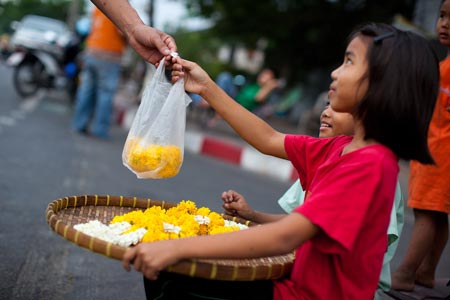
Nuch selling flower garlands on the streets of Bangkok, Thailand.
© UNICEF Thailand/2011/Athit Perawongmetha

Like any large city, Bangkok is multi-faceted and the view you get can be radically different depending on your perspective. Having seen the city from the viewpoint of a tourist and an office worker, my next job was to see the same locations from the perspective of the urban poor: in particular children living in slums and working on the streets.

I went on three project visits around Bangkok with my colleagues from the Thailand office, Tum and Cherry, and a local photographer, Chum. I’m working with Tum and Cherry to create stories for the UNICEF Thailand website on the right to an education, while training them up on producing different types of content, including audio, video and social media.

As well as doing freelance work for UNICEF, Chum is an award winning photo journalist. His pictures from the front line of the Red Shirt riots last year paint a vivid picture of anger, bloodshed and arson among the normally placid Thai people. “It’s hard to get natural shots,” Chum explained. “Even during the violence, people would smile and wave at the camera. These were the best 15 pictures from thousands.” I’d just taken my own photos of Red Shirts on their way to a weekend rally, so it was fascinating to see Chum’s much edgier work.


The projects we visited were run by Peuan Peuan (‘Friends’ in Thai), part of the NGO Friends International, which gets support from UNICEF. For the first visit, we drove a short distance from the UNICEF office to a slum community near the flower market on the opposite bank of Chao Praya, a wide river that flows through the heart of Bangkok.

There we met 12-year-old Nuch (not her real name), a slight, quietly-spoken girl in a red t-shirt with a pigtail in her hair. She was living with her mother Dao, stepfather and five siblings in a single room hut. Nuch used to go out begging in Bangkok’s commercial district, but her mother decided to find another way to earn a living. Now, Dao goes to the market early each morning to buy flowers. She uses these to make garlands, which Nuch and her siblings sell to tourists and worshipers in the temple district of Banglumpu, undercutting the prices in shops.

“I leave the house with my mom, brothers and sisters around 5 or 6pm,” Nuch told us. “We go to Banglumpu area with 400 garlands. My mum sells some on the pavement with my youngest brother, who is two and a half. I walk around the area with my other brothers and sisters to sell the rest. We only return after we sell them all, which can be anytime from 11.30pm to 2am.”

Working late at night on the streets puts children like Nuch at risk of abuse and exploitation. Her brother had already been detained by the police and sent to a shelter, although he was now back with the family. Nuch also frequently misses school because of work. “I don’t usually go to school,” Nuch says. “Sometimes I do and sometimes I don’t. If mum doesn’t sell anything, she doesn’t have money for us to go. I like going to school but I’m still in Grade One because I flunked my exams so many times.”

Making ends meet is a constant struggle for the family. “We make around 500 baht [£10] a day selling garlands,” Dao explained, while chopping chili peppers and preparing dinner for the children on a small gas burner outside their hut. “The rent is only 1,500 baht [£30] a month, but I have to feed the children and pay for them to go to school. Yesterday Nuch left her earnings in a tuk-tuk, so today we have no money to buy flowers.”

School’s out

Nuch draws a picture of a house by a waterfall at the community classroom.
© UNICEF Thailand/2011/Athit Perawongmetha

The slum where we met Nuch is not the best environment for a child. It is a small settlement of 50 households, squeezed into a small plot of land between a school and main road. Except for the slum owner’s house, the homes were dilapidated wooden shacks, often on the verge of collapse, with electric wires hanging low across the walkways. There were attempts at decoration, with bird cages and pictures of celebrities torn from magazines outside some huts. In the centre of the slum, an old tree had been turned into a shrine with flower garlands, incense sticks and a small Buddha statue. Everywhere we went rubbish littered the ground, which the children ran across with bare feet.

The settlement was much smaller than those in Manila, which are home to around 50 per cent of the population, but it lacked the infrastructure and community of the larger, more established Filipino slums. In Thailand, slums are usually home to marginalised people like foreign migrant workers and street prostitutes, who rent shacks by the day for 50 baht [£1]. Although the settlement where Nuch lives is next to a large, well-equipped school, the families cannot afford to send their children there. Instead, those lucky enough to go to school have to travel to a free temple school some distance away.

Friends International runs a classroom in the slum, where staff provide life skills education, play activities and a place for children to do their homework. In the classroom, Nuch drew a picture of a large house by a waterfall, surrounded by trees, butterflies and heart-shaped balloons. I was struck by the stark contrast with her real home. Her six-year-old brother Tor, meanwhile, played with Lego bricks while a Friends worker cleaned and dressed a cut on his foot. “The staff teach me how to do homework,” Nuch said. “Sometimes they ask me to draw pictures. I like it here because they are kind. It’s good that we have this classroom near our house because I walk there on the afternoons that I’m free. Mom never tells me not to go.”

“About half the children in the community come regularly to our centre,” Ann Charoenpol from Friends explained. “We need to get to know them first, build their trust and find out about their situation.”

As well as the classroom, Friends runs a ‘child safe community’ scheme. They have trained 15 volunteers living in the settlement about child rights. The volunteers keep an eye on the children when their parents are not around and report any instances of abuse or domestic violence. The organisation also provides income generation activities for the families. They offer them funding, supplies and training to set up a small business such as making products from recyclable materials, which are then sold by Friends. In return, the parents sign a contract promising to keep their children in school.

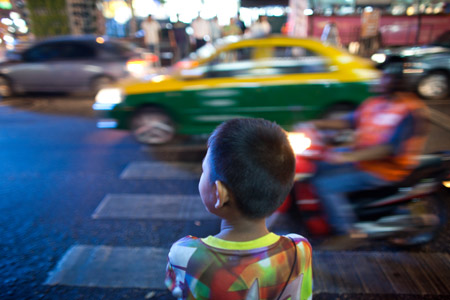
An unaccompanied Cambodian boy waits to cross a busy Bangkok street.
© UNICEF Thailand/2011/Athit Perawongmetha

Soi Cowboy

Our next visit was to a government-run shelter for homeless and trafficked children, where Friends International works with homeless and trafficked children from Laos, Cambodia and Burma to provide them with educational activities in their own language. They also help with family tracing. I’ll come back to this in my next blog.

For our final trip, we went out after work on Friday night to the sex tourism hotspots of central Bangkok, where street children beg or sell trinkets to tourists. We visited the infamous ‘Soi Cowboy’, where scantily-clad Thai women dance for seedy old men in front of bars and ‘massage parlours’ to the competing sounds of rock and dance music. I recognized some of the songs, but not the context. The usual street food stalls had been replaced by street bars, with stalls selling whisky shots to pedestrians. Above us, the sky was lit up by flashing neon lights, with a huge floodlit picture of a cowgirl in leather boots and a whip presiding over the debauchery below. Needless to say, none of this is a good environment for a child.

Compared to the Philippines, the street children here were fewer but more marginalised. The Thai Government has recently proposed a law making it illegal for children to be out on the streets after 10pm. “We find many children from Nuch’s community working here late at night,” Ann said. “We don’t want them to be arrested.”

Ann took us to meet Nang, an outreach worker with Friends International. It was the day of their quarterly street survey and Nang was particularly busy. She had been on the streets since 6am in the morning and was on her second to last shift – she wouldn’t finish until 2am the next day. Together we made our way on foot from Chit Lom to Sukhumvit, looking for street children. For a while we were trailed by two hyperactive Cambodian brothers who ran across the busy roads, careless of their own safety. Another boy, who was begging on the pavement with a puppy, happily posed for several photos for Chum.

We found several young children begging with their mothers or grandmothers on overpasses around the skytrain station. One young girl sat on her own on a staircase. It turned out her mother was just round the corner, but she earned more money if she was on her own. I knew some of these bridges from weekend trips to the malls and cinemas, but walking across them with Friends gave me a very different perspective, as if I were seeing them again for the first time through someone else’s eyes.

Nang comes from the border area between Thailand and Cambodia, which has been in the news recently due to fighting over the disputed sovereignty of a Hindu temple. As a result, she can speak Cambodian and was able to talk to all the mothers and children we met. She handed out information cards in different languages, so that the parents could get in touch with Friends if they had any problems. “Sometimes a mother will phone us up and say: ‘Have you seen my son? He’s been missing for four days’,” Ann commented.

“Most of the children in this area are Cambodian,” Nang told me as we walked to the next Skytrain station. “They cross the border in forest areas and then get a public bus to Bangkok for 250 baht [£5]. Often, the mother or grandmother comes with the youngest children, while the father stays in Cambodia with the older ones. They spend a few months begging, then they go home. When the money runs out, they come back to Bangkok.”

Nang will get to know the mothers and talk to them about children’s right to an education and the dangers they face on the streets. She tries to motivate them to give up begging and join Friends’ home-based production scheme, but it can be a tough sell. “A mother and baby can earn up to 10,000 baht [£200] a month begging on the streets,” Ann explained. “That’s a lot more than they can get doing a low-paid job, even in Thailand, so it can be hard to persuade them to change.” As if to prove her point, a middle-aged American woman stopped and handed 40 baht to a mother. “For the children,” she said.

Nang holds up a selection of information cards in Cambodian and other languages.
© UNICEF Thailand/2011/Athit Perawongmetha

Work, eat, sleep: adjusting to life in Bangkok

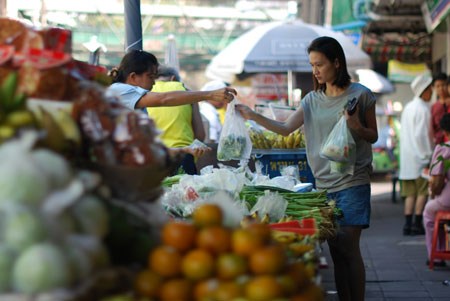
A street vendor selling fruit and veg in Ari. © Andy Brown/2011/Thailand

Living in Bangkok is a very different experience to visiting it, and after our first week we started to feel less like tourists and more like inhabitants of the sprawling metropolis. We moved into an apartment in Ari, a residential Thai area. It’s upmarket but still feels more adventurous than living in expat central round Sukhumvit. We’re staying in a small block of 15 apartments around a swimming pool. It’s very homely and ‘traditional Thai style’ with lots of shade and pot plants everywhere. We’re surrounded by quiet leafy lanes, populated with villas and garden restaurants. It feels a bit like a Thai equivalent of the more villagey suburbs of London like Highgate or Hampstead.

The streets near the Skytrain are lined with food stalls, selling fruit or fried noodles. Scattered among them are occasional folding tables covered with lottery tickets. There is also a cobbler and a middle-aged man with an old-fashioned sewing machine, patiently repairing an endless succession of garments. The ready availability of fruit here is a welcome contrast to Manila and, along with my twice-daily swims, allows me to maintain the semblance of a healthy lifestyle while eating spicy soup noodles every night.

Each of the street stalls is in fact a small trailer with gas canisters pulled by bike, moped or sometimes by hand. Owners of the larger stalls set up folding chairs and tables along the roadside to create a makeshift restaurant. Late at night, they take all this down and do their washing up with large plastic bowls and hosepipes, emptying the dirty water out into the gutters. One night, after the stalls had gone, I noticed that the pavement was actually marked out into small areas with painted lines like a car park. Presumably the stall owners pay rent on their space to the local council.


My first few weeks at work have been busy but interesting. I’m helping China write a proposal for a new website, while working on a digital strategy for Thailand and training their team on writing for the web, using images and email broadcast. I’ve also been on two project visits, to a slum community and a shelter for homeless boys, which will be the subject of next week’s blog.

My new colleagues are all very friendly and welcoming. Like Filipinos, Thais have two names – formal and informal. Some nicknames are in English, while others are in Thai. However, where Filipinos favour terms of endearment like ‘Love’ and ‘Baby’, Thais seem to prefer a fruit theme, hence ‘Pear’ and ‘Cherry’. So my Thai colleagues Natnapin, Pimsai and Waraporn are known respectively as ‘Kwan’, ‘Pear’ and ‘Yui’. Waraporn, or Yui, is always laughing at me and the daft things I do, like turning up for a meeting on my first day with a ‘Mission Banana’ notebook I’d bought at 7-Eleven with a cartoon monkey on the front. “I think that’s for school children,” she laughed.

Fantastic voyage

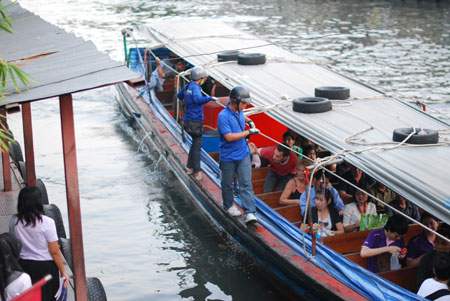
The canal boat – you either love it or you hate it. © Andy Brown/2011/Thailand

In the morning, after waking to the hooting and clattering of tropical birds (‘Baroo, baroo, baroo,’ one bird calls loudly at 6am every morning), I grab a quick swim and get a taxi to work. I’ve been brushing up on my taxi -Thai, such as ‘lieow saai’ (turn left), ‘lieow kwaa’ (turn right), ‘dtrong bpai’ (straight on), ‘hai chah long’ (slow down) and ‘jawt’ (stop).

My journey home is more local-style and provides a fascinating daily glimpse into the changing face of Bangkok. Leaving the office at around 5:30 pm, I hail a tuk-tuk and negotiate a ride to ‘Pan Fa, ta rua’ (the local boat dock) for ‘see sip baht’ (40 baht). Bangkok’s tuk-tuks are similar to the ‘tricyles’ of Manila, but with the passenger seat behind the driver rather than alongside him. The tuk-tuk weaves through the traffic, bypassing the bottleneck around Siam Commercial Bank by driving on the wrong side of the road and dodging back in between cars if something comes the other way. Reaching the intersection at Pan Fa, the tuk-tuk cuts suicidally across six lanes of traffic and drops me at the boat dock. ‘Khob khon kap,’ I say, handing over two 20 baht notes and relieved to be in one piece.

After grabbing a couple of spicy chicken skewers at the street food stalls, I make my way down to the boat dock. The canal boats are basic affairs with wooden benches and tarpaulin sides. They only stop for a brief moment at each dock while passengers scramble on and off. As soon as we’re all on board, the boat sets off and two teenage girls in face masks and pink crash helmets scamper along the outside of the boat, collecting fares from passengers. ‘Ratchathewi,’ I say, holding up three fingers to indicate the number of stops. My fare is nine baht (18 pence).

When the boat comes to a bridge, the roof is winched down and the girls on the sides duck low. I suspect their crash helmets are intended to protect them should they misjudge this and get a face full of fast moving concrete. To start with, the canal is lined with small houses and a tidy path, but this soon deteriorates into a slum, with shanty houses piled on top of each other right up to the edge of the canal. The slum owners have annexed the canalside path and turned it into a back yard. At the weekend, the railing is covered with clothes hanging out to dry on metal hangers, like a downmarket, second-hand fashion stall. The clothes are interspersed with pot plants, the occasional bird cage and even a fish tank, lashed to the railings with a well-tied rope.

Unfortunately, the canal is also clearly used as a rubbish dump and sewer by the slum inhabitants, and as a result the water can get very smelly. Passengers live in constant fear of splashes from boats passing the other way. On her way to a job interview, Joyce was deeply traumatised when she got a generous splash of water full in the face. ‘If I’d had time, I’d have gone home and showered,’ she recalled with a shudder. Despite this, the canal boat is my favourite part of the journey. I feel almost like a local, squeezed cheek-to-cheek between my fellow commuters as the sun sets, creating orange ripples on the water and reflecting off the metal roofs of the shanty houses. The canal boat’s dubious charms are lost on my local colleagues however. ‘I took it once four years ago,’ Cherry told me, adding emphatically, ‘Never again.’

In olden times, the canal was the main transport route through the city – a kind of pre-industrial express way. The few remaining nineteenth century villas have gates opening onto the canal path, which would previously have been their main entrance. 

I get off the canal boat at Ratchathewi (prounced like the French vegetable stew ratatouille), walk through an underpass where a drafts board has been set up with bottle tops on an old table, and past the remains of a demolished, graffiti-fringed housing block. Enterprising teenagers have cleared the rubble from one end and turned it into an improvised football pitch where they engage in nightly sporting contests.

Just past the derelict lot, I climb a flight of stairs to the Skytrain and enter a different world, a bit like the moment in a movie when someone discovers a portal to a fantasy world in the back of a wardrobe or some other improbable place. Suddenly, the street stalls are replaced by smart outlets selling iPhone accessories, the pink-helmeted teenagers by an electronic ticket machine and the canal boat itself by a state-of-the-art, air conditioned train with TV screens playing adverts for make-up and motorbikes. I’m used to London’s hundred-year-old underground so the Skytrain feels almost futuristic to me. This impression is reinforced by the fact that the year here is 2554, as Thais count from the year of Buddha’s birth rather than Christ’s.

I sometimes reach the Skytrain station at 6pm, when the national anthem is played in all public places and everyone has to stand still to pay homage to the King. At Ari, I get off the Skytrain and walk for 10 minutes through the hot, humid streets and evening hustle and bustle of the street stalls, to our apartment block where I get out of my sweaty, smelly clothes and go for a refreshing swim in the pool.

Year of the Rabbit

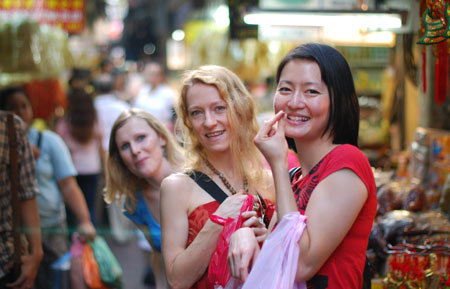
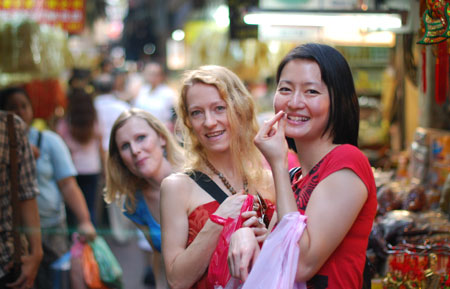
Lizz, Esther and Joyce (left to right) in Chinatown. © Andy Brown/2011/Thailand

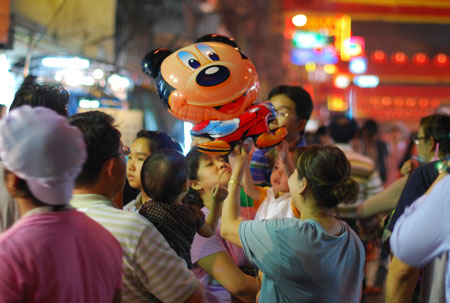
Last week was Chinese New Year (I’m told we should call it Lunar New Year out of respect for non-Chinese who mark the occasion), so on Saturday we went to Chinatown with Lizz,who I used to work with at UNICEF UK, and her friend Esther. We missed the dragon show but the streets were still festooned with red lanterns and packed with both locals and tourists. We explored the narrow back streets, which I was excited to discover stood in for 1960s Hong Kong in Wong Kar-wai’s classic movie ‘In the Mood for Love’.

I’m a big Wong Kar-wai fan – his movies were the subject of my MA dissertation and first publication. On my first trip to Hong Kong, I dragged Joyce and her parents around looking for the location of scenes from ‘Chungking Express’, including the titular Chungking Mansions. ‘Why does he want to go there?’ Joyce’s mum asked her, perplexed. ‘It’s just full of gangsters and fake Rolexes. The Big Buddha statue is much nicer.’ Joyce sighed. ‘It’s a movie thing,’ she explained.

In Bangkok’s Chinatown we stumbled upon a traditional Chinese temple down one of the back streets, where people were burning incense and buying offerings of fresh vegetables, presumably to mark the Year of the Rabbit. ‘Last time they were selling meat and eggs,’ Esther said. ‘That was the Year of the Tiger’.

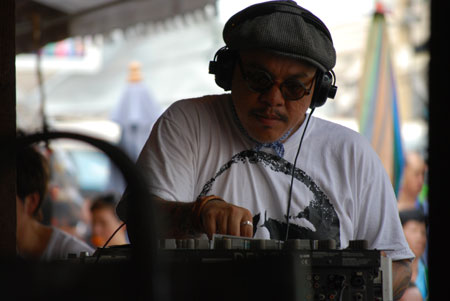
We ended the weekend at Chatuchak Market, looking for things to buy for our flat. Having spent most of December giving away all our wordly possessions, we’re now having to repurchase many of them, albeit at substantially lower prices. Chatuchak is a bit like Camden Market multiplied a hundredfold. It’s a huge, sprawling behemoth of a place, selling everything from arts and crafts to clothes, pot plants and pets. There’s even a stall somewhere selling baby alligators. With over 5,000 stalls and 200,000 visitors a day, it’s easy to get lost. The stall owners are well aware how bewildering it is, so they all have business cards showing their location in the market, numbered by section and soi (street). In the evening, the character of the market changes and it takes on a party atmosphere. Most of the stalls close and bars open up with live bands or DJs spinning dance tunes late into the night.

A DJ playing funky tunes at Chatuchak market. © Andy Brown/2011/Thailand

First impressions of Bangkok

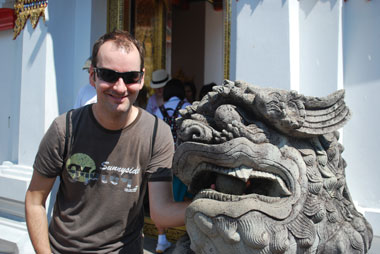
The author, demonstrating the rolling ball action in a dragon’s mouth.
© Joyce Lee/2011/Thailand


Like déjà vu or a half remembered dream, Bangkok strikes me as both familiar and unknown. The hustle, bustle and good-natured chaos of Banglumphu (the old town and backpacker district) reminds me of Manila. Among the glitzy, air-conditioned skyscrapers, malls and skytrain of Sukhumvit, meanwhile, we could easily be in Hong Kong or Shanghai. In between are the temples, saffron-robed Buddhist monks, monarchy and Sanskrit writing that are inimitably Thai. The city is in a mid-point of development. It has left behind the huge, sprawling slums of Manila but the streets are still gridlocked, lined with hawker stalls, and home to stray dogs in feral packs and street children selling flower garlands. “It’s like Hong Kong fifteen years ago, before they made the street stalls illegal,” Joyce says.

I’m here on a 12 month contract with UNICEF’s East Asia and Pacific Regional Office. My job is to help develop websites and other digital activities like email and social media for UNICEF offices in the region. I’m focusing on the middle-income countries, such as Thailand, China and Malaysia. While UNICEF’s main business in these countries is still delivering programmes in health, education, child protection and the like, they also have an opportunity to fundraise from an emerging middle class that is wealthy, online and looking for projects to support.

I came out a week early with Joyce (my fiancée) to find a flat, sort out practical matters like banking, and get a feel for our new home. For the first week, we stayed in a guest house in Banglumphu. The district is full of foreigners (called ‘farang’ in Thai), bars and restaurants with shisha pipes, and travel agencies offering cheap rides down to the islands or to the hills up north. Images of the King are everywhere, from calendars in shops and cafes to giant portraits at road intersections and on government buildings. While staying here, we went out for cocktails on Ko San Road, the famous hippy mecca. It reminded me of the dance village at Glastonbury festival, with pumping trance music, t-shirt stalls and glow-in-the-dark gadgets. Unlike Glastonbury, however, it also features beggars displaying their missing or broken limbs, in an uncomfortable reminder of the darker side of tourism in a poor country.


It’s now the middle of winter, which in Thailand terms means it’s cool for a few hours in the morning before the mercury rises to 30 degrees at midday, after which Bangkok swelters through the afternoon. I quickly learned to walk on the shady side of the street with the locals, rather than on the opposite side with the sun-starved European tourists. On a hot day, the smells of the street intensify, alternating between sweet and foul. One minute it’s all incense and green curry, the next you’re caught off-guard by the stench of drains and pollution from vehicle exhaust pipes.

Thai people are charming – full of smiles and polite bows, their hands clasped in a prayer-like symbol of greeting. At first they can come across as a bit shy or deferential but once you get to know them they’re full of warmth and humour. We made friends with a woman called Joy in our local travel agency who decided that Joyce was her idol. “I want to be more like you,” she declared. “I am always shouting and arguing with my husband but you two are so soft with each other.” On another occasion we came in to find her on her break, watching a YouTube video of a fat man in a bikini doing a belly dance. She collapsed into giggles and turned it off. “It’s OK, I’ve seen it many times before,” she said.

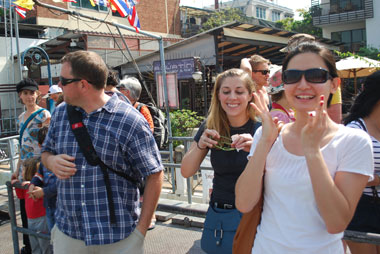
Keith, Carlene and Joyce share a joke at the river boat pier.
© Andy Brown/2011/Thailand

We’ve been brushing up on our Thai etiquette. The Lonely Planet, my indispensable travel bible, warned us that Thais are very foot-phobic. So it’s important to take your shoes off before going indoors, to always walk around things rather than stepping over them and never, ever to point your feet at people, Buddha statues or the King’s portrait. When sitting down, you need to tuck the offending appendages behind you, pointing harmlessly away from everyone.

We’ve also learned to eat with a spoon and fork. Unlike the UK, where a fork is for shoveling food into your mouth, here you eat with the spoon after pushing food onto it with the back of the fork. Thai people used to eat with their hands, like the Malays across the southern border, but in the 1880s King Rama V visited Europe and came back inspired by ideas of western architecture and cutlery.

As well as the ethnic Thais, there are lots of Chinese here and a few Indians. The Chinese are typically rich businessmen. Very few speak Cantonese or Mandarin but they have kept other traditions like eating with chopsticks. Our guesthouse owner in Banglumphu was old Chinese man who got very excited when he met Joyce (who is from Hong Kong) and proceeded to say hello and count to ten in Cantonese. Beyond that, however, his Cantonese was about as good as mine.

Food is central to Thai culture and it is truly fantastic. My early favourite was steamed sea bass in lime and chilli sauce. You can eat out for as little as 40 Baht (80 pence) so it’s very tempting to do so every lunchtime and evening. You do need to develop a strong stomach, however, and even the ‘special chilli-con-carne’ I developed as a student had not prepared me for a twice-daily intake of jalapeño peppers. There are some local delicacies I have yet to try. While eating at a riverside restaurant one evening, we saw an old couple in a wooden canoe paddling along the riverside selling dried squid to diners. The woman smoked the squid over hot coals, while her husband rolled them through an iron press to flatten them out.

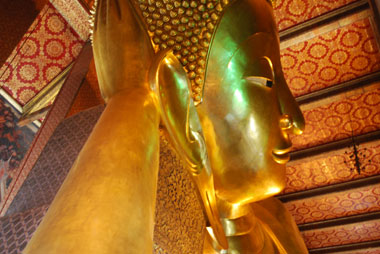
The reclining Buddha – happy but not for the reasons you might expect.
© Andy Brown/2011/Thailand

By coincidence, our friends Carlene and Keith were in Bangkok for the weekend, on holiday from the US, so on Sunday we went out with them for a day of sightseeing. We got the riverboat downstream from Phra Athit pier. Unlike the Thames, the river at the heart of Bangkok (Chao Phraya) still has shoals of large fish in it that come up to the surface at dusk to catch flies. There are also clumps of reeds that drift down from rural areas upstream. The west shore of the river is less developed, with old wooden houses, temples and open land.

We got off at Tha Tien, a crowded pier with noodle stalls and souvenir shops pressed up against the river’s edge. From there, it was a short walk to Wat Phra Kaew, home of the famous ‘Reclining Buddha’. The temple was very Chinese-influenced, with sloping, tiled roves and statues of Guan Yu, the Chinese patron saint of honour and justice who is revered in Hong Kong by police officers and triads alike. There were also stone dragon statues, but with an interesting innovation compared to their counterparts in the Middle Kingdom – the stone balls in their mouths had been carved to come loose and move around their mouths. Both the balls and the inside of the dragons’ mouths had been worn smooth by being rolled around by generations of curious visitors.

Inside the temple was a giant, gold statue of the ‘Reclining Buddha’. The temple must have been built around the statue, which is so massive that you can’t see the whole thing at once. The Buddha lies on his side, his head resting on his hand, with a languorous, almost sensual smile on his golden face. In fact, he is depicted at the moment of death and his pleasure is the anticipation of imminent nirvana. At the other end of the statue, the Buddha’s massive feet are covered with intricate patterns and pictures of horses and elephants in mother-of-pearl – which seems a bit odd given Thai people’s aversion to all things foot-related.

The temple walls are covered with murals in which scenes of everyday life are intermingled with epic battles and scenes of calm contemplation. Buddha figures painted with gold leaf appear throughout, in sometimes improbable places. On one wall, an army is storming a fortress with elephants, while on the back of one great beast a Buddha figure sits smiling and calming playing a sitar.

The air was full of the smell of burning incense and the sounds of the temple were almost musical. A deep booming gong was accompanied by a higher tinkling sound which turned out to be caused by a constant stream of worshippers filing past a line of metal pots and dropping a coin into each one in turn. Around the temple, people prayed, burned incense, pasted small squares of gold leaf onto Buddha statues, or dipped a lotus flower into a bowl of water and touched it to their foreheads. It occurred to me that although the religion and philosophy of Buddhism is very different to the Catholicism of the Philippines, somehow the ritual and ceremony ends up being remarkably similar.

As we left, I noticed hundreds of coloured roof tiles piled up outside the temple for restoration work. The underside of each tile carried a message, presumably from a donor. Most were in Thai but occasionally there was one from a tourist such as ‘Wat’s up?’ from Bruno in Australia, who was clearly a bit of a joker – ‘wat’ is the Thai word for temple.

After lunch we caught a boat to Wat Arun, another temple on the other side of the river but hundreds of miles away in terms of its influences, which were much more Indian. It comprised several tall tapering towers with rounded tops, guarded by demons with green faces and tusks in full battle armour. The temple was covered in multicoloured ceramics, including flowers made from broken plates. Its spires rose vertiginously, with staircases that climbed to the third level, getting progressively narrower and steeper at each level. “Please don’t make me go up there,” implored Carlene, who doesn’t have the best head for heights. In the end she came with us, white knuckles on the railings, and was rewarded with stunning views across the river with tiny boats plying the piers far below and skyscrapers rising over the Central district to the east.

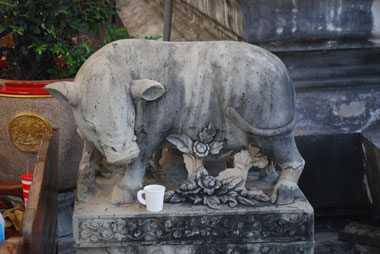
On the way out, we passed a series of statues of farm animals. Someone had left a coffee cup on the plinth of a pig statue and the stone animal had his head turned towards it, looking for all the world as if he was contemplating whether or not to take a sip of the steaming liquid.

The stone pig considering his options. © Andy Brown/2011/Thailand