 |
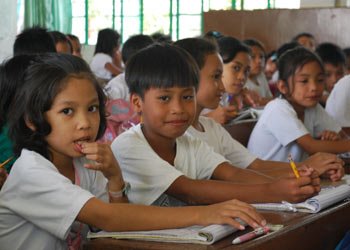
Children do their best to learn in an over-crowded classroom
© UNICEF Philippines/2009/Andy Brown |
In my last week working for UNICEF Philippines, I returned to the evacuation centres to see how children and their families were coping in the run up to Christmas. In the two months since Tropical Storm Ondoy, many of the 400,000 displaced people had returned to their homes or to resettlement communities. However, around 70,000 were still living in evacuation centres, primarily in the Laguna region.
The focus of the trip was on schools being used as evacuation centres. I was travelling with Martijn, who was looking at the impact on children’s education, and Hirut, who was testing a new needs assessment form.
The first evacuation centre, in San Pedro Elementary School, was quite chaotic. The 200 families living there had been told that the military would be arriving the next day to transfer them to a ceramics warehouse. While the education team met local officials, I went with a teacher to interview evacuees. I was quickly surrounded by a large crowd of people demanding food, money and supplies. They were clearly desperate and I knew from my security training how these situations can turn ugly. With the teacher’s help, I explained that my job was to report on their situation, in order to try and raise more money, but that I couldn’t personally promise them anything. Eventually they calmed down but it was an unnerving experience.
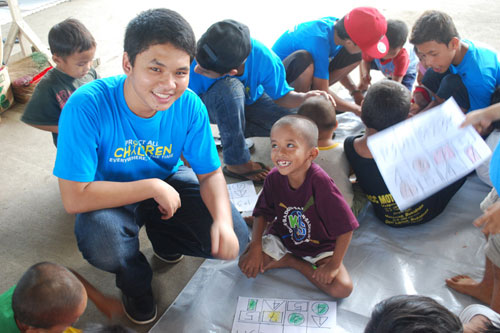
The second school, Dela Paz Main Elementary, was much more organised and peaceful. We were shown round by Mrs Bennett Layngan, the teacher in charge of evacuees, who also teaches a Grade Four class in the afternoons. She was managing the situation as best she could. “The evacuees are in a separate extension wing, separated from the rest of the school,” she explained. “They have a water pump and cooking and cleaning areas. There are also education sessions for the children, run by Save the Children. To make room for the evacuees, some of our students have been transferred to another school nearby.”
Close family
 |
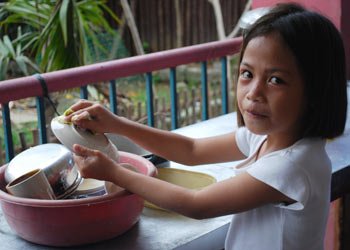
Mariel, 9, demonstrates her washing up skills at the evacuation centre
© UNICEF Philippines/2009/Andy Brown |
We also met the Cervito family, who were living in the evacuation centre. The family of six were living in a two-metre square corner of a former classroom. Their tiny living area was marked by bedsheets hung from a clothes line, with their few remaining possessions neatly arranged on a small wooden table.
I spoke to Mariel Cervito, 9, who is in Grade One. She told me that she enjoys maths, reading and writing and wants to be doctor when she grows up. “I like having lots of play mates here but I miss my home,” she said of living in the evacuation centre. “I like helping my mum wash the dishes.”
After the storm struck, Mariel and her four siblings were carried to safety by their parents. “We just took the children and left all our possessions,” her mother Marlene recalled. “My husband and I waded here through the flood waters carrying the children.”
The Cervitos’ home is near Laguna lake and has been flooded since September. The waters are slowly subsiding but with no drainage channel from the lake, it will take until the end of January before it’s safe for families to move back in. As a result, they will have to spend Christmas in the evacuation centre. “I’ve been back to the house to clean it but the water’s still knee deep outside,” Marlene said. “When I open the doors, it just floods back in.”
There are nearly 150 families still living at Dela Paz Main Elementary School and life isn’t easy for them. “It’s uncomfortable and sometimes dangerous,” Marlene commented. “My one year old fell down the stairs and cracked her head open. She’s OK now but we had to rush her to hospital.” The family had no money so Bennett paid the hospital fees out of her own pocket.
The school was only a couple of blocks from the flooded area, so afterwards we drove down to take a look. The streets were still flooded and we had to be careful where we drove. We saw women and children wading to those houses that were still habitable and a few other vehicles driving slowly through the water. On one street, we unexpectedly saw three men carrying a fridge through the flood waters and into a house.
Training days
I spent the rest of the week training Marge, Pam and Gina in a range of web activities including audio and video editing, designing mass emails and producing ‘splash’ webpages. I also wrote a report for UNICEF’s regional headquarters in Bangkok about what we’d achieved over the two months, with recommendations for other offices in the region.
On the social side, I organised a trip to climb Taal Volcano with Martijn, Silje, Harout and others. A few hour’s drive south of Manila, Taal is an impressive sight, with a (geologically speaking) young volcano rising out of a lake inside the vast crater of an ancient volcano. On the way up, we passed hot vents exhaling sulphurous steam into the atmosphere. Back in Manila, I went to a gig with Marge to see my favourite Filipino band, Sinosikat?, at a small venue in a converted Spanish villa.
Martijn and I both finished work on 18 December, so we had a joint leaving party. Rather than going straight back to the UK, I’d taken the opportunity to spend my Christmas and New Year holiday in the Philippines. My girlfriend, Joyce, flew out to join me and together we travelled south to the Bacuit Archipelago, in Palawan, then north to Banaue rice terraces, in Luzon.
The Bacuit Archipelago is how I imagine Thailand must have been like before mass tourism arrived there. We stayed in a beachside cottage in a rural village on the mainland and took snorkelling trips out with local fisherman to the islands, where vertical limestone cliffs rose directly out of a still sea. On Christmas Day, we watched the sun set behind the islands from a boat in the bay, as giant turtles swam past.
 |
| Me and Joyce at the rice terraces in Banaue |
The rice terraces at Banaue gave us a glimpse into Filipino life in past centuries. Now a UNESCO World Heritage Site, the mountain sides were first sculpted into stone walls terraces somewhere between two and four thousand years ago. Local farmers still maintain the terraces and elaborate irrigation system. They live in traditional wood and bamboo houses, although in many places the thatched roofs have been replaced by corrugated iron. At Batad, a vast amphitheatre-shaped terrace dominates a small village in the basin below. When we visited, farmers were just starting to plant the rice for next year and a few vivid patches of bright green stood out amongst the fallow fields.
In Manila I’d met Jacque, a friend of Angela’s, who works at the UN Food and Agriculture Organisation. She told us about a project she was managing in the area. Many of the rice terraces are declining in productivity and can no longer support the area’s growing population. They are also under attack from worms, accidently imported in pig feed, which eat the rice roots and weaken the terrace walls. “We’re working with local farmers to eradicate the worms and diversify their rice crops, enabling two harvests a year instead of just one,” Jacque said.
Eventually, my time in the Philippines drew to a close and I packed my bags with some reluctance. I’m looking forward to going home and returning to work at UNICEF UK but there are many things I’ll miss. It’s been an amazing experience to live and work in another country and I’ve gained a much deeper understanding of UNICEF’s work after seeing so many projects and meeting the children who are our ultimate beneficiaries. I’ve also been working with a great team of enthusiastic people, who have in many cases become good friends and introduced me to Filipino culture. Finally, I’ll miss the tropical weather and lush scenery as I head back to a country in the icy grip of its worst winter for thirty years.





 Beneath the Baobab