Papua: long walk to the mummy’s tomb

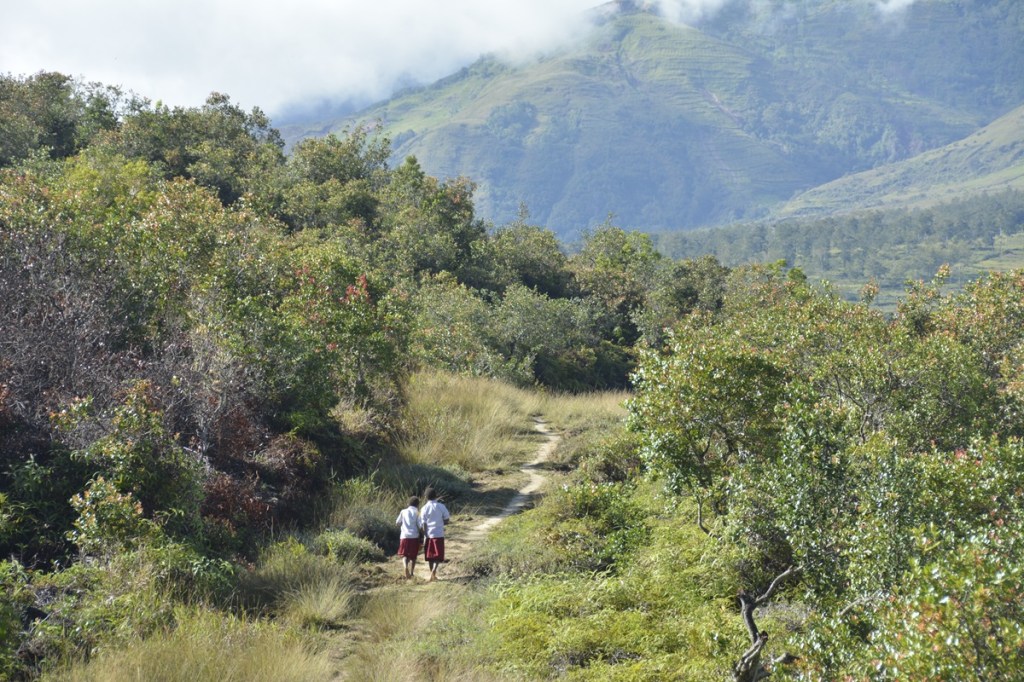
Tolaka and Lima walk to school for an hour through grasslands and forests
© UNICEF Indonesia/2014/Andy Brown

I was in Papua in March to document the issues facing children in one of the most remote and mountainous regions on Earth. With few roads and no horses, there is only one way for most people to get around – on foot. Children often walk for hours to get to school each day, and we wanted to document that journey.

It was our second day in the highlands of Papua, after arriving and meeting Yumelina the day before (see part one of this blog). We got up at 5am and drove out towards the Baliem valley, which is in the heart of the Cyclops Mountains and had no contact with the outside world until after World War II.

Continue reading “Papua: long walk to the mummy’s tomb”

Cambodia: ancient temples of the Khmer Empire

An early morning view of Angkor Wat, seen just after sunrise
© Andy Brown/Cambodia/2012

Two years ago, my honeymoon blog stalled in Luang Prabang, Laos. I returned to a busy work schedule, but it’s been at the back of my mind ever since to finish the story.

After leaving Luang Prabang, Joyce and I continued our overground trip by bus instead of boat. Our next stop was Vang Vieng, a beautiful riverside town backed by craggy cliffs that was somewhat spoilt by hordes of teenage backpackers getting drunk or high and ‘tubing’ down the river in tractor tyres. There were bars selling ‘happy meals’ laced with cannabis, and ‘super happy meals’ laced with opium. All this would have been fine on a party island like Ibiza, but felt somewhat inappropriate in rural Laos.

Continue reading “Cambodia: ancient temples of the Khmer Empire”

Mongolia: land of the eternal blue sky

Herds of livestock wander through the barren landscape of Khuvsgul
© Andy Brown/2013/Mongolia

Mongolia is unlike any other country I’ve been to. For most of the year it’s a frozen wasteland. Temperatures plunge to minus 35, lakes freeze over and heavy snow piles up across the land. Then, for a few brief months in summer, the snow melts and the country is transformed into a land of wide, open grasslands, sparkling lakes and vast green forests under an endless blue sky. I visited in June, when this transformation was nearly complete. The snow had temporarily retreated to the mountain tops, leaving the land clear for people, animals and vehicles.

Continue reading “Mongolia: land of the eternal blue sky”

Independence days: the new nation of Timor-Leste

In the mornings, Neng helps her mum on the family food stall
© UNICEF/Indonesia 2012/Andy Brown

I’d only vaguely heard of Timor-Leste (or East Timor) before I went there last August. The tiny former Portuguese colony of just over a million people is most famous as the first new nation of the century. It achieved independence in 2002 after a long and bloody struggle with Indonesia, which invaded after the Portuguese left. The BBC describes the subsequent rebuilding of Timor-Leste as “one of the UN’s biggest success stories” so it was fascinating to visit with UNICEF, the UN Children’s Fund.

Continue reading “Independence days: the new nation of Timor-Leste”

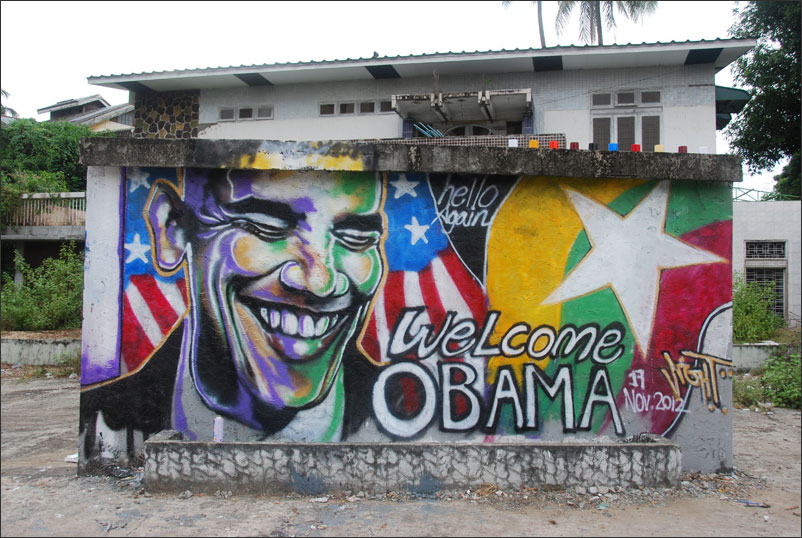
Welcome Obama: making history in Myanmar

‘Welcome Obama’ graffiti on the roadside opposite my Yangon hotel
© Andy Brown/Myanmar 2012

I always seem to be visiting Myanmar (previously Burma) at historic moments. On my first visit in June, Aung San Suu Kyi was visiting London for the first time in 24 years. On my second in November, Barack Obama was making the first visit to the country by a serving US President. On the street opposite my hotel, a large ‘Welcome Obama’ graffiti mural had sprung up, and the papers were full of the news. ‘From Sanctions to Success’ claimed the headline of the Myanmar Times, with articles inside ranging from sober analysis of the visit to a fortune teller’s predictions for Obama’s second term. Whatever else, Myanmar remains a deeply superstitious country.

Continue reading “Welcome Obama: making history in Myanmar”

Coping with tragedy: the legacy of war in Laos

Peter Kim, a young bomb survivor, at the COPE centre
© UNICEF/Laos 2012/Andy Brown

Peter Kim is a victim of the Vietnam War. But he’s not a Vietnamese or American veteran; he’s a 20-year-old Lao youth living in Vientiane. Four years ago he lost both his hands and eyesight to one of the millions of unexploded bombs that still litter the Laos countryside almost four decades after the war ended.

Peter Kim grew up in a small rural village in Viangchan province, where his father grew rice and kept cows and buffalos. “On my sixteenth birthday, I went to school for an exam,” he told me. “I came home with my friend. On the way back, my friend saw something on the ground. He picked it up to show me. I tried to open it and that’s when it exploded. It happened very fast. Afterwards I couldn’t see or hear anything.”

Continue reading “Coping with tragedy: the legacy of war in Laos”

Pirates of the Pacific: colonial history in Cebu

A painting at the Basilica del Santo Nino, showing an idealised view of colonial history
© Andy Brown/Philippines 2012

From a European perspective, the history of the Philippines began abruptly in 1521 with the arrival of the Portuguese conquistador Ferdinand Magellan. Like Christopher Columbus before him, Magellan was a mercenary on hire to the King of Spain. His mission was to find a new trade route to the Spice Islands by heading west from Europe via the Spanish colony of Mexico, handily avoiding the Portuguese navy, which controlled the Eastern route around Africa.

Continue reading “Pirates of the Pacific: colonial history in Cebu”

Filipino history and the 'Pied Piper of Manila'

Carlos holds a portrait of Filipino ‘national hero’, Jose Rizal
Photo © Andy Brown/2011/Philippines

When I think of the great histories of the world – the Roman civil war of the First Century BC, the ‘Three Kingdoms’ of Imperial China, the British Raj and the partition of India – the Philippines doesn’t get much of a look in. But this oft-neglected corner of the world has a fascinating heritage that occasionally places it at the heart of global events in surprising ways.

I was first introduced to Filipino history in 2009 by Carlos Celdran, the self-styled ‘Pied Piper of Manila’, his diminutive figure and larger-than-life character dressed up in Nineteenth Century top hat and tails. Every week, Carlos takes tourists and locals around Manila’s handful of historic buildings – those that survived World War II – and treats them to, not so much a tour, as a piece of stand-up political theatre.

Continue reading “Filipino history and the 'Pied Piper of Manila'”