South Africa diary: Rock DJ

Day four, Monday 14 July
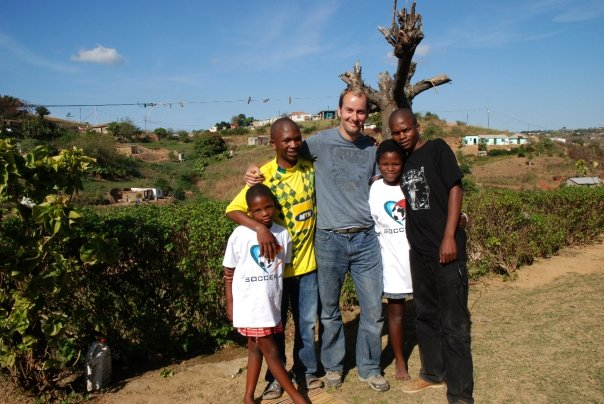
Me with the Zondi family at their home in Durban

I get up at 6am, in time to see an amazing sunrise over Durban bay. Far below, I can see a crowd of people out on the pier, waiting for the sun to make its appearance above the rapidly lightening horizon. Downstairs, we meet the local Isibindi project manager and I get a chance to go through some questions from our media team. Today, we’re visiting the Zondi family, who were the focus of a 2006 appeal film starring Robbie Williams. One of our key objectives is to report back on their progress since then.

After getting briefly lost on our way out of Durban, we arrive at the township where the Zondi family lives. We’re met by Umlum Zondi (not his real name), a smiley and chatty 16 year old. He leads us to his home – three small, yellow and green buildings perched precariously on a hillside by the coast. There’s also a banana tree, a single tap for washing, an outside latrine and two graves below the house where the children’s parents are buried. Although they’re still poor, the people round here are clearly a step up from those in Ndondo Square. Their brick homes are well constructed and they all have running water and electricity.

When Robbie first visited the Zondis in 2006, Kiki, who was 17 at the time, was looking after his younger brother Umlum, then 14 and sisters Banu, 9, and Katie, 8. The children’s father died in 2002 and the boys cared for their mother until she died in 2005, after which they had no one to look after them. Fortunately, the family came to the attention of Isibindi, who provided a child and youth care worker to help out around the house, teach the children life skills, help with homework and provide emotional support.

Two years on, we found four very happy young people. They are all healthy and going to school except Kiki, who has finished school. He’s secured a place to study economics and business at college next year. In the meantime, he’s learning to drive in order to get work and help support the family. The Zondi’s care worker, Dozoi, has helped Kiki secure a financial grant for the family. He has also recently adopted his brother and sisters, becoming their official foster parent.

A picture of the children’s father is still prominently displayed on the wall in the lounge, but it has been joined by another picture of the children with Robbie Williams. There’s lots more Robbie memorabilia around the house and he clearly made a big impression on them.
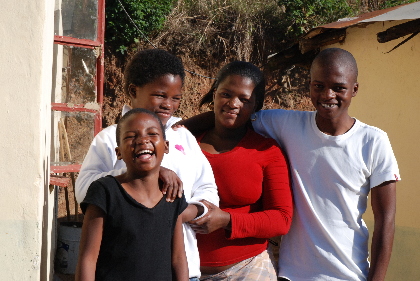
The Zondi children with their care worker Dozoi

While we’re setting up the film, I spend some time getting to know the Zondis. Umlum is a big football fan and very keen on Manchester United. Kiki wants to know where I live and if I’ve met David Beckham. I tell him that I live in London and haven’t met Beckham, but that he does work with UNICEF, so some of my colleagues have. The boys are happy to talk about their parents and they show us pictures of their mother, father and themselves when they were younger. I notice that while Umlum is very outgoing and a bit of a joker, Kiki is much more serious – perhaps a sign of the responsibility he has had to bear from an early age.

The crew have finished setting up so the family gather outside to tell us how their lives have changed. “Life was difficult before Robbie came here,” Umlum says. “We were not earning much and had to budget for everything, including school uniforms. Now things are much easier for us. Soccer Aid has given us the opportunity to go to University and do what we like with our lives.”

After the interview, the children make thank you cards for Robbie and record a message for him, including their own song and dance version of Rock DJ. They have enormous fun doing it and seem happy and carefree – a sure sign of how far they have come in the last two years.

For the final scene, the crew go off with Kiki to film a driving lesson, while the rest of us stay at the house. As usual, we’ve brought an England football with us and before long a group of teenage boys, friends of Umlum, arrive for an impromptu kick around in the backyard. I join them for a game but they’re far better than I am. Their favourite catch phrase is “quality pass”. By this point, we’ve overrun our schedule so we skip lunch and head off to meet our last family, the Sibanyonis, grabbing a few pretzels and an apple in the van on the way.
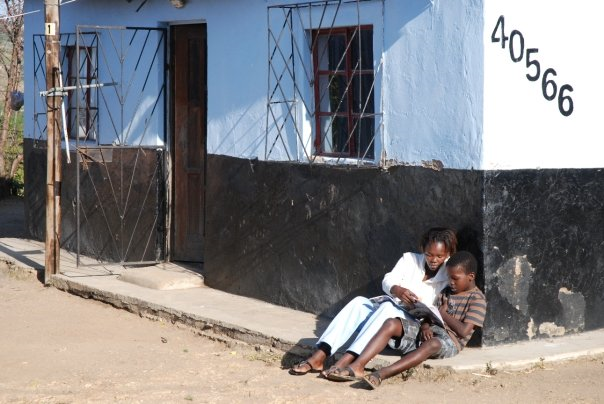
Ntombi reading with her younger brother

Ntombi Sibanyoni, 19, has been looking after her brother, sister and nephew for five years. Her mother became too ill to look after them when she was 14. By the time she was 16, both her mother and aunt had passed away. Ntombi was left on her own, responsible for her sister Zola, then 11, brother Themba, 7, and nephew Bongani, 9. She now has her own baby daughter Sithembile to look after as well. All five live together in a small, four-room house.

It’s a lot for a teenage girl to cope with and Ntombi struggled at first with so much responsibility and very little income. But things are a lot better now. Ntombi gets help from Nilisiwe, a child and youth care worker provided by Isibindi. Nilisiwe helps out around the house, looks after the younger children and provides emotional support for the whole family. This has allowed Ntombi to finish school and get a job as a Facilitator at Adam’s Mission, where she is working on a water and sanitation project. The job allows her to support her family and she is now in the process of building a larger house for them.

It’s my turn to do the interviewing and I’m a bit nervous because I don’t want to mess it up. We don’t have much time here but while the film crew is setting up, I get to know Ntombi. She’s nervous too but has done this before for another UNICEF film. I tell her that, compared to everyone else, she’s virtually a professional actress.

Ntombi is very intelligent and eloquent. Amazingly, as well as working and caring for her family, she also finds time to help those of her neighbours who have less than she does. All in all, Ntombi is a real inspiration and Isibindi have plans to train her as an advocate. They’re sending her on a female empowerment course, but I’m not sure that she needs it.

At the end of the interview, I ask Ntombi if she has a message for people in the UK who are thinking of donating to UNICEF through Soccer Aid. “It is a very good thing when you give money to UNICEF, because people are sick and dying in South Africa and they need help,” she says. “Nilisiwe has helped me so much and I wish this scheme could be extended to other families who are suffering, even those where children still have their parents but they’re not working because they are sick. We need more child care workers like Nilisiwe to come and help these families.”

Once we’ve finished the interview, I suggest that we film sequences of Ntombi helping Themba with his reading. For the final scene, Bongani and Themba sweep the yard outside the house with great enthusiasm – almost certainly more so than when they’re doing their real chores.

We say goodbye to the family and head back up the hill to the vans and the long flight home. I’m exhausted, but sad that it’s all over. I look out across the township to the sea and think about what an amazing experience this has been. It’s also been hugely productive: I’ve collected over 1,000 photos, four case studies, several interviews and an entire book full of notes. There’ll be lots of work for me to do sorting it all out when I get home.
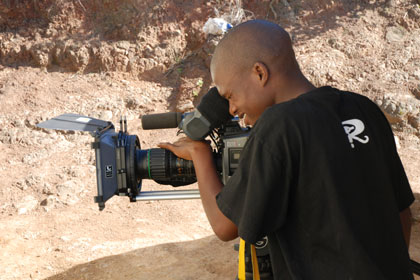
Kiki Zondi tries his hand as a cameraman

Back to part two »

South Africa diary: Missing generation

Day three, Sunday 13 July

Unathi Nyathi with two of her many grandchildren

We’re staying at a guest house in Eliott, in the Transkei region of South Africa. It’s another early start, but after getting up at 4am yesterday, 7 O’Clock feels like a nice lie-in. It’s still well below freezing outside so in order to stay warm, I’m now wearing all my clothes in layers each day. We have a hearty breakfast at the guest house, then pile in to the vans and head back to Ndondo Square to film the second family – the Nyathis.

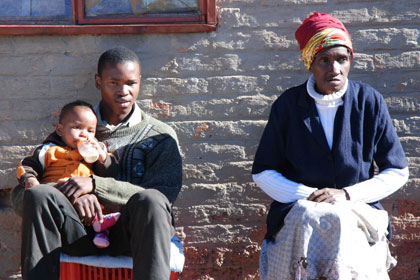
We arrive at the Nyathi home and get a tangible sense of South Africa’s ‘missing generation’. There are countless children running around the yard making a racket, while an old woman sits quietly outside the house, gazing into the distance. Nasi Nyathi (not her real name) is 15 and, along with her brothers and sisters, is an orphan. Her mother died four months ago, leaving five grieving children in the care of their grandmother Unathi, who was already looking after their twelve cousins. The only source of income for the entire family was Unathi’s pension.

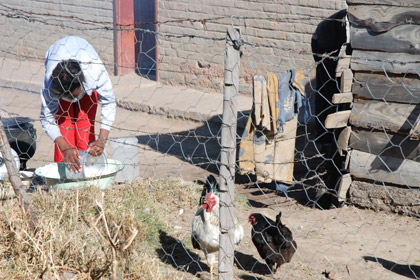
After her mother died, Nasi initially took care of her siblings and did all their washing, cooking and cleaning. Things in the house became disorganised. Unathi didn’t want Nasi to do the housework but she’s a 65 year old woman looking after 17 children and things got too much for her.

“When my daughter was alive, she used to help around the house and supported me financially,” Unathi says.  After her death it was so difficult and we sometimes lived without food. I couldn’t buy any shoes or school uniforms for the children. My own health wasn’t good so I allocated tasks and responsibilities to Nasi, the eldest child.”

Nasi Nyathi washing dishes in the yard

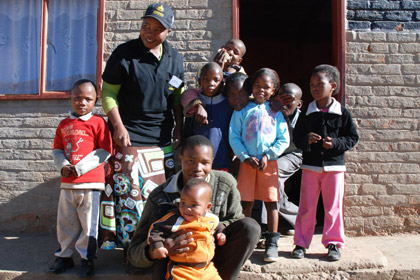
Luckily, help was at hand. Unathi approached Nolita, a child and youth care worker with Isibindi. For the last couple of months, Nolita has been working with Unathi to bring some structure and normality back to the family. There is now a rota, so all the children share the chores. They are back at school and Nolita helps them with homework, as well as keeping the house in order.

“After Unathi spoke to me I came to the house to do an assessment,” Nolita says. “There was a lot of grief. I found that the older boys were doing nothing, just hanging around in the street. Nasi was doing all the chores, looking after the younger children and caring for her granny when she was sick. The children were not going to school regularly and their work was not up to standard. I talked to the boys to give them some life space counselling but also to make sure they did something to help Nasi. We set up a house rota whereby every child has tasks.”

Nolita visited the children’s school and arranged for them to return to their classes. Through the Isibindi project, she provided new shoes, school uniforms and food parcels, so the children would have something to eat in the evenings. Nolita also encouraged Nasi to go to the local Isibindi safe park. For Nasi, it’s a place where she can get away from her busy family life and be herself. It’s a place where she can meet her friends, listen to music and just be 15 again.

“In the safe park there is a lot to do,” Nolita continues. “We educate the young people about sex, teenage pregnancy, drug abuse, sexual and physical abuse and hygiene. Every child is supervised, whether they are playing or involved in a group discussion. Care workers can also identify vulnerable children and do an assessment of any that seem to be struggling or have a problem at home.”

“The young people love the safe park and they know the rules,” she adds. “They don’t hurt anyone or shout: they just play.”

Nolita with the Nyathi children

While the film crew are doing interviews inside the house, the rest of us wait outside and try to keep everyone quiet. This proves quite a challenge: there are over a dozen small children to manage, along with curious neighbours and a flock of very noisy geese.

At one point, I take some of the children down the road and play football and piggy back with them. It’s hot work and I get down to a t-shirt for the first time on the trip. My favourite kid is a four-year-old boy in a jumper with a picture of a demented robot on it and the slogan ‘System Overload… he’s going out of control’. There’s always one child I want to adopt on these kind of trips and this time System Overload is definitely the one. He’s also a precocious footballer and pulls off shots a boy twice his size would be proud of.

After the interviews have finished, we film sequences of Nasi doing her chores in the yard and walking with her sisters down the dusty road to the safe park.

Back at the safe park, I take the opportunity to grab Lulamile, who had previously been working as our translator, for a short interview on the camcorder in one of the cabins. Lulamile has been working for Isibindi for seven years, which he describes as “a wonderful experience”. Initially, he was a volunteer but now, thanks to funds from UNICEF, he’s in a full time, paid role. We talk about his life, career and aspirations. It turns out that he’s also a volleyball coach for some of the children and is enthusiastic about the use of sport for development. After the interview I take a few minutes to film Lulamile playing football with some of the boys in the park.

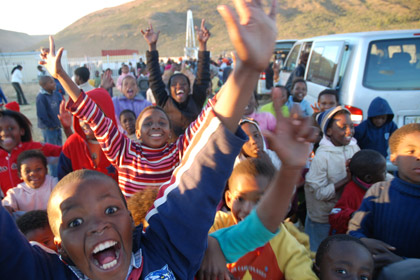
As we’re loading up the vans to leave, dozens of kids emerge from the safe park. They crowd around for a final photo shoot and I get some amazing shots of a sea of small smiling faces, turning orange in the rays of the setting sun.

Last chance for a photo

Back in the vans, we start a three hour drive to East London. The scenery is stunning so I take a few shots out the window but we’re on a very tight schedule so there’s no time to stop. From East London, we fly to Durban and check into a proper hotel, all of us looking forward to a good night’s sleep.

It’s late and we’re tired, which probably explains how Richard manages to leave his very expensive film camera under a table in reception. Steve takes it up to his room and pretends he hasn’t seen it. I’m too soft and give the game away by telling Richard – he’s going frantic and is about to make the hotel management go through the CCTV security tapes.

Despite my plans for an early night, I end up in the bar with Hilton until past midnight copying photos to DVD on his laptop. It’s only been two days in the field but I’ve already taken over 800 photos. It’s hard not to: the scenery is so stunning and the children so excited and photogenic that you can point the camera in virtually any direction and get a great shot.

We’ve got a 6am start tomorrow, which will be our last day. I hope that, like System Overload, I can still function.

Back to part one | Read part three »

South Africa diary: Safe from harm

Day one, Friday 11 July

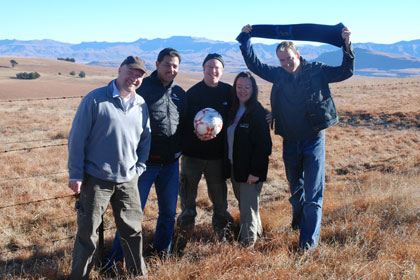
Me (right, with scarf) and the Soccer Aid film crew

We arrive in Johannesburg, South Africa at 6:30am, bleary eyed after an overnight flight from London. We’re here to record appeal and feedback films for Soccer Aid 2008, a televised charity football match.

At Jo’burg, we meet the rest of the film crew, who are all very experienced. Steve Cole, the director, has just produced a documentary on filmmaker Werner Herzog for BBC1. His past highlights include an Omnibus special on Aardman’s animated classic Chicken Run. Richard Kruger, our camera man, has worked on similar appeal films for Comic Relief and American Idol Gives Back. Hilton Auffray, our sound man, has just finished a feature film and is about to start a global health documentary for BBC World. He has also interviewed Nelson Mandela and is hoping to go to his 90th birthday party, which is coming up soon. My job is to gather materials for the website, including photographs, interviews, case studies and this journal.

While things are looking good on the crew front, the logistical side is another matter entirely. We’d expected to spend the morning at Johannesburg airport before flying on to Umtata in the afternoon but our connecting flight is cancelled. We’ll have to spend the night in Jo’burg and catch a 6am morning flight. It’s really frustrating: we’re only in South Africa for four days and we’re spending an entire day at the airport.

It’s also rather colder than we’d expected. It’s minus two degrees in Jo’burg and gets as low as minus seven at night in the Transkei, where we’re heading next. I’m going to be taking photos and writing notes outside so I buy some gloves and scarves at the airport. Unfortunately, all we can find are South African rugby scarves and pink women’s gloves. Fashion is not going to be my strong point on this trip!

One useful thing about the delay is that I get to spend time with Jerry, from UNICEF South Africa, learning the local lingo. In Pedi, ‘lekae’ means ‘hello’ and ‘kealeboga’ means ‘thank you’, while in Zulu ‘kunjani’ means ‘hello’ and ‘ngiyabonga’ means ‘thank you’.

Day two, Saturday 12 July

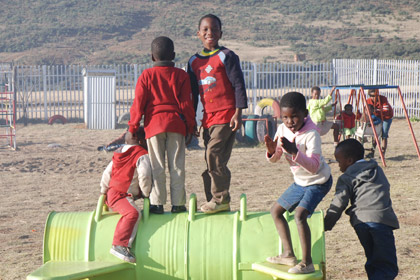
Children play in the Isibindi safe park at Ndondo Square

We struggle up at 4am to catch our 6am flight to Umtata. We’re flying in the smallest plane I’ve ever been in – 30 seats in a tiny fuselage like a missile with oversized propellers.On the plus side, it does mean that we get to see sunrise from the air. It’s an amazing view as the vast African plains and mountains are gradually lit up by the rising sun. The airport we land at is equally tiny, with only one other plane covered in a layer of early morning ice.

At Umtata, we meet Heidi and Nikki from UNICEF South Africa and pile into their vans for a two-hour drive through the Transkei to our destination: the township of Ndondo Square. It’s a truly magnificent landscape, with vast red earth plains and great carved plateaus reminiscent of the Grand Canyon.

Soon after 9am, we arrive at the convent at Ndondo Square, which acts as the local headquarters for the project we’re visiting. Run by Isibindi, a local NGO set up by the National Association of Child Care Workers, which receives support from UNICEF, the project involves providing child and youth care workers to children who have lost their parents to HIV and AIDS. If it wasn’t for Isibindi, the older children would be looking after their younger siblings without any financial or emotional support. Recently, Isibindi has also built a ‘safe park’, which they’re very proud of. It’s a fenced-off, supervised area which provides a safe environment for the children to play and learn.

While we’re learning about this from the Isibindi project managers, Smangele and Lulamile, we become aware of a drumbeat outside the convent. Apparently, the local children have prepared a welcome dance for us. We ask if they can wait a few minutes while we set up the film equipment – this is too good an opportunity to miss. We then film the children dancing down the street in gold and silver headdresses and into the safe park, while locals watch from the surrounding fields and houses.

Once in the safe park, more kids crowd around in excitement to watch the filming. I notice some children watching the show from the top of a climbing frame and Yvonne, from UNICEF UK, and I climb up too. I get some great aerial shots of the playground and also of the dozens of children around us, all of whom want their photo taken.

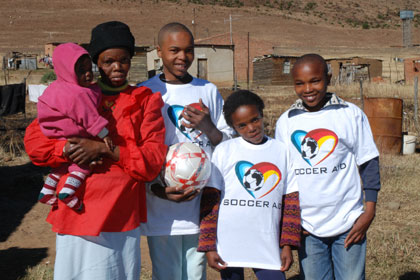
The Butshingi family outside their home

After the safe park, we head into the township to film the Butshingi family. Nosizwe, the mother, is HIV-positive and disfigured from a fire some years ago. She used to be very ill and the children had to skip school to look after her. Now an Isibindi child and youth care worker, Claudisa, visits the family every day. She helps Nosizwe stay well by taking her medication correctly and eating well, allowing the children to go back to school. Claudisa also helps out around the home and provides emotional support for the children.

The Butshingi family are clearly very poor. They live in a small wooden shack with cracks filled with plastic bags, lacking even the basic facilities we can see in some of the other homes. Despite this, and all the other hardships they’ve faced, the children are incredibly happy and outgoing. They race cars ingeniously constructed from wires and old tin cans.

We interview the family and the care worker. Nosizwe has been incredibly brave to disclose her HIV status, given the stigma that still surrounds HIV and AIDS in South Africa, and braver still to let us into her home and film all of this.It’s quite humbling. I feel enormously privileged to be here, meeting these remarkable people. “After I was diagnosed with HIV, I decided it was not something to keep secret,” Nosizwe says. “I felt that I should inform my family and the care workers. I’m not afraid to tell people.”

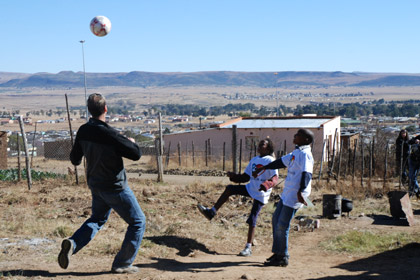
After the interview, we give the kids Soccer Aid t-shirts and an England football. They hardly need any encouragement to start kicking it around, and this proves an excellent photo shoot. The girl, Thandiwe (not her real name), is the most enthusiastic footballer and we get some great shots of her jumping to save goals.

Playing football with the Butshingi kids

When the light starts to fade, we head back to our guest house in Elliot, run by an elderly Afrikaans couple. Although it was relatively warm in the sunshine in the afternoon, after dark it quickly drops to well below freezing. There’s no heating but it’s warm in the dining room thanks to a roaring log fire.

Before dinner, I interview Heidi about UNICEF South Africa’s work with children affected by HIV and AIDS. “We’ve got over two million orphans in South Africa, many of whom are living on their own and need care,” she says. “This is not just about having somebody who comes to the house to see if the children are OK.  It’s about someone who has a real and consistent relationship with the children, who they can trust, who can help them get through school, who makes sure they eat well and who can help them work through their loss and grief.”

By the time we’ve finished eating I’m shattered, so I go to bed and read a bit of David Attenborough’s autobiography – a reminder that field trips can be a lot tougher than ours. Luckily, I’m saved from hyperthermia by an electric blanket, although I can’t help but think what it must be like for the people back in the township.

Read part two »