Ugly duckling: eating balut in the Philippines

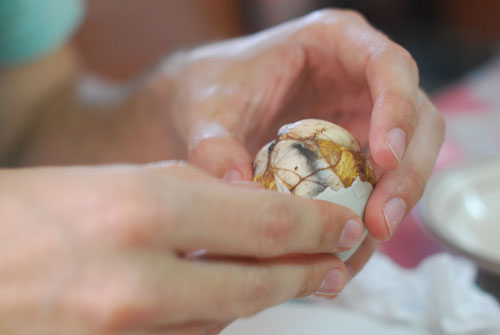
Peeling a fertilised balut egg, while trying to hold down my nausea
© Marge Francia/2012/Philippines

Balut is probably South East Asia’s most gruesome delicacy. It’s a fertilized duck egg with a half-grown embryo that is boiled alive and eaten whole. For Filipinos, balut is a treat. They buy it from street vendors or in local restaurants and bars, where it is served as a drinking snack, much like salted peanuts in British pubs. Inside the shell is a curled up foetus that looks like something out of an Alien horror movie or one of Gunther von Hagens’ Body Worlds exhibitions. Filipino children will cheerfully crunch their way through the foetal bones and feathers but just the thought of it makes me feel ill.

Continue reading “Ugly duckling: eating balut in the Philippines”

Filipino history and the 'Pied Piper of Manila'

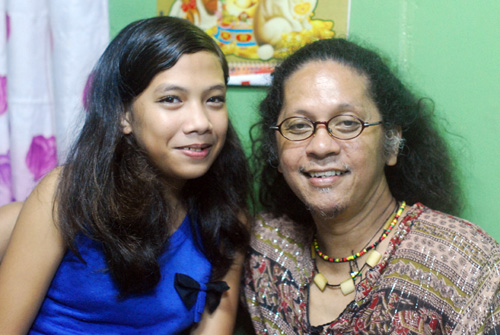
Carlos holds a portrait of Filipino ‘national hero’, Jose Rizal
Photo © Andy Brown/2011/Philippines

When I think of the great histories of the world – the Roman civil war of the First Century BC, the ‘Three Kingdoms’ of Imperial China, the British Raj and the partition of India – the Philippines doesn’t get much of a look in. But this oft-neglected corner of the world has a fascinating heritage that occasionally places it at the heart of global events in surprising ways.

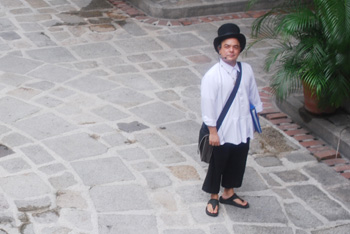
I was first introduced to Filipino history in 2009 by Carlos Celdran, the self-styled ‘Pied Piper of Manila’, his diminutive figure and larger-than-life character dressed up in Nineteenth Century top hat and tails. Every week, Carlos takes tourists and locals around Manila’s handful of historic buildings – those that survived World War II – and treats them to, not so much a tour, as a piece of stand-up political theatre.

Continue reading “Filipino history and the 'Pied Piper of Manila'”

Full house: former street children in Manila

Mary with Butch at his home in Binondo, Manila’s Chinatown.
Photo © Andy Brown/2011/Philippines

Last year I visited Manila, capital of the Philippines, with photographer Sharron Lovell to document a day in the life of three children, for the launch of the new UNICEF UK website. One of them was thirteen-year-old Mary (not her real name) who lived with her family on the street outside Starbucks, where her mother ran a cigarette stall. Back then, Mary spent her days working on the stall or looking after her younger sisters, and her nights hanging out on the streets with other street children, many of whom ‘did rugby’ (sniffed solvents).

Continue reading “Full house: former street children in Manila”

Educating Sally: a street child goes to school

Sally with her mother Grace.
“I don’t want Sally to be illiterate or to drop out of Grade 3 like I did,” Grace says.Photo © Andy Brown/2011/Philippines

The Philippines will always have a special place in my heart. I lived and worked here for three months in 2009, following Typhoon Ketsana and the flooding of Manila. It was my first overseas posting and I was captivated by the friendly, outgoing people, the colourful chaos of the cities with their brightly decorated ‘jeepneys’ (public buses made from converted army jeeps), and the unspoilt natural landscapes of the islands and mountains.

One of my tasks back then was to collect photos and stories of children living on the streets of Manila, to feature in UNICEF UK’s ‘Put it Right’ campaign, which aimed to raise awareness of children’s rights and money to protect them. One girl who featured heavily in the final material was three-year-old Sally, along with thirteen-year-old Mary and fifteen-year-old Crisanto (not their real names). Although this time I was in the country to help UNICEF Philippines develop a digital communications strategy, I took the opportunity to revisit the three children and see how they were getting on.

After a morning in the office, I made my way to Childhope Asia Philippines, a local charity supported by UNICEF that works with street children. Childhope is run out of an old Spanish villa in Paco, a district of Manila. The road outside was potholed and lined with posters from local politicians wishing residents a ‘Happy Fiesta’. Inside, the villa was full of faded grandeur – high ceilings, teak wood panels, antiques and oil paintings. An administrator worked on an old typewriter surrounded by paper files, while electric fans thudded rhythmically, moving hot air around the room. Above the bay window hung an alternative take on Da Vinci’s ‘Last Supper’, with the disciples replaced by Filipino street children.

Continue reading “Educating Sally: a street child goes to school”

A Day in the Life: Mary's story

Thirteen-year-old Mary (not her real name) lives and works with her family on the streets of Manila, capital of the Philippines. The family occupy a corner of the pavement outside Starbucks in Binondo Square, where they sell cigarettes and newspapers, cook and eat, and sleep outside at night. Mary works with her mother on the family stall and looks after her younger sisters. She’s been out of school for three years.

The family have been forced onto the streets because of poverty. “We have a house in Cavite, south of Manila, but there aren’t enough opportunities there to earn a living,” Mary explains. “That’s why we live on the streets in Binondo. We’ve been here for three years now. My mother works as a street vendor, selling cigarettes, snacks and newspapers. My stepfather is a community guard and my older brother drives a pedicab. My younger brother Jun-jun is a jeepney barker – he hails buses and taxis for passengers”

Although they no longer live there, the family still pays 500 peso (£7.30) a month in rent on their house. “Sometimes we don’t have enough money to pay the rent, which is why we don’t have anything to sell,” Mary says. “Whatever we earn is just enough to buy my stepfather’s medicine. He needs a lot of medicine because he has diabetes and a heart condition.”


Working life

Mary has a busy daily schedule. “In the mornings I help my mother out,” she says. “After waking we tidy up, then I boil some water. After that I go with Mama to buy her wares. Then I take care of my younger sister. My friends are Love, Cecile and Mariel. They cheer me up when I’m sad. They make me laugh or they say: ‘Forget your problems for a while, let’s go and swim in the river’.”

Children from the Binondo area often swim in the Pasig River, which runs through the centre of Manila. They challenge each other to jump off a road bridge above the river. After a typhoon, they come to the river to catch fish that have escaped from damaged fish pens further upstream.

“When evening comes I hang out with my friends but they sometimes do rugby,” [a Filipino term for sniffing glue], Mary continues. “Now I spend more evenings helping Mama and sleeping with her. We have to wait for Starbucks to close so we don’t get to sleep until after midnight.”

Life on the streets presents many challenges for children like Mary. “The main problems for me are not having a place to stay and not being able to go to school,” she says. “I used to go to school even when we lived on the streets, but one day when I was in the third grade, I asked Mama to go with me to school to claim my report card. It’s a requirement that the parent be there.

“I had no idea that my little sister would go missing that day. When we returned home, she was gone. She was missing for four days until she was found by a social worker. It turns out that two kids took her while we were away. They even put her in a sack. After that, my stepfather wouldn’t let me go school anymore. He said many hurtful things to me and I ran away because I was so upset.”

http://www.flickr.com/apps/slideshow/show.swf?v=104087

Given a chance

Mary attends street education sessions run by Childhope Asia Philippines, with support from UNICEF. “I like all of the sessions, particularly the life skills education and the choir practice,” she says. “Its fun to be in the choir because you learn to sing and you get to express the problems you carry in your heart. Sometimes, I wish they would teach choir every day instead of just Wednesdays. The life skills sessions have taught me how to plan for my future to achieve my ambitions and dreams. Everyone has a dream and street children are no different. Even animals dream of eating good food.”

Mary is now a Junior Advocate for children’s rights. “We teach other children about gender sensitivity, life skills and substance abuse,” she explains. “I used to sniff glue because I thought it would help me forget my problems. But I was wrong, it added to my problems. It stopped me from studying. If I can go back to school and finish my studies, I’d like to be a reporter. I’ll be able to solve problems and help support my family. And I can tell other people what’s going on. I’ll be able to offer assistance when a child goes missing.”

Despite her problems, Mary is positive about life. “I’m happy here, in a way, because we have enough to eat and I have lots of friends,” she says. “But we’re dependent on my stepfather and he often gets ill. What would happen to us if he’s no longer around? Sometimes I think about going to a shelter because I know that it would be better for me there. But I don’t want to leave Mama. I have a responsibility to her and to my brothers and sisters.”

Mary is thankful for the chance she’s been given to continue her studies. “I’m grateful to Childhope because they are able to help children finish their education,” she says. “They teach us and show concern for us. They treat us like family, not like strangers. I’m also grateful to Butch, our street educator, because he patiently guides us no matter what the time. Even if it means he goes to sleep late and has to wake up early for work the next morning, he still comes and finds us.”

Upholding child rights

UNICEF is helping children like Mary get a basic education, talk about their problems and, ultimately, get off the streets and back into school. The programme works on three levels: on the streets, where outreach workers get to know the children and win their trust; in shelters, where children can stay and attend school; and in the community, where local ‘barangay’ councils respond to issues affecting children.

We’re supporting Childhope Asia Philippines, which employs street educators like Butch. They go out onto the streets of Manila and make contact with the children. They provide counselling and basic education through alternative learning sessions, help the children access information and services, and ultimately motivate them to give up life on the streets. UNICEF provides training and materials for the street educators and food for children who attend the sessions.

For children like Mary, life is an ongoing battle where their rights are denied on a daily basis. However, through the work of UNICEF, Childhope Asia Philippines and street educators like Butch, there is hope that at least some children will escape this vicious circle and start enjoying their right to a full and happy childhood.

A Day in the Life: Crisanto's story

Fifteen-year-old Crisanto (not his real name) lives at Pangarap Shelter for Street Children in Manila, capital of the Philippines. He ran away from home when he was nine because his father was an alcoholic and would beat him when he got drunk. Crisanto lived on the streets for two years. During the day he would earn money by snatching bags and phones or scavenging rubbish for recycling. At night, he slept in a cemetery with a gang of other boys.

“We were very poor and my parents were always fighting,” Crisanto remembers. “When my father got drunk he would hit me. It started when I was six years old. He did it just because he felt like it – he wasn’t himself when he was drunk. That’s when I began thinking I was nothing more than a burden. A few years later I decided to run away.

“After that I lived in Sangandaan Cementery. It was very dangerous. I was in a gang and the other boys made me do rugby [a Filipino term for sniffing glue]. The gang would steal things like mobile phones and we would scavenge for plastic bottles and electric wire. We would sell recyclable materials to junk shops to get money for food or drugs. You could buy a cup of rugby for 5 pesos. I didn’t get hungry when I sniffed rugby.”


There were lots of problems on the streets for children like Crisanto. “I got into a lot of fights back then and I would get chased by policemen,” he says. “I would get dizzy from hunger and sick with eye infections. I couldn’t afford to buy any medicine when I was sick. I would beg for drinks from canteens and wash in the public toilets. Studying didn’t even cross my mind. I didn’t know I could go to school.”

Movin’ on up

Things started to get better for Crisanto when he met Elvie, a street educator from Childhope Asia Philippines. “Elvie came to the cemetery where I lived and we’d go to a quiet place to talk,” Crisanto says. “We talked about my life on the streets and about children’s rights. That’s when I became interested in pursuing my education.”

Elvie brough Crisanto to Pangarap Shelter, which is run by Pangarap Foundation with support from UNICEF. The shelter offers a homelike atmosphere for boys who are unable to return to their family homes and gives them the opportunity to go back to school. “I first came to Pangarap Shelter in 2006 but I ran away because some kids were being mean and bullying me,” Crisanto says. “I went to another shelter, Kuya Centre, where I stayed for three years and went to school. Then I came back here to Pangarap.”

At first, Crisanto had trouble fitting in at the shelter. He would get into fights with the other children. He felt he had to be tough, like when he was on the streets. But he’s calmed down since then. Now, he likes to study and help other boys with their homework. He’s more playful and smiles more often. “I feel happy here because I can study again,” Crisanto says. “I have a new life and can be like a normal child. I like the activities here and the resilience sessions. This is a program to keep us from going astray. It gives us greater strength and guidance as we grow older.”

The shelter also has a workshop where the boys can earn money by making candles for sale. “For every candle you sell, you get 20 per cent of the price,” Crisanto explains. “I use the money if I need to buy something or I give it to my mother when I go home. I visit my family every three months. I’m happy when I’m at home because I’m with my Mama again and she knows that I’m back in school.”

http://www.flickr.com/apps/slideshow/show.swf?v=104087

Time for class

Crisanto leaves the shelter every morning and goes to a local school, Pasay West, with other boys from the shelter. “I’ve been coming here for one year,” he says at the school. “I’m happy here. My friend Arvin from the shelter is in the same class as me. I like learning about the history of the Philippines and finding out how things came about. My favourite sport is badminton because it’s fun to play and I often win.”

“I’m happy because I’m studying again after staying on the streets for so long. I’ll get my high school certificate in two years. When I’ve finish studying I can get a job and help my Mama. I’ve met a lot of people here and I’ve gained new inspiration.”

When classes finish, Crisanto comes back to the shelter for lunch. Afterwards, he does his homework and daily chores, then he has free time to play. “I practice dance moves every evening with my friend Arvin,” he says. “We watch videos on MTV and make up our own moves. Even though we’ve got exams, we still want to have a quick practice before revision.”

Crisanto’s parents are now separated and his father has left home. His mother works at a denim factory but is still very poor. Recently, Crisanto went with his mother to see his father. He was surprised because his father was not as big as he remembered and he wasn’t afraid of him anymore. “My father apologised for all the things he did to us, like hitting me,” he says. “I’ve forgiven him and I feel much better now. My family is my motivation to have a better life. I want to lift them out of poverty.

“I’ll leave Pangarap Shelter when I have a good job,” Crisanto continues. “I’ll only go when they know I’m okay and I can really fend for myself. I’m contemplating two choices: going to college to study accounting or becoming a sailor and travelling the world. I’d like to go to Beijing and see the Great Wall of China. Then I’d like to come to the UK and see what it looks like, the way of life, and if there are any street children there.”

Gimme shelter

UNICEF is helping children like Crisanto get an education and reintegrate into their families and communities. We’re supporting Pangarap Shelter with clothes and bedding for the children, as well as training and education materials for the social workers, teachers and psychologists who staff the centre. We also support Childhope Asia Philippines, which employs street educators like Elvie. They do outreach work with children who are still living and working on the streets.

Ultimately, the aim is to return children to their families or to a foster home. The family receives livelihood assistance, counselling services and parenting skills training. Social workers work with the parents to make sure they’re prepared to assume parental responsibilities, particularly if the child has had negative experiences in the past.

For children living and working on the streets of Manila, life is an ongoing battle in which their rights are denied on a daily basis. However, through the work of UNICEF and Pangarap Foundation, children like Crisanto have been able to escape this environment and start enjoying their right to a full and happy childhood.

Philippines diary: Gimme shelter

Efren, 11, lost three fingers in a flour grinding machine
© UNICEF UK/Philippines 2009/Sharron Lovell

In my penultimate week in the Philippines, I returned to the streets of Binondo to revisit the street children living and working around the night market. This time, I was joined by Sharron Lovell, a Shanghai-based photographer, who had been commissioned by UNICEF UK to take photos of street children for a fundraising campaign. My role was to collect the stories of the children she photographed.

We were reunited with Butch from Childhope Asia Philippines, who was very happy with the photos and story I sent him from our previous trip together. We arrived in Binondo at around 3pm and started looking for Butch’s students. In the end we were out on the streets for eight hours, interspersing our time photographing children with refueling stops at Jolibee (the Filipino equivalent of MacDonalds) and Starbucks, where I quizzed Butch for details of the children’s case histories.

I was amazed by how much information he had in his head, not just about the kids but about their parents, some of whom were also former students of his. “I have thousands of case histories in here,” Butch said, taping his forehead.


In the month since our last trip, Butch had won a ‘Filipino hero’ award on C/S 9, one of the Philippines’ most popular TV channels, in recognition of his many years working with street children. As a result, almost everyone now knows him – from the street kids who call him ‘Papa Butch’ to the customers in the coffee shops and restaurants who asked for his autograph or had their photo taken with him.

One of the many children we met that night was 11-year-old Efren (not his real name), who lives on the streets with a group of friends. Earlier this year, he dropped a one peso coin (1.3 pence) in a flour grinding machine. When he put his hand in to get it back, he lost three fingers. The stall owner paid for Efren to go to the hospital but he couldn’t afford to pay for medication, so the wound got infected.

Efren hasn’t been home since February. His older brother came to Butch and asked him to look out for him on the streets. Butch found him in July, by which time his hand had become infected. “I’d been looking for him for months, then one day he just turned up at an education session,” Butch commented. “By that point his hand smelt really bad.” Childhope Asia arranged for Efren to go back to hospital and get a skin graft, and is now paying for the antibiotics he needs. Butch gives him medication twice a day and changes his dressing every three days.

Efren still comes to the street education sessions with his friends but he’s a slow learner. Butch is trying to persuade him to go to a shelter so he can be properly looked after. Efren doesn’t want to go home. His family live in the port area where his father used to run a delivery business. “Last year his father sold his kidney for 70,000 pesos. Now he’s too ill to work,” Butch says.

Despite his injury, Efren is an outgoing, playful child. He was very active, running and jumping all over the place. He showed off his injured hand, which was red and raw and shaped like a deformed claw, and tried to gross out his friends with it. “It’s a good sign that he plays with his hand,” Butch explained. “It means that he’s accepted what’s happened to him.”

A new hope

Carl, 13, ran away from home after being abused by his father
© UNICEF UK/Philippines 2009/Sharron Lovell

The next day, we visited Pangarap Shelter for Street Children, where Butch refers those of his students who tell him they want to stop living on the streets. The centre, which is staffed by social workers, house parents, teachers and psychologists, offers a homelike atmosphere for former street boys who are unable to return home. While at the shelter, they can attend school and there is a workshop where they can make candles and beads for sale in the shelter’s shop, earning a share of the proceeds.

Unlike government-run ‘rescue’ programmes, children go to these shelters voluntarily and are free to leave at any time. UNICEF is supporting Pangarap with educational materials, clothes and bedding for the children and training for the teachers and social workers.

At the shelter, we attended a group therapy session, where a dozen boys talked through their experiences, facilitated by a child psychologist, also called Sharon. Afterwards, I interviewed five boys, including Carl, 13, who used to live with his mother and sister at a brothel. His sister ran the bar while his mother did the cleaning and housework. There were lots of strippers and prostitutes living there and he found it very difficult to study.

His father, who has since left home, used to physically abuse him. He would put him in a sack and hang him upside down from a tree. Then he would beat him with a stick. Carl told Sharon that his father put holes in the sack so he could hear him scream but he tried to keep silent because he didn’t want to give him the satisfaction. “I think the holes might have been there so he could breath,” Sharon says, “But that’s not the way a child views it.” Either way, it’s a horrific story.

“I ran away from home because I felt imprisoned there,” Carl said. “It was always chaotic and my parents would fight about money. After I left, I sold plastic bottles for a living.”

Carl is happy to be at the shelter. “I’m able to study here and I can stand on my own two feet,” he commented. “My favourite subject is Maths. I want to be a ship engineer and go to different countries. Most of all, I want to go to Australia because Mr Bond is made there. It’s my favourite brand of coffee – it tastes so good.”

Carl also enjoys the group therapy sessions with other boys. “We’re given advice so we can finish our studies,” he added. “We’re taught not to steal and to enjoy ourselves.”

After the session, we went downstairs to the recreation area where the boys played basketball and other games. One group of teenagers was setting up a scrabble board and invited me to join. I tried to find words that were relevant to the Philippines, starting with ‘jeep’, then ‘beach’ and – more controversially – ‘steal’. “This is what you’ve been taught not to do,” I said to laughter.

I’d previously noticed that male Filipino youths show their affection for each other by walking with one person’s arm across the other’s shoulder. As I was playing the game, Carl came over to watch and put his arm over my shoulder in the same way. It was a touching moment for me as it meant that even after our brief acquaintance, he considered me a friend.

Birthday boy

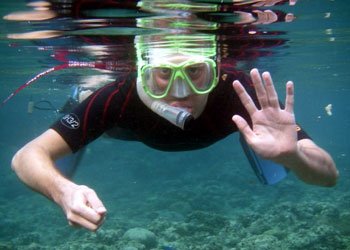
Enjoying the underwater world in Anilao

This was also my birthday week. I was born in November, so I’ve always been slightly jealous of people with summer birthdays and it was a nice change to spend it in the Philippines.

On my actual birthday, I went out with assorted friends and colleagues to ‘The Filling Station’, a 1950s-style diner. Every spare inch was filled with memorabilia, from framed portraits of the Rat Pack, to superhero statues and an antique juke box (non-functioning). We ate ‘crispy pata’ – a traditional Filipino dish made from pig trotters – played pool and took comedy photos with the statues.

At the weekend, I went on diving trip to Anilao on a sheltered bay south of Manila with Martijn and Erik, a Swedish friend of Martijn’s who’d come over to visit. We arrived at the diving centre by boat, traversing clear, still water like that of the Mediterranean but teeming with tropical life. The resort was perched on a rocky ledge over a coral reef in a marine reserve, with sheer cliffs rising vertically behind it.

We did four dives and snorkeling trips over the course of the weekend. I remember underwater scenes of astonishing beauty. There were brightly colored corals and shoals of tropical fish everywhere you looked. Long slender needle fish swam together in a line, while a dozen batfish floated lazily in the shade of a coral chimney.

There were enormous purple giant clams tethered to the bottom of trenches formed by the coral and camouflaged scorpion fish, which looked exactly like barnacle encrusted rock until they moved. At the edge of the reef, the sea floor dropped off into a hypnotic, dark blue immensity below.

Not for the first time, I marveled at how easily we think of the world as comprising everything above water, remaining unaware of the second, magical world that exists just the other side of the water’s surface.

Philippines diary: Iron man

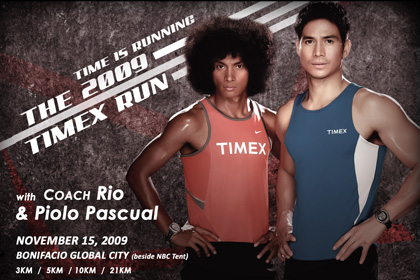
A detail from the promotional flyer for the Timex ‘Iron Man’ race
© Timex/RunRio

Sunday 15 November began early, as I met Gina at 4:45am to get a taxi to Fort Bonifacio, the starting point of Manila’s Timex ‘Iron Man’ race. Part of the proceeds of the race were donated to a UNICEF school project.We started at 5:30am, just as the sky was starting to lighten. The first half of the race was easy enough, despite climbing a flyover with sweeping views across the slums and skyscrapers of the city. Things got trickier on the way back though, as the sun brought with it a noticeable increase in heat and humidity, but I finally sprinted across the finish line in 58 minutes.

After a quick change of clothes, the sporting theme continued with the world welterweight title boxing match between Filipino Manny Pacquiao and Miguel Cotto, the reigning champion. I’m not normally a huge boxing fan but it was impossible not to get caught up in the enthusiasm for the event.

The importance of this match for Filipinos cannot be underestimated: Pacquiao is a national hero with an amazing life story. He started off as a street child, similar to those I met in Binondo, skipping school to help his single mother sell vegetables on the roadside in General Santos City, Mindanao. Even with his help, his mother still wasn’t earning enough to feed six children, so Manny left home at 14 to go to Manila, where he worked as a laborer and became an amateur boxer.


Fast forward 14 years and Pacquiao’s face glowers out of the cover of Time Magazine, as he aims to become the first boxer in history to win world titles in seven different weight categories.

For the first two rounds, the fight seemed equal but it all changed in the third round, when Pacquiao knocked Cotto down with a flurry of blows. The venue erupted as everyone cheered wildly, threw confetti in the air and hugged their nearest neighbor. The fight continued into the twelfth round, but it was increasingly obvious that Pacquiao had won the belt and world record he sought.

Chain of command

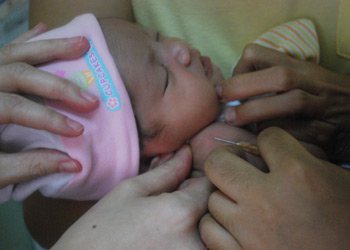
Twelve-day-old Danica receives her BCG vaccination
© UNICEF Philippines/2009/Andy Brown

Back in the office, I spent my time getting the website ready for the 20th anniversary of the UN Convention on the Rights of the Child (CRC), an event with huge significance for UNICEF.

I also visited two projects: one on immunization and another on children living and working on a rubbish dump in Payatas. For the immunization project, I visited a health centre in Manila where mothers, and in some cases grandmothers, brought their babies to receive vaccinations against diseases like measles, diphtheria and tuberculosis.

I also saw Manila’s main cold room, where the city’s vaccines are stored, and met Rolando, the cold chain manager for Manila. An engineer by trade, he is now the Philippines’ leading expert on storing and transporting vaccines. He’s spent the last twenty years ensuring that they’re kept at exactly the right temperature to preserve the delicate biological material inside each tiny vial.

Rolando told me about the challenge of delivering vaccines in the aftermath of Tropical Storm Ondoy. “We had to use military trucks and boats to get the vaccines to the evacuation centres,” he said.

Below the poverty line

My second project visit of the week was to Payatas, Quezon City, where a community of 200,000 people live alongside, and in many cases work on top of, the city’s main rubbish dump. Driving into the slum settlement, you cannot escape the spectre of the dump, which looms above the ramshackle houses like a sacred mountain to some twisted deity.

The town is a stark illustration of the economics of poverty. The main road is lined with ‘junk shops’ that buy plastic, metal, paper and glass by the kilo, for sale to massive recycling plants in southern China. The junk shops take all the profit and none of the risk, typically turning over millions of pesos a year while paying a pittance to the desperate dump workers.

Children risk their lives every day scavenging the dump site for the quantities of recyclable materials needed to make a living. They are at risk of diseases such as respiratory infections, pneumonia, diarrhoea and tuberculosis. The dump itself is unstable and parts of it can collapse in heavy rain, burying workers and their homes beneath the rubbish.

There are also dangers from the vehicles and machinery. “The sister of one of our students died recently after being run over by a garbage truck,” Helen from UNICEF’s partner organisation Kokkyo Naki Kodomotachi says. “The driver didn’t see her because she was so small. She was only nine years old.”

In the last year, things have got even worse for these children and their families. The global economic crisis has caused many of the Chinese recycling plants to close, reducing demand for the scrap materials. The junk shops have responded by slashing their prices by up to half. This means the children have to spend twice as long on the dump site and carry twice as much rubbish up the hill to the junk shops, just to earn the same meagre amount.

“Tin cans have gone down from 25 peso to 15 peso per kilo, plastic cups from 12 peso to 5 peso and clear plastic from 2 peso to 1 peso,” Helen says. By way of comparison, a single can of Coke costs 25 peso in a 7-Eleven store in Makati city.

The living conditions are scarcely better than the working environment. Slum houses, often made of materials scavenged from the dump, are crammed together right up to its edge. The border between the dump and the town is porous and the rubbish finds its way into the town, where it lines the streets and clogs the waterways. The town does have electricity but no running water or proper drainage. The smell of the dump lingers over everything, getting into clothes and hair, so that even those children who are lucky enough to go to school face discrimination from their peers.

“Hard up families live in Payatas as an option to survive,” UNICEF’s Jess Far says. “These are the poorest of the poor.”

Alternative learning

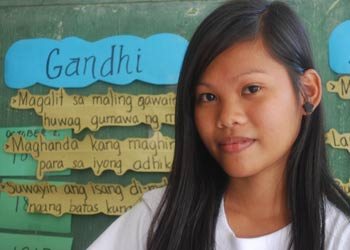
Michelle, 16, attends a UNICEF-supported education session in Payatas
© UNICEF Philippines/2009/Andy Brown

UNICEF is supporting Kokkyo Naki Kodomotachi (KnK), a local NGO that provides alternative learning sessions for children in Payatas whose parents can’t afford to send them to school. They have two classrooms: one by the old dump and one by the new, larger dump. This is partly to make it easier for the kids to come to class from work but also for a more sinister reason. There are gang wars between rival factions working the two dumps and children get caught in the middle. One family we visited has a daughter with brain damage caused by a stray bullet from a gang-related shooting.

We visited both centres. The first centre was holding an elementary class, although you wouldn’t know it from the age of the children there, many of whom were already teenagers. In the afternoon, we saw a high school class at the second centre, where Michelle, 16, delivered a presentation about Ghandi. Encouragingly, children who attend regularly can sit an exam and get a qualification which is now recognised by the department of Education as equivalent to a high school diploma. Less encouragingly, the pass rate is around 25 per cent.

“I’ve been coming to the learning sessions for ten months,” Michelle says. “I liked reading the story of Gandhi because it made me realise that you have to strive to be able to reach your dreams. I’m very thankful to KnK for giving me the opportunity to complete my studies and to integrate with other students.”

The visit made a deep impression on me. In the UK, we’re used to thinking of recycling as a good thing and of course in many ways it is. But now every time I put my rubbish down the garbage chute in my apartment block, I think of a child picking up my empty water bottle and putting it towards their next kilo of plastic, for their next two pesos.

Happily, the week ended on a high point as Philippines President Gloria Arroyo signed a bill making child pornography illegal, in a major victory for UNICEF and other child rights advocates. UNICEF Philippines has been campaigning on the issue for several years and had specifically called for the law to be passed before next year’s national elections.

I was able to write this up as the lead news story for the website, as we marked the anniversary of the CRC on Friday. Much work remains to be done on child rights but it was a timely reminder of what has been achieved by UNICEF and its partners in their ongoing struggle to achieve a world fit for children.

Philippines diary: In the path of the storm

Arries Tejo, 15, at an evacuation centre in Cubao
© UNICEF Philippines/2009/Andy Brown

At the end of last week’s diary, I was heading home on Friday night with the tops of the tower blocks disappearing beneath a shroud of rain and cloud, the wind starting to whip up and a distinct sense of trepidation as Typhoon Santi stormed directly towards Manila.

I’d witnessed a hurricane before, in Cuba in 2005. That time, I remember spending half the night in a hotel bar in Havana, drinking rum and playing cards while the wind beat on the boarded up doors and windows. It was like something out of John Huston’s 1948 film noir classic, Key Largo. The next day, the street outside was flooded waist deep and you could see waves crashing over the sea wall and against the lighthouse in Havana bay.

This time, the storm was due to pass directly overhead in the early hours of the morning. As a precaution, I moved my bed from under the window to behind a wardrobe in the lounge area. I slept through most of the night but woke up at 6am, with the wind rattling the windows and the electricity out. I took a quick look out of the window to see trees bent almost double but still rooted to the ground. There was, thankfully, no sign of further flooding.


By 10am the storm was over and I was checking in with UN Security. I also spoke to Martijn, my colleague from the education department, who told me that the head of UNICEF Philippines, Vanessa Tobin, had already been on BBC News. Once the power was back on, I was able to do a bit of research and put together a news story for the website.

According to early reports, slum houses had been destroyed by strong winds Taytay, Rizal province, leaving around 5,000 people homeless. There were also reports on local radio that one man had died while crossing a river in Rizal, and another had drowned when his home was washed away in Manila.

“The reports from Manila are not as bad as had been expected,” Vanessa said. “But we are getting reports from the South, particularly around Bicol which was hit in 2006 by mudslides, that there has been heavy rain and significant damage there.”

After the flood

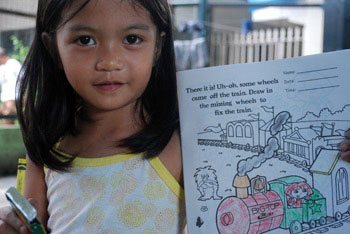
A young girl displays her colouring at the evacuation centre
© UNICEF Philippines/2009/Andy Brown

Next week, I’ll be visiting the province of Camarines Norte, partly to assess the damage caused by Santi, but in Manila the focus remains on the victims of Tropical Storm Ondoy.

On Wednesday, I visited an evacuation centre in a former basketball court in Cubao, Quezon City. The centre is currently home to around 40 families, down from 100 in the immediate aftermath of the floods. When we arrived, it was still hot, humid and crowded. The families live literally on top of their belongings with their clothes hanging to dry from the basketball hoops above. They are either waiting for new homes or for the Government to provide transport back to their home towns in the provinces.

For the last five weeks, Arries Tejo, 15, has been living with his mother, three brothers and two sisters in Barangay Bagumbayan evacuation centre. “After the storm came, we were trapped in our house by the flood water,” he said. “We had to wait until the next day for the water to go down enough for us to leave. Then we carried out our belongings and walked to the evacuation centre.”

In many ways, Arries had a lucky escape. “Our house was next to the concrete wall of a factory,” he explained. “After we left, the wall collapsed and destroyed all the houses on our road. Now we have to wait here for a new house.”

UNICEF is working with local charities to provide child-friendly spaces, education and psychosocial support to children like Arries in the evacuation centres. In Barangay Bagumbayan, we have partnered with Lingap Pangkabataan (Caring for Children), a faith-based organisation that was already working in the area with street children, indigenous communities and the victims of child trafficking.

Staff at Lingap saw firsthand the impact of the disaster on children in the area. “After the flood the children were traumatised,” Project Officer Rexan Dayad said. “Some of them are orphans; others have been left behind by their families. Many of the children have no access to healthcare and cannot go back to school because they have lost their school supplies and uniforms. There are children that sleep on the streets, even during the afternoon, because there are no activities for them. We are advocating for their rehabilitation.”

At the evacuation centre, Lingap outreach workers ran several sessions simultaneously. One group of girls got crayons and colouring books, while boys listened to a story, then learnt and sang songs. Older children took part in a more advanced music group with xylophones. A fourth group made birds out of coloured clay. “These activities allow children to rediscover their world in a protected and supervised environment,” Project Coordinator Cathyrine Eder commented.

There is still a lot of work to be done, particularly with children and families who were unable to get to the evacuation centres. “In those areas we haven’t yet reached, there are children who are afraid their community will be flooded again when it rains hard,” Cathyrine added. “Every time it rains they start putting their things on plastic bags. There are also children who wake up in the middle of the night because they’re having nightmares.”

Pied Piper of Manila

Carlos stands in the courtyard of Casa Manila, a reconstructed
Spanish colonial house. © UNICEF Philippines/2009/Andy Brown

The next weekend, I got a chance to do a bit of sightseeing. I met up with Martijn and Silje, my colleagues from Holland and Norway respectively, to go on a walking tour of Intramuros, the old Spanish fort at the centre of Manila. Our guide was Carlos Celdran, the self-styled ‘Pied Piper of Manila’, famous for his irreverent and theatrical take on Filipino history. Lonely Planet describes him as “the best thing to happen to Manila tourism in decades”.

Carlos arrives outside Manila Cathedral at 9am in shorts, an immaculate white shirt and top hat, with a stereo playing patriotic music. He’s small man with a larger than life character. Martijn says there’s a Dutch word that translates as ‘pleasantly insane’ which sums him up, however I’m sure it’s at least partly an act. The tour is as much stand up comedy as anything else, with Carlos changing characters for different periods, swapping his top hat for a military cap and glasses or Uncle Sam hat, as befits the narrative.

Carlos takes frequent pops at Catholicism, a potentially controversial approach in such a devout country. He tells us that in Tagalog, the word for ‘heaven’ comes from the Malay for ‘sky’, while the word for Hell is the Spanish ‘Inferno’. “This tells us that there was always Heaven in the Philippines, but Hell arrived with the Spanish.” he jokes.

Nothing is sacred. US General McArthur, who ‘liberated’ Manila from the Japanese at the end of the civil war by carpet bombing the city, contributing to the deaths of 150,000 civilians, comes in for a particularly savage mauling.

Even the Philippines’ national hero, Jose Rizal, whose 20 foot statue dominates the lobby of my office, his giant quill poised in mid air, gets a gentle ribbing. Carlos says Rizal was chosen as national hero by the Americans because he was a writer, not a revolutionary, and above all safely dead – having been executed by the Spanish in 1896 for writing two subversive novels Touch Me Not and The Reign of Greed. This is true but only in the same sense that Karl Marx was a writer not a revolutionary. After all, Rizal’s ideas and subsequent execution were the trigger for the first nationalist uprising against the Spanish.

Rizal remained an intellectual to the very end. “I am most anxious for liberties for our country,” he wrote on the eve of his execution. “But I place as a prior condition the education of the people so that our country may have an individuality of its own and make it worthy of liberties.” Inspired by our history tour, I later bought a copy of ‘The Noli’, as Rizal’s first novel is popularly known by Filipinos, to read on the road next week.

During the tour, Carlos sums up Filipino culture with the metaphor of the ubiquitous jeepney. These are clapped-out American jeeps, covered with Catholic slogans and Chinese good luck symbols. Like the Filipinos themselves, they’ve taken something from every culture they’ve come into contact with but combined it to make something uniquely their own.

Philippines diary: Learning the hard way

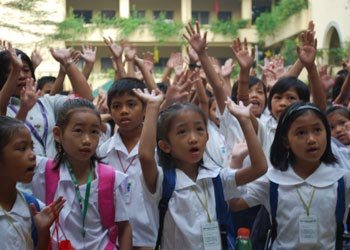
Children wave at a morning assembly on their first day back after the floods
© UNICEF Philippines/2009/Andy Brown

If my first week in the Philippines could be described as relatively uneventful, the same certainly can’t be said for the second. I saw a school reopening for the first time since the floods, I met street children in Chinatown, watched the government being held to account over child rights and ended the week barricaded in my flat in the path of an oncoming typhoon.

My week started at 5:30am on Monday. I was up, not necessarily bright but certainly early, to go to Pinagbuhatan Elementary School, which was opening for the first time following the devastation caused by Typhoon Ketsana. For children who had been through the stress of losing their homes and in some cases loved ones to the floodwaters, it was to be a welcome return to normality.

It took us a while to find the school and by the time we arrived the assembly had already started. Hundreds of children in clean and pressed uniforms thronged a large courtyard in the middle of the school. I was summoned to the stage and made my way through a press of small bodies to the front.


Again, perhaps by virtue of my status as a celebrity foreigner, I was asked to address the school. Feeling a bit of a fraud, I complied. I haven’t had to speak in front of so many children since I ran as the Labour candidate in my own school’s mock election back in 1990. This time, my speech was far shorter and much less political.

Towards the end of the assembly, the children were presented with school kits in UNICEF backpacks. Finally, my colleague Arnaldo from the education department, universally known as Ar-ar, led a puppet show for the children, with four puppets in the style of Sesame Street. It was great fun but there was also a serious point to the exercise, as Ar-ar explained to me later.

“Children love puppetry and are very receptive to it,” he said. “So this morning, before the assembly, we talked to the children about their experiences and how they felt. We put all of that into the story of today’s puppet show. We also talked to the teachers about using the puppets later on to tackle health, nutrition, water and sanitation issues.”

After the assembly, I interviewed the Principal, Iluminado Leno. “All our classrooms were damaged in the flood, along with the canteen and the clinic, and all the equipment was swept away,” she said. “We sent teachers to the evacuation centres to continue lessons wherever possible. We are happy and surprised by how many pupils came back today and hope even more will come tomorrow. This will help them forget their distressing experiences.”

Finally, I tried to talk to some of the children but they were too shy to say much. I think I need to work on my interviewing technique. Ar-ar recommends using puppets! One thing that strikes me is the contrast between the UK, where a lot of children take school for granted and can’t wait for a chance to skip it. Here the opposite is true. Filipino children really value education and will overcome great barriers to get it, as I was to see even more starkly the next day.

“After a disaster, children are sent to evacuation centres and often they’re just sitting there all day with nothing to do,” Ar-ar said. “When we asked them how they feel, the children would say ‘I miss my teachers; I miss my classmates; I lost my school bag; I want to go back to school.’.”

Under pressure

Butch with Mary. He hopes to get her back into school soon
© UNICEF Philippines/2009/Andy Brown

On Tuesday, I hooked up with Jes from UNICEF’s child protection department and went to see an amazing project that’s bringing education and life skills counselling to Manila’s most vulnerable people: the street children.

The project is run by a local charity called Childhope Asia Philippines, which operates out of an old Spanish colonial villa. The Spanish ran the Philippines for over 300 years, from 1571 to 1898, and are not remembered fondly for it. Much of their architectural legacy was destroyed in the battle for Manila between the US and Japan at the end of the Second World War but a few building like this survived.

At the villa, we met one of the charity’s outreach workers. Butch, 47, is a real character. In combat shorts and t-shirt, he still retains some of the style and attitude of the street child he used to be. Butch never knew his parents and ran away from home after his grandmother died. He ended up on the streets, where he led a gang, sold drugs and acted as a pimp for other boys. By the time he was 17, he realised his life had to change.

“We were a group of eight kids and I was the leader,” Butch said. “I was street smart and didn’t trust anyone. But these people, the social workers, they were persistent and really got to know the group. So I said ‘I’m going to try this. Why not? I have nothing to lose’.”

While other street workers educate the children with regular classes, where they learn things like basic maths and literacy, Butch concentrates on counselling, helping individual children work through their problems.

“There is a lot of abuse on the streets,” he says. “In my area there are a lot of market vendors who think that street children are the dregs of society. So they don’t think these kids have rights. Every day, the kids get sick from pneumonia, skin disease and tuberculosis. They are hungry and have to look for food all the time. They don’t have good friends and there are lots of vices around them.”

Butch is strongly motivated to do this kind of work. “It’s more than payback,” he says. “I feel an obligation and responsibility to take care of other people. Certain kids have the inner strength but they need some support from the outside.”

As the light started to fade, we headed into town to the square outside Binondo Church in Chinatown where the street children congregate. We got out of the car into a busy square, surrounded by the hustle and bustle of Manila street life. We’re immediately surrounded by a crowd of excited children who clearly know Butch. They make us press our hands to their foreheads, which is a form of blessing.

Despite their blackened bare feet and ragged clothes, the children seem happy and outgoing. There’s none of the shyness I saw at the school. Several of the kids want me to take their photos and strike up tough street poses. This attitude is belied, however, by their child-like enthusiasm to see the pictures.

Street children play an educational game at a street learning session
© UNICEF Philippines/2009/Andy Brown

One of the other street educators starts a class right there in the street and the children’s attention is diverted. If anything, they’re even keener to learn than the children at Pinagbuhatan Elementary School. As the class starts, other children race across the square to join in.

Afterwards, I talk to Mary (not her real name), 12, who lives and works with her family on the streets of Manila. She helps her mother sell cigarettes outside Starbucks in Binondo (Chinatown) and looks after her younger brothers and sisters. She has been out of school for two years and is under pressure from her peers to sniff solvents. “I don’t want to sleep on the streets anymore,” she says.

After counselling from Butch, Mary is attending the alternative learning sessions, where she is showing academic promise. She’s now decided that she wants to go back to school. “I like learning maths, Filipino and how to take care of my body,” she says. “I want to be a nurse and help people who are sick, like the people who got ill after the last typhoon.”

We’re just round the corner from Starbucks, so afterwards we go and meet Mary’s family. I tell her mother how smart Mary is and show her some of the photos. Later on, I get prints made which I’ll give to Butch to pass on to the children.

This is without a doubt the highlight of my visit so far. I feel overwhelmed by a jumble of conflicting emotions. I’m upset for the children and what they have to go through but inspired by their resilience and by the work that Butch and the other street educators do. Also in the mix is the slightly selfish thrill of getting a really strong story. This is what I love most about my job: finding and telling the stories of these kids, hopefully to inspire others to take action, whether by donating, campaigning or fundraising for UNICEF.

Could do better

On Wednesday morning, I went to a forum to see the Philippines Government and a coalition of non-governmental organisations present their reports on how the UN Convention on the Rights of the Child has been implemented in the Philippines. The consensus seems to be that although the Government has made progress on passing laws to protect children’s rights, it has failed to implement many of them effectively. One particularly shocking practice that is still going on is executing children in some parts of the country for being ‘communists’.

The forum was held in Club Filipino, another colonial era building. Our event is somewhat overshadowed, and at one point literally drowned out, by an event held by Senator Francis ‘Chiz’ Escudero, who plans to run for President next May. He gave a statement to journalists that he was leaving the Nationalist People’s Coalition. In the Philippines, politicians are only loosely aligned to political parties and it’s not unusual for them to jump ship ahead of an election.

On a personal level, my major triumph this week is mastering the jeepneys. I needed a bit of local help to start with but I now know the main routes around Makati and roughly where to get on and off (it’s an inexact science). I also discovered that if you sit towards the front, you’re expected to pass money back and forth between the driver and other passengers. In the Philippines, everyone’s a bus conductor.

I’m already over my word length so I will tell you about the typhoon next week. Suffice to say that I went home on Friday night with the tops of the tower blocks disappearing beneath a shroud of rain and cloud, the wind starting to whip up and a distinct sense of trepidation as Typhoon Santi stormed directly towards Manila.