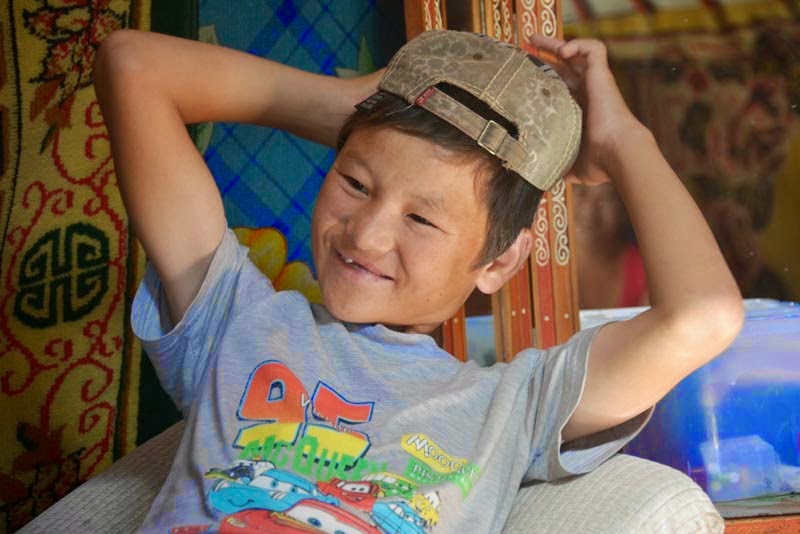
In a ger tent in Ulziit, horse racing capital of Mongolia, 15-year-old former child jockey Budgarav rests on his crutches and adjusts the baseball cap on his head. Four years ago he was thrown from a horse during training and trampled, losing his front teeth and breaking both his legs. “It was very painful when I fell,” he says.
The third and final stage of my Mongolia journey was perhaps the most challenging, with both highs (encountering a caravan of camels) and lows (staying in a horror movie hotel). We were planning to drive south from Tsagaan-Uur to Tarialan soum, but were warned that the ‘road’ had become impassable because of the rains. So we had to take a longer way round.
We passed some amazing sights along the way. We drove through woodland where the ground was sprinkled with brightly coloured spring flowers. When we came out into a meadow, it was so dense with flowers that the grass looked canary yellow instead of green. Later, we saw a large eagle that had just killed a rabbit. It moved along the track away from us, dragging its prey with one taloned foot. It spread its wing to fly but the rabbit was too heavy for it to take off. Given the choice, the bird stayed on the ground and slowly hopped out of view.
Look at a map of Khuvsgul and one feature will jump out at you – Khuvsgul Nuur, or lake. This is a massive 2,760 square kilometre body of water that stretches almost to the border with Siberia. It is the second largest in Asia and one of the oldest lakes in the world, being among just 17 that formed over two million years ago. Mongolians call it ‘ocean mother’ and revere it as the country’s main source of fresh water. It is famous for its clear, drinkable water and blue/green colour.
Mongolia is unlike any other country I’ve been to. For most of the year it’s a frozen wasteland. Temperatures plunge to minus 35, lakes freeze over and heavy snow piles up across the land. Then, for a few brief months in summer, the snow melts and the country is transformed into a land of wide, open grasslands, sparkling lakes and vast green forests under an endless blue sky. I visited in June, when this transformation was nearly complete. The snow had temporarily retreated to the mountain tops, leaving the land clear for people, animals and vehicles.


 Beneath the Baobab