A stitch in time: street children learn a trade

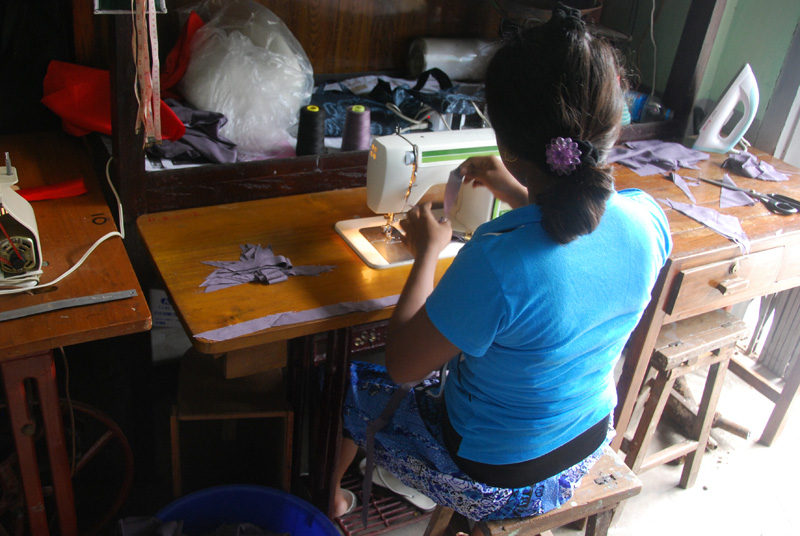
Thanda sews a shirt during the vocational training offered to street children
© UNICEF Myanmar/2012/Andy Brown

Sixteen-year-old Thanda* has spent much of her life living and working on the streets of Yangon, capital of Myanmar (also known as Rangoon, Burma). She is a a Burmese of ethnic Indian descent: a small, serious teenager in a blue polo shirt and traditional longyi skirt.

Thanda’s father is a manual labourer and her mother is a washer woman. She has seven siblings. When the family earns enough, they live in bamboo hut outside town. But other times they can’t afford the rent and have to live on the streets. “I used to pick up garbage with my brothers,” she told me when I met her at a drop-in centre for street children. “We would sell plastic bottles to junk shops for 2 to 4 dollars a day. I never went to school and I didn’t know how to look after my health.”

Continue reading “A stitch in time: street children learn a trade”

Exile on main street: Chiang Mai street children

Four-year-old Tong makes a tie-dye t-shirt for sale in the centre’s gift shop.
Photo © Andy Brown/2011/Thailand

Last week, we took a group of popular Thai bloggers to see projects for marginalised children in Thailand’s Chiang Mai district. After two days visiting orchard schools in Fang (see part two of this blog), we returned to Chiang Mai itself to visit a drop-in centre for street children. Run by the Volunteers for Children Development Foundation, the centre focuses on preventing and supporting the victims of sexual abuse. Many of the street children in Chiang Mai were sold to child traffickers at the Burmese border and brought into Thailand to work in the sex industry. Once in Thailand, these children are considered ‘stateless people’ and are not entitled to identity cards. This denies them the right to education, healthcare and – when they grow up – to legal work.

Continue reading “Exile on main street: Chiang Mai street children”

Full house: former street children in Manila

Mary with Butch at his home in Binondo, Manila’s Chinatown.
Photo © Andy Brown/2011/Philippines

Last year I visited Manila, capital of the Philippines, with photographer Sharron Lovell to document a day in the life of three children, for the launch of the new UNICEF UK website. One of them was thirteen-year-old Mary (not her real name) who lived with her family on the street outside Starbucks, where her mother ran a cigarette stall. Back then, Mary spent her days working on the stall or looking after her younger sisters, and her nights hanging out on the streets with other street children, many of whom ‘did rugby’ (sniffed solvents).

Continue reading “Full house: former street children in Manila”

Educating Sally: a street child goes to school

Sally with her mother Grace.
“I don’t want Sally to be illiterate or to drop out of Grade 3 like I did,” Grace says.Photo © Andy Brown/2011/Philippines

The Philippines will always have a special place in my heart. I lived and worked here for three months in 2009, following Typhoon Ketsana and the flooding of Manila. It was my first overseas posting and I was captivated by the friendly, outgoing people, the colourful chaos of the cities with their brightly decorated ‘jeepneys’ (public buses made from converted army jeeps), and the unspoilt natural landscapes of the islands and mountains.

One of my tasks back then was to collect photos and stories of children living on the streets of Manila, to feature in UNICEF UK’s ‘Put it Right’ campaign, which aimed to raise awareness of children’s rights and money to protect them. One girl who featured heavily in the final material was three-year-old Sally, along with thirteen-year-old Mary and fifteen-year-old Crisanto (not their real names). Although this time I was in the country to help UNICEF Philippines develop a digital communications strategy, I took the opportunity to revisit the three children and see how they were getting on.

After a morning in the office, I made my way to Childhope Asia Philippines, a local charity supported by UNICEF that works with street children. Childhope is run out of an old Spanish villa in Paco, a district of Manila. The road outside was potholed and lined with posters from local politicians wishing residents a ‘Happy Fiesta’. Inside, the villa was full of faded grandeur – high ceilings, teak wood panels, antiques and oil paintings. An administrator worked on an old typewriter surrounded by paper files, while electric fans thudded rhythmically, moving hot air around the room. Above the bay window hung an alternative take on Da Vinci’s ‘Last Supper’, with the disciples replaced by Filipino street children.

Continue reading “Educating Sally: a street child goes to school”

Recipe for success: Delhi children learn to cook

Former street children working in the kitchen at the Butterflies catering school.
© UNICEF India/2011/Andy Brown

The notion of India as a single country is a relatively modern one, forged in the ashes of British rule in 1947. “India is more of a continent than a country,” my colleague Shweta said. “Most people here identify themselves as Punjabis or Bengalis first, and Indians second.” A quick glance at Wikipedia backed up her assertion. India has 28 states, 21 official languages, nine religions and over 200 ethnic and tribal groups.

Continue reading “Recipe for success: Delhi children learn to cook”

Down and out in Delhi: a home for street children

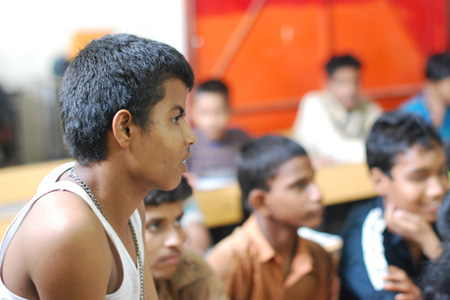
Former street child Suraj listens to an English lesson at the shelter for street children
© UNICEF India/2011/Andy Brown

After our morning at the culinary training centre (see part one of this blog), we went to Old Delhi to visit a night shelter for street children and a community bank. This time, I was training Lalita, Ruchi and Omesh, from the UNICEF India office, in blogging and online video. The afternoon’s projects were again run by Butterflies, a local charity that UNICEF works with on sport and development, including by provide sporting activities for street children during the Commonwealth Games and Cricket World Cup.

Continue reading “Down and out in Delhi: a home for street children”

Friends in need: children living in Bangkok slums

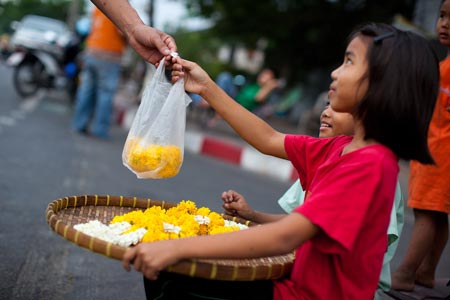
Nuch selling flower garlands on the streets of Bangkok, Thailand.
© UNICEF Thailand/2011/Athit Perawongmetha

Like any large city, Bangkok is multi-faceted and the view you get can be radically different depending on your perspective. Having seen the city from the viewpoint of a tourist and an office worker, my next job was to see the same locations from the perspective of the urban poor: in particular children living in slums and working on the streets.

I went on three project visits around Bangkok with my colleagues from the Thailand office, Tum and Cherry, and a local photographer, Chum. I’m working with Tum and Cherry to create stories for the UNICEF Thailand website on the right to an education, while training them up on producing different types of content, including audio, video and social media.

As well as doing freelance work for UNICEF, Chum is an award winning photo journalist. His pictures from the front line of the Red Shirt riots last year paint a vivid picture of anger, bloodshed and arson among the normally placid Thai people. “It’s hard to get natural shots,” Chum explained. “Even during the violence, people would smile and wave at the camera. These were the best 15 pictures from thousands.” I’d just taken my own photos of Red Shirts on their way to a weekend rally, so it was fascinating to see Chum’s much edgier work.


The projects we visited were run by Peuan Peuan (‘Friends’ in Thai), part of the NGO Friends International, which gets support from UNICEF. For the first visit, we drove a short distance from the UNICEF office to a slum community near the flower market on the opposite bank of Chao Praya, a wide river that flows through the heart of Bangkok.

There we met 12-year-old Nuch (not her real name), a slight, quietly-spoken girl in a red t-shirt with a pigtail in her hair. She was living with her mother Dao, stepfather and five siblings in a single room hut. Nuch used to go out begging in Bangkok’s commercial district, but her mother decided to find another way to earn a living. Now, Dao goes to the market early each morning to buy flowers. She uses these to make garlands, which Nuch and her siblings sell to tourists and worshipers in the temple district of Banglumpu, undercutting the prices in shops.

“I leave the house with my mom, brothers and sisters around 5 or 6pm,” Nuch told us. “We go to Banglumpu area with 400 garlands. My mum sells some on the pavement with my youngest brother, who is two and a half. I walk around the area with my other brothers and sisters to sell the rest. We only return after we sell them all, which can be anytime from 11.30pm to 2am.”

Working late at night on the streets puts children like Nuch at risk of abuse and exploitation. Her brother had already been detained by the police and sent to a shelter, although he was now back with the family. Nuch also frequently misses school because of work. “I don’t usually go to school,” Nuch says. “Sometimes I do and sometimes I don’t. If mum doesn’t sell anything, she doesn’t have money for us to go. I like going to school but I’m still in Grade One because I flunked my exams so many times.”

Making ends meet is a constant struggle for the family. “We make around 500 baht [£10] a day selling garlands,” Dao explained, while chopping chili peppers and preparing dinner for the children on a small gas burner outside their hut. “The rent is only 1,500 baht [£30] a month, but I have to feed the children and pay for them to go to school. Yesterday Nuch left her earnings in a tuk-tuk, so today we have no money to buy flowers.”

School’s out

Nuch draws a picture of a house by a waterfall at the community classroom.
© UNICEF Thailand/2011/Athit Perawongmetha

The slum where we met Nuch is not the best environment for a child. It is a small settlement of 50 households, squeezed into a small plot of land between a school and main road. Except for the slum owner’s house, the homes were dilapidated wooden shacks, often on the verge of collapse, with electric wires hanging low across the walkways. There were attempts at decoration, with bird cages and pictures of celebrities torn from magazines outside some huts. In the centre of the slum, an old tree had been turned into a shrine with flower garlands, incense sticks and a small Buddha statue. Everywhere we went rubbish littered the ground, which the children ran across with bare feet.

The settlement was much smaller than those in Manila, which are home to around 50 per cent of the population, but it lacked the infrastructure and community of the larger, more established Filipino slums. In Thailand, slums are usually home to marginalised people like foreign migrant workers and street prostitutes, who rent shacks by the day for 50 baht [£1]. Although the settlement where Nuch lives is next to a large, well-equipped school, the families cannot afford to send their children there. Instead, those lucky enough to go to school have to travel to a free temple school some distance away.

Friends International runs a classroom in the slum, where staff provide life skills education, play activities and a place for children to do their homework. In the classroom, Nuch drew a picture of a large house by a waterfall, surrounded by trees, butterflies and heart-shaped balloons. I was struck by the stark contrast with her real home. Her six-year-old brother Tor, meanwhile, played with Lego bricks while a Friends worker cleaned and dressed a cut on his foot. “The staff teach me how to do homework,” Nuch said. “Sometimes they ask me to draw pictures. I like it here because they are kind. It’s good that we have this classroom near our house because I walk there on the afternoons that I’m free. Mom never tells me not to go.”

“About half the children in the community come regularly to our centre,” Ann Charoenpol from Friends explained. “We need to get to know them first, build their trust and find out about their situation.”

As well as the classroom, Friends runs a ‘child safe community’ scheme. They have trained 15 volunteers living in the settlement about child rights. The volunteers keep an eye on the children when their parents are not around and report any instances of abuse or domestic violence. The organisation also provides income generation activities for the families. They offer them funding, supplies and training to set up a small business such as making products from recyclable materials, which are then sold by Friends. In return, the parents sign a contract promising to keep their children in school.

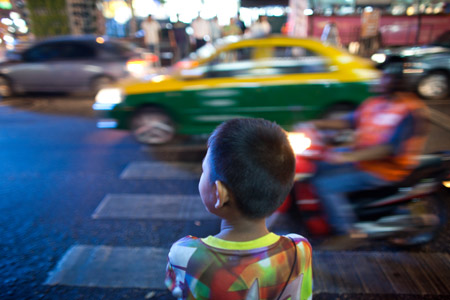
An unaccompanied Cambodian boy waits to cross a busy Bangkok street.
© UNICEF Thailand/2011/Athit Perawongmetha

Soi Cowboy

Our next visit was to a government-run shelter for homeless and trafficked children, where Friends International works with homeless and trafficked children from Laos, Cambodia and Burma to provide them with educational activities in their own language. They also help with family tracing. I’ll come back to this in my next blog.

For our final trip, we went out after work on Friday night to the sex tourism hotspots of central Bangkok, where street children beg or sell trinkets to tourists. We visited the infamous ‘Soi Cowboy’, where scantily-clad Thai women dance for seedy old men in front of bars and ‘massage parlours’ to the competing sounds of rock and dance music. I recognized some of the songs, but not the context. The usual street food stalls had been replaced by street bars, with stalls selling whisky shots to pedestrians. Above us, the sky was lit up by flashing neon lights, with a huge floodlit picture of a cowgirl in leather boots and a whip presiding over the debauchery below. Needless to say, none of this is a good environment for a child.

Compared to the Philippines, the street children here were fewer but more marginalised. The Thai Government has recently proposed a law making it illegal for children to be out on the streets after 10pm. “We find many children from Nuch’s community working here late at night,” Ann said. “We don’t want them to be arrested.”

Ann took us to meet Nang, an outreach worker with Friends International. It was the day of their quarterly street survey and Nang was particularly busy. She had been on the streets since 6am in the morning and was on her second to last shift – she wouldn’t finish until 2am the next day. Together we made our way on foot from Chit Lom to Sukhumvit, looking for street children. For a while we were trailed by two hyperactive Cambodian brothers who ran across the busy roads, careless of their own safety. Another boy, who was begging on the pavement with a puppy, happily posed for several photos for Chum.

We found several young children begging with their mothers or grandmothers on overpasses around the skytrain station. One young girl sat on her own on a staircase. It turned out her mother was just round the corner, but she earned more money if she was on her own. I knew some of these bridges from weekend trips to the malls and cinemas, but walking across them with Friends gave me a very different perspective, as if I were seeing them again for the first time through someone else’s eyes.

Nang comes from the border area between Thailand and Cambodia, which has been in the news recently due to fighting over the disputed sovereignty of a Hindu temple. As a result, she can speak Cambodian and was able to talk to all the mothers and children we met. She handed out information cards in different languages, so that the parents could get in touch with Friends if they had any problems. “Sometimes a mother will phone us up and say: ‘Have you seen my son? He’s been missing for four days’,” Ann commented.

“Most of the children in this area are Cambodian,” Nang told me as we walked to the next Skytrain station. “They cross the border in forest areas and then get a public bus to Bangkok for 250 baht [£5]. Often, the mother or grandmother comes with the youngest children, while the father stays in Cambodia with the older ones. They spend a few months begging, then they go home. When the money runs out, they come back to Bangkok.”

Nang will get to know the mothers and talk to them about children’s right to an education and the dangers they face on the streets. She tries to motivate them to give up begging and join Friends’ home-based production scheme, but it can be a tough sell. “A mother and baby can earn up to 10,000 baht [£200] a month begging on the streets,” Ann explained. “That’s a lot more than they can get doing a low-paid job, even in Thailand, so it can be hard to persuade them to change.” As if to prove her point, a middle-aged American woman stopped and handed 40 baht to a mother. “For the children,” she said.

Nang holds up a selection of information cards in Cambodian and other languages.
© UNICEF Thailand/2011/Athit Perawongmetha

A Day in the Life: Mary's story

Thirteen-year-old Mary (not her real name) lives and works with her family on the streets of Manila, capital of the Philippines. The family occupy a corner of the pavement outside Starbucks in Binondo Square, where they sell cigarettes and newspapers, cook and eat, and sleep outside at night. Mary works with her mother on the family stall and looks after her younger sisters. She’s been out of school for three years.

The family have been forced onto the streets because of poverty. “We have a house in Cavite, south of Manila, but there aren’t enough opportunities there to earn a living,” Mary explains. “That’s why we live on the streets in Binondo. We’ve been here for three years now. My mother works as a street vendor, selling cigarettes, snacks and newspapers. My stepfather is a community guard and my older brother drives a pedicab. My younger brother Jun-jun is a jeepney barker – he hails buses and taxis for passengers”

Although they no longer live there, the family still pays 500 peso (£7.30) a month in rent on their house. “Sometimes we don’t have enough money to pay the rent, which is why we don’t have anything to sell,” Mary says. “Whatever we earn is just enough to buy my stepfather’s medicine. He needs a lot of medicine because he has diabetes and a heart condition.”


Working life

Mary has a busy daily schedule. “In the mornings I help my mother out,” she says. “After waking we tidy up, then I boil some water. After that I go with Mama to buy her wares. Then I take care of my younger sister. My friends are Love, Cecile and Mariel. They cheer me up when I’m sad. They make me laugh or they say: ‘Forget your problems for a while, let’s go and swim in the river’.”

Children from the Binondo area often swim in the Pasig River, which runs through the centre of Manila. They challenge each other to jump off a road bridge above the river. After a typhoon, they come to the river to catch fish that have escaped from damaged fish pens further upstream.

“When evening comes I hang out with my friends but they sometimes do rugby,” [a Filipino term for sniffing glue], Mary continues. “Now I spend more evenings helping Mama and sleeping with her. We have to wait for Starbucks to close so we don’t get to sleep until after midnight.”

Life on the streets presents many challenges for children like Mary. “The main problems for me are not having a place to stay and not being able to go to school,” she says. “I used to go to school even when we lived on the streets, but one day when I was in the third grade, I asked Mama to go with me to school to claim my report card. It’s a requirement that the parent be there.

“I had no idea that my little sister would go missing that day. When we returned home, she was gone. She was missing for four days until she was found by a social worker. It turns out that two kids took her while we were away. They even put her in a sack. After that, my stepfather wouldn’t let me go school anymore. He said many hurtful things to me and I ran away because I was so upset.”

http://www.flickr.com/apps/slideshow/show.swf?v=104087

Given a chance

Mary attends street education sessions run by Childhope Asia Philippines, with support from UNICEF. “I like all of the sessions, particularly the life skills education and the choir practice,” she says. “Its fun to be in the choir because you learn to sing and you get to express the problems you carry in your heart. Sometimes, I wish they would teach choir every day instead of just Wednesdays. The life skills sessions have taught me how to plan for my future to achieve my ambitions and dreams. Everyone has a dream and street children are no different. Even animals dream of eating good food.”

Mary is now a Junior Advocate for children’s rights. “We teach other children about gender sensitivity, life skills and substance abuse,” she explains. “I used to sniff glue because I thought it would help me forget my problems. But I was wrong, it added to my problems. It stopped me from studying. If I can go back to school and finish my studies, I’d like to be a reporter. I’ll be able to solve problems and help support my family. And I can tell other people what’s going on. I’ll be able to offer assistance when a child goes missing.”

Despite her problems, Mary is positive about life. “I’m happy here, in a way, because we have enough to eat and I have lots of friends,” she says. “But we’re dependent on my stepfather and he often gets ill. What would happen to us if he’s no longer around? Sometimes I think about going to a shelter because I know that it would be better for me there. But I don’t want to leave Mama. I have a responsibility to her and to my brothers and sisters.”

Mary is thankful for the chance she’s been given to continue her studies. “I’m grateful to Childhope because they are able to help children finish their education,” she says. “They teach us and show concern for us. They treat us like family, not like strangers. I’m also grateful to Butch, our street educator, because he patiently guides us no matter what the time. Even if it means he goes to sleep late and has to wake up early for work the next morning, he still comes and finds us.”

Upholding child rights

UNICEF is helping children like Mary get a basic education, talk about their problems and, ultimately, get off the streets and back into school. The programme works on three levels: on the streets, where outreach workers get to know the children and win their trust; in shelters, where children can stay and attend school; and in the community, where local ‘barangay’ councils respond to issues affecting children.

We’re supporting Childhope Asia Philippines, which employs street educators like Butch. They go out onto the streets of Manila and make contact with the children. They provide counselling and basic education through alternative learning sessions, help the children access information and services, and ultimately motivate them to give up life on the streets. UNICEF provides training and materials for the street educators and food for children who attend the sessions.

For children like Mary, life is an ongoing battle where their rights are denied on a daily basis. However, through the work of UNICEF, Childhope Asia Philippines and street educators like Butch, there is hope that at least some children will escape this vicious circle and start enjoying their right to a full and happy childhood.

A Day in the Life: Crisanto's story

Fifteen-year-old Crisanto (not his real name) lives at Pangarap Shelter for Street Children in Manila, capital of the Philippines. He ran away from home when he was nine because his father was an alcoholic and would beat him when he got drunk. Crisanto lived on the streets for two years. During the day he would earn money by snatching bags and phones or scavenging rubbish for recycling. At night, he slept in a cemetery with a gang of other boys.

“We were very poor and my parents were always fighting,” Crisanto remembers. “When my father got drunk he would hit me. It started when I was six years old. He did it just because he felt like it – he wasn’t himself when he was drunk. That’s when I began thinking I was nothing more than a burden. A few years later I decided to run away.

“After that I lived in Sangandaan Cementery. It was very dangerous. I was in a gang and the other boys made me do rugby [a Filipino term for sniffing glue]. The gang would steal things like mobile phones and we would scavenge for plastic bottles and electric wire. We would sell recyclable materials to junk shops to get money for food or drugs. You could buy a cup of rugby for 5 pesos. I didn’t get hungry when I sniffed rugby.”


There were lots of problems on the streets for children like Crisanto. “I got into a lot of fights back then and I would get chased by policemen,” he says. “I would get dizzy from hunger and sick with eye infections. I couldn’t afford to buy any medicine when I was sick. I would beg for drinks from canteens and wash in the public toilets. Studying didn’t even cross my mind. I didn’t know I could go to school.”

Movin’ on up

Things started to get better for Crisanto when he met Elvie, a street educator from Childhope Asia Philippines. “Elvie came to the cemetery where I lived and we’d go to a quiet place to talk,” Crisanto says. “We talked about my life on the streets and about children’s rights. That’s when I became interested in pursuing my education.”

Elvie brough Crisanto to Pangarap Shelter, which is run by Pangarap Foundation with support from UNICEF. The shelter offers a homelike atmosphere for boys who are unable to return to their family homes and gives them the opportunity to go back to school. “I first came to Pangarap Shelter in 2006 but I ran away because some kids were being mean and bullying me,” Crisanto says. “I went to another shelter, Kuya Centre, where I stayed for three years and went to school. Then I came back here to Pangarap.”

At first, Crisanto had trouble fitting in at the shelter. He would get into fights with the other children. He felt he had to be tough, like when he was on the streets. But he’s calmed down since then. Now, he likes to study and help other boys with their homework. He’s more playful and smiles more often. “I feel happy here because I can study again,” Crisanto says. “I have a new life and can be like a normal child. I like the activities here and the resilience sessions. This is a program to keep us from going astray. It gives us greater strength and guidance as we grow older.”

The shelter also has a workshop where the boys can earn money by making candles for sale. “For every candle you sell, you get 20 per cent of the price,” Crisanto explains. “I use the money if I need to buy something or I give it to my mother when I go home. I visit my family every three months. I’m happy when I’m at home because I’m with my Mama again and she knows that I’m back in school.”

http://www.flickr.com/apps/slideshow/show.swf?v=104087

Time for class

Crisanto leaves the shelter every morning and goes to a local school, Pasay West, with other boys from the shelter. “I’ve been coming here for one year,” he says at the school. “I’m happy here. My friend Arvin from the shelter is in the same class as me. I like learning about the history of the Philippines and finding out how things came about. My favourite sport is badminton because it’s fun to play and I often win.”

“I’m happy because I’m studying again after staying on the streets for so long. I’ll get my high school certificate in two years. When I’ve finish studying I can get a job and help my Mama. I’ve met a lot of people here and I’ve gained new inspiration.”

When classes finish, Crisanto comes back to the shelter for lunch. Afterwards, he does his homework and daily chores, then he has free time to play. “I practice dance moves every evening with my friend Arvin,” he says. “We watch videos on MTV and make up our own moves. Even though we’ve got exams, we still want to have a quick practice before revision.”

Crisanto’s parents are now separated and his father has left home. His mother works at a denim factory but is still very poor. Recently, Crisanto went with his mother to see his father. He was surprised because his father was not as big as he remembered and he wasn’t afraid of him anymore. “My father apologised for all the things he did to us, like hitting me,” he says. “I’ve forgiven him and I feel much better now. My family is my motivation to have a better life. I want to lift them out of poverty.

“I’ll leave Pangarap Shelter when I have a good job,” Crisanto continues. “I’ll only go when they know I’m okay and I can really fend for myself. I’m contemplating two choices: going to college to study accounting or becoming a sailor and travelling the world. I’d like to go to Beijing and see the Great Wall of China. Then I’d like to come to the UK and see what it looks like, the way of life, and if there are any street children there.”

Gimme shelter

UNICEF is helping children like Crisanto get an education and reintegrate into their families and communities. We’re supporting Pangarap Shelter with clothes and bedding for the children, as well as training and education materials for the social workers, teachers and psychologists who staff the centre. We also support Childhope Asia Philippines, which employs street educators like Elvie. They do outreach work with children who are still living and working on the streets.

Ultimately, the aim is to return children to their families or to a foster home. The family receives livelihood assistance, counselling services and parenting skills training. Social workers work with the parents to make sure they’re prepared to assume parental responsibilities, particularly if the child has had negative experiences in the past.

For children living and working on the streets of Manila, life is an ongoing battle in which their rights are denied on a daily basis. However, through the work of UNICEF and Pangarap Foundation, children like Crisanto have been able to escape this environment and start enjoying their right to a full and happy childhood.

Philippines diary: Gimme shelter

Efren, 11, lost three fingers in a flour grinding machine
© UNICEF UK/Philippines 2009/Sharron Lovell

In my penultimate week in the Philippines, I returned to the streets of Binondo to revisit the street children living and working around the night market. This time, I was joined by Sharron Lovell, a Shanghai-based photographer, who had been commissioned by UNICEF UK to take photos of street children for a fundraising campaign. My role was to collect the stories of the children she photographed.

We were reunited with Butch from Childhope Asia Philippines, who was very happy with the photos and story I sent him from our previous trip together. We arrived in Binondo at around 3pm and started looking for Butch’s students. In the end we were out on the streets for eight hours, interspersing our time photographing children with refueling stops at Jolibee (the Filipino equivalent of MacDonalds) and Starbucks, where I quizzed Butch for details of the children’s case histories.

I was amazed by how much information he had in his head, not just about the kids but about their parents, some of whom were also former students of his. “I have thousands of case histories in here,” Butch said, taping his forehead.


In the month since our last trip, Butch had won a ‘Filipino hero’ award on C/S 9, one of the Philippines’ most popular TV channels, in recognition of his many years working with street children. As a result, almost everyone now knows him – from the street kids who call him ‘Papa Butch’ to the customers in the coffee shops and restaurants who asked for his autograph or had their photo taken with him.

One of the many children we met that night was 11-year-old Efren (not his real name), who lives on the streets with a group of friends. Earlier this year, he dropped a one peso coin (1.3 pence) in a flour grinding machine. When he put his hand in to get it back, he lost three fingers. The stall owner paid for Efren to go to the hospital but he couldn’t afford to pay for medication, so the wound got infected.

Efren hasn’t been home since February. His older brother came to Butch and asked him to look out for him on the streets. Butch found him in July, by which time his hand had become infected. “I’d been looking for him for months, then one day he just turned up at an education session,” Butch commented. “By that point his hand smelt really bad.” Childhope Asia arranged for Efren to go back to hospital and get a skin graft, and is now paying for the antibiotics he needs. Butch gives him medication twice a day and changes his dressing every three days.

Efren still comes to the street education sessions with his friends but he’s a slow learner. Butch is trying to persuade him to go to a shelter so he can be properly looked after. Efren doesn’t want to go home. His family live in the port area where his father used to run a delivery business. “Last year his father sold his kidney for 70,000 pesos. Now he’s too ill to work,” Butch says.

Despite his injury, Efren is an outgoing, playful child. He was very active, running and jumping all over the place. He showed off his injured hand, which was red and raw and shaped like a deformed claw, and tried to gross out his friends with it. “It’s a good sign that he plays with his hand,” Butch explained. “It means that he’s accepted what’s happened to him.”

A new hope

Carl, 13, ran away from home after being abused by his father
© UNICEF UK/Philippines 2009/Sharron Lovell

The next day, we visited Pangarap Shelter for Street Children, where Butch refers those of his students who tell him they want to stop living on the streets. The centre, which is staffed by social workers, house parents, teachers and psychologists, offers a homelike atmosphere for former street boys who are unable to return home. While at the shelter, they can attend school and there is a workshop where they can make candles and beads for sale in the shelter’s shop, earning a share of the proceeds.

Unlike government-run ‘rescue’ programmes, children go to these shelters voluntarily and are free to leave at any time. UNICEF is supporting Pangarap with educational materials, clothes and bedding for the children and training for the teachers and social workers.

At the shelter, we attended a group therapy session, where a dozen boys talked through their experiences, facilitated by a child psychologist, also called Sharon. Afterwards, I interviewed five boys, including Carl, 13, who used to live with his mother and sister at a brothel. His sister ran the bar while his mother did the cleaning and housework. There were lots of strippers and prostitutes living there and he found it very difficult to study.

His father, who has since left home, used to physically abuse him. He would put him in a sack and hang him upside down from a tree. Then he would beat him with a stick. Carl told Sharon that his father put holes in the sack so he could hear him scream but he tried to keep silent because he didn’t want to give him the satisfaction. “I think the holes might have been there so he could breath,” Sharon says, “But that’s not the way a child views it.” Either way, it’s a horrific story.

“I ran away from home because I felt imprisoned there,” Carl said. “It was always chaotic and my parents would fight about money. After I left, I sold plastic bottles for a living.”

Carl is happy to be at the shelter. “I’m able to study here and I can stand on my own two feet,” he commented. “My favourite subject is Maths. I want to be a ship engineer and go to different countries. Most of all, I want to go to Australia because Mr Bond is made there. It’s my favourite brand of coffee – it tastes so good.”

Carl also enjoys the group therapy sessions with other boys. “We’re given advice so we can finish our studies,” he added. “We’re taught not to steal and to enjoy ourselves.”

After the session, we went downstairs to the recreation area where the boys played basketball and other games. One group of teenagers was setting up a scrabble board and invited me to join. I tried to find words that were relevant to the Philippines, starting with ‘jeep’, then ‘beach’ and – more controversially – ‘steal’. “This is what you’ve been taught not to do,” I said to laughter.

I’d previously noticed that male Filipino youths show their affection for each other by walking with one person’s arm across the other’s shoulder. As I was playing the game, Carl came over to watch and put his arm over my shoulder in the same way. It was a touching moment for me as it meant that even after our brief acquaintance, he considered me a friend.

Birthday boy

Enjoying the underwater world in Anilao

This was also my birthday week. I was born in November, so I’ve always been slightly jealous of people with summer birthdays and it was a nice change to spend it in the Philippines.

On my actual birthday, I went out with assorted friends and colleagues to ‘The Filling Station’, a 1950s-style diner. Every spare inch was filled with memorabilia, from framed portraits of the Rat Pack, to superhero statues and an antique juke box (non-functioning). We ate ‘crispy pata’ – a traditional Filipino dish made from pig trotters – played pool and took comedy photos with the statues.

At the weekend, I went on diving trip to Anilao on a sheltered bay south of Manila with Martijn and Erik, a Swedish friend of Martijn’s who’d come over to visit. We arrived at the diving centre by boat, traversing clear, still water like that of the Mediterranean but teeming with tropical life. The resort was perched on a rocky ledge over a coral reef in a marine reserve, with sheer cliffs rising vertically behind it.

We did four dives and snorkeling trips over the course of the weekend. I remember underwater scenes of astonishing beauty. There were brightly colored corals and shoals of tropical fish everywhere you looked. Long slender needle fish swam together in a line, while a dozen batfish floated lazily in the shade of a coral chimney.

There were enormous purple giant clams tethered to the bottom of trenches formed by the coral and camouflaged scorpion fish, which looked exactly like barnacle encrusted rock until they moved. At the edge of the reef, the sea floor dropped off into a hypnotic, dark blue immensity below.

Not for the first time, I marveled at how easily we think of the world as comprising everything above water, remaining unaware of the second, magical world that exists just the other side of the water’s surface.