Laos: slow boat down the Mekong

Sunset at Huay Xai, Laos, looking back over the Mekong river to Thailand.
Having lost my camera memory card, this photo is from Lonely Planet

Coming from Thailand (see part one of this blog), Laos is both familiar and subtly different. The people are from the same ethnic group, they have a similar language and the same religion. The streets of a Lao town look very similar to those of a small rural Thai town. They have the same wooden stilt houses with the same spirit shrines in the corner. The shops accept Thai currency and locals sit in cafes watching melodramatic Thai soap operas on TV.

However, there are small but significant differences. Where in Thailand you see yellow royal flags hanging next to the national flag, in Laos their place is taken by red flags bearing the communist hammer and sickle. And where Thailand hustles and bustles, Laos moves at a slow, sleepy pace. Here, roads are often unpaved and bicycles and motorbikes are the main modes of transport. “Thai people view Laos as a backwards province of Thailand,” I was told in Bangkok, and while it’s true that the economic benefits of development were absent, so too were their darker side effects, like pollution, over-population and prostitution. It was in many ways a refreshing change.

Continue reading “Laos: slow boat down the Mekong”

Chiang Rai: bamboo forests and hill tribes

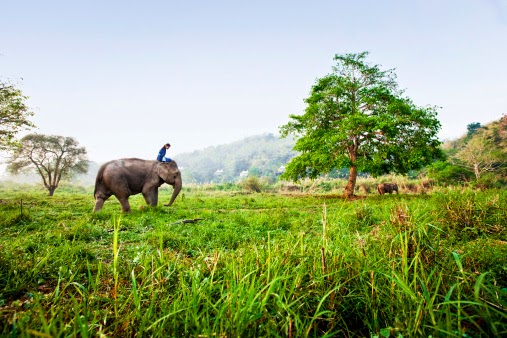
Elephant trekking in Chiang Rai province. Sadly, having lost a memory card
during the trip, this photo is from Lonely Planet

Where Bangkok is concrete grey, Chiang Rai is red, yellow and green. We landed at sunset at a small airport surrounded by dusty red earth and fields of tall yellow grass translucent in the evening sun. Beyond the fields, green forested hills curved out of the plains like the backs of whales from the ocean. This was the first stop on Joyce and my adventure honeymoon through Laos and Cambodia  – the adventure being admittedly more my idea than hers and obtained against the promise of a future beach holiday. We were in Chiang Rai primarily to reach starting point for our overground journey through Laos, but while we were here we decided to take a few days to see the sights.

Continue reading “Chiang Rai: bamboo forests and hill tribes”

Movement of the masses: the Filipino jeepney

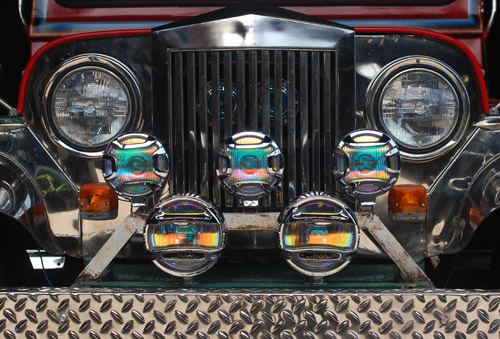
A newly-built jeepney at Sarao Motors, complete with five extra headlights.
Photo © Andy Brown/2011/Philippines

I’ve been fascinated by jeepneys since the first time I first visited Manila in 2009. The psychedelic, graffiti-style artwork mixing religion and pop culture. The names and slogans emblazoned on the front, like ‘Evangeline’ or ‘God is Love’, dwarfing the actual destination. The myriad of coloured streamers and extra, false headlights that serve no practical purpose whatsoever. Decked out in all this finery, they speed up and down the main roads of Manila, picking people up and dropping them off apparently at random. They pile up at traffic lights, sounding their horns in a continuous cacophony and pumping black exhaust fumes into the already polluted atmosphere.

Continue reading “Movement of the masses: the Filipino jeepney”

Filipino history and the 'Pied Piper of Manila'

Carlos holds a portrait of Filipino ‘national hero’, Jose Rizal
Photo © Andy Brown/2011/Philippines

When I think of the great histories of the world – the Roman civil war of the First Century BC, the ‘Three Kingdoms’ of Imperial China, the British Raj and the partition of India – the Philippines doesn’t get much of a look in. But this oft-neglected corner of the world has a fascinating heritage that occasionally places it at the heart of global events in surprising ways.

I was first introduced to Filipino history in 2009 by Carlos Celdran, the self-styled ‘Pied Piper of Manila’, his diminutive figure and larger-than-life character dressed up in Nineteenth Century top hat and tails. Every week, Carlos takes tourists and locals around Manila’s handful of historic buildings – those that survived World War II – and treats them to, not so much a tour, as a piece of stand-up political theatre.

Continue reading “Filipino history and the 'Pied Piper of Manila'”

Treasure island: exploring Jakarta's boat docks

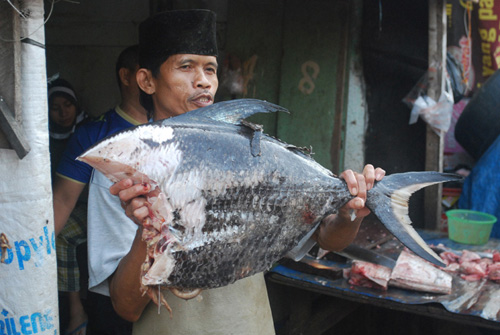
A market trader displays his scaly wares at Jakarta’s fish market.
© Andy Brown/2011/Indonesia

I was warned about Jakarta. ‘It’s polluted, dangerous and characterless,’ everyone said. Even the Lonely Planet calls it “a hard city to love”, noting the “relentless urban sprawl”. Yet now that I’m here I find myself liking the place, somewhat to my own surprise. It’s true that the traffic is terrible. In the mornings it takes me 15 minutes to get to the UNICEF office on foot – or 30 minutes in a ‘taksi’. The roads are solid with cars, although a tide of motorbikes makes its way through, flowing between the cars or racing along pavements three abreast. Travelling by foot, you have to dodge these same motorbikes and breathe in their exhaust. You also have to cope with the intense heat, which I managed by staying in the shade of the skyscrapers.

Continue reading “Treasure island: exploring Jakarta's boat docks”

Lost Kingdom of Ayutthaya

An election poster outside one of Ayutthaya’s ancient temples
© Andy Brown/2011/Thailand

In the three-part Thai epic blockbuster The Legend of King Naresuan, the eponymous hero rebels against Burmese rule and restores the Kingdom of Siam around Ayutthaya in 1590. He then expands the kingdom with the help of an army of elephants, ushering in a period of peace and prosperity that lasts until 1767, when the Burmese return to sack and burn the imperial city. They loot its treasures and wipe out its population, leaving the charred ruins to be reclaimed by jungle.

Continue reading “Lost Kingdom of Ayutthaya”

Return of the King: Nepal's royal capitals

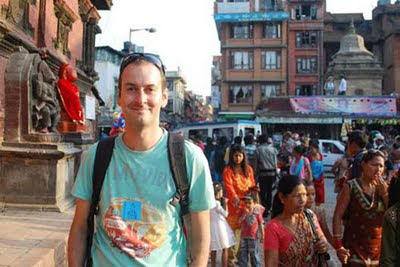
The author in Patan’s Durbar Square. © Joyce Lee/2011/Nepal

Nepal is both one of the most beautiful countries in the world, and one of the poorest. In the capital Kathmandu, both the beauty and poverty are very much on display. The city is an odd mixture of historic grandeur and modern squalor. Its medieval buildings and squares have remained unchanged for centuries. Houses, temples and palaces are all adorned with beautiful and intricate wood carvings, which cover doors, windows, pillars and rafters. Stone lions guard the dusty, potholed streets and crumbling buildings. Sacred cows wander unhindered among the tractors, rickety vehicles and women carrying baskets on their heads. There is a Hindu temple on almost every street corner and square, from small shrines to local spirits and sacred trees, to huge towering monuments to the major Hindu deities Shiva and Vishnu. And it is all marvelously intact – there are no office blocks, shopping malls or multi-story car parks to disrupt the historic skyline.

Continue reading “Return of the King: Nepal's royal capitals”

On the roof of the world: trekking in Nepal

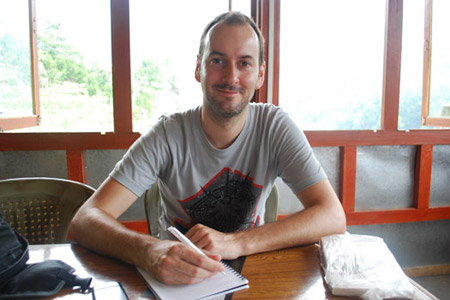
Working on my blog, with four days’ worth of beard.
© Joyce Lee/2011/Nepal

Our reason for being in Nepal was to hike the Himalayas, so after exploring Kathmandu (see part one of this blog) we took a light aircraft to Pokhara, the starting point of our trek in the Annapurna mountain range. Tourism has saved this region from many of the ills that plague the Kathmandu valley. The streets are cleaner and the buildings in better repair, with even slum houses painted sky blue. There is also 24-hour electricity thanks to locally-produced renewable energy. Solar panels on houses heat people’s water and hydro-power in the valleys provides electricity for the villages. Houses here are painted with the words ‘Never End Peace And Love,’ the first letter of each word spelling out ‘Nepal’. “In Kathmandu, it means: ‘No Electricity Product, Always Load-shedding,” a local woman joked. 

We signed up to do a five-day trek through the mountains to Poon Hill, with a local organisation called ‘Three Sisters’ that employs, educates and empowers local women. Our guide, Kamala, had been working with them since 1999. We also had two teenage porters, Manuka and Danu. As soon as we set off, we started feeling guilty about letting the girls carry our heavy backpacks while we carried lightweight daypacks. Every time we stopped, Joyce and I would take something out of their bags and put it into ours. We felt less guilty, however, when we saw the other porters. One Dutch couple had a single 60-year-old man as a porter. Each morning he tied three large backpacks together with rope and attached them to a strap across his forehead. While Manuka and Danu often raced ahead of us, waving cheerfully back from the top of the next hill, the old man struggled along behind his group, taking slow and shaky steps up the steep mountainsides.

The thing that struck me most about the mountains of Nepal is that they are very much lived in, in a way that European mountains no longer are. There are bustling villages all along the trekking trail, where subsistence farming is now combined with tourism. Even the smallest group of stone huts now has a restaurant, a guesthouse, a general store and – bizarrely – a ‘German bakery’. Children in crisp school uniforms run up and down the vertiginous stone steps like nimble mountain goats. Women dressed in bright colours wash clothes in the river, work in the fields with babies strapped to their backs, or dry mushrooms on rooftops in the midday sun. Men drive trains of donkeys (“the mountain car,” Kamala called them) laden with rice sacks across rope and wood bridges over deep gorges. Others carried goods themselves, using the same forehead strap as the old porter. We saw one man carrying a cage of a dozen live chickens in this way. Strings of brightly coloured Buddhist prayer flags were hung in even the most remote locations.


Inevitably, the accommodation in the mountains was basic. On the first night we stayed in a makeshift building that bore a close resemblance to the slum houses I’ve seen on UNICEF project visits in Bangkok and Manila. The ground floor was made of concrete but the first floor, where we slept, was a ramshackle construction made from sheets of metal, wooden planks and plastic windows, all nailed together haphazardly. The room was unfurnished except for two mattresses that were best left unexamined and a couple of Bibles on a concrete shelf. There were gaps in the walls where they failed to meet up and a cold wind blew through. Despite this, both Joyce and I slept soundly for eight hours. Dinner and breakfast, as elsewhere in Nepal, was cooked on a wood stove made from baked earth. In the evening, the guests, guides and porters huddled around a single heater in the dining room, playing cards and chess, reading or discussing the day’s hike.

Politics reached here too. The Annapurna region was a Maoist stronghold during the civil war and several times we saw communist slogans painted on rocks and huts, often accompanied by a Soviet-style hammer and sickle and a clenched fist. In one guesthouse, however, I spotted a faded picture of the former royal family still hanging on a wall in the dining room. In the past Maoist rebels would waylay foreign hikers along this route and demand ‘political contributions’. Now, however, there were official government checkpoints where we paid a pre-arranged fee and had our trekking permits stamped.

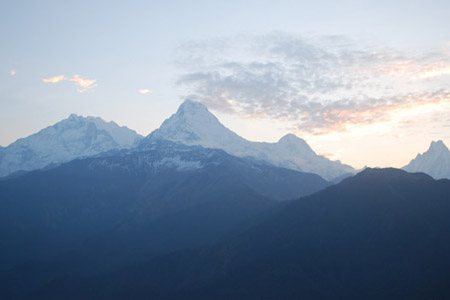
Sunrise from Poon Hill – like this, only much, much bigger.
© Andy Brown/2011/Nepal

Our destination was the inappropriately named ‘Poon Hill’, which at 3,200 metres is more than twice the height of the UK’s highest mountain, the comparatively puny Ben Nevis (1,340 metres). In fact, it is only a ‘hill’ in comparison to the ice-and-snowbound mountains that tower above it, many of them over 8,000 metres and among the highest in the world. In the evening, I sat on the balcony outside our lodge at Ghorepani on the slopes of Poon Hill and watched the massive stone peaks slip in and out of view as the clouds moved across the valleys. They looked fundamentally wrong so high up in the sky: way above the clouds where millions of tonnes of rock had no right being. It was a bit like looking at skyscrapers in New York – your neck would start aching after a while from being held at such an unusual angle.

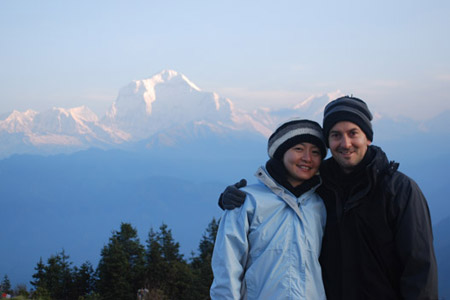
We got up at 4am in order to make the final ascent to the summit in time for sunrise. We started off climbing through trees in the pitch black with flashlights. Occasionally, we would see the lights of another group through the trees. As we came out of the forest the sky was lightening and we could see the outline of the mountains, dark blue against a paler sky. There was now enough light to see the path so we turned off the torches. After climbing for about an hour, we reached the summit just before sunrise. The sky was clear and we could see the whole Annapurna range stretched out in front of us along the horizon, as if nature had laid on its most spectacular display for us. The mountains were unfeasibly high, massive pillars of rock punching up through the sparse clouds and rising to over 8,000 metres above sea level. This is the ‘roof of the world’ – the highest point on Earth. It was awe inspiring. The sun was still behind Annapurna South, but it started to light up the top of Dhaulagiri Mountain, turning the peak and ridge pink. Over the next hour, the line of light moved slowly downwards, picking off the ice-bound slopes and ridges one by one. Along the top of Poon Hill, tattered Tibetan prayer flags fluttered in the breeze in faded shades of blue, white, red, green and yellow. “They represent the five elements of sky, air, fire, water and earth,” Kamala said. With the exception of fire, we were visibly surrounded by them all.

One of the things I enjoyed most about being in the mountains was getting up just before dawn and wandering round whatever village we were in with my camera, watching sunrise, visiting temples for the dawn prayers and meeting local people. I’m not religious myself but there was something undeniably magical about watching sunrise from the balcony of Ghandruk Buddhist monastery while old women burned incense, rotated prayer wheels rat-a-tat-tat and banged a gong with a deep, echoing boom. All the while, a tape played a Buddhist chant: “Buddham… saranam… gachhami”. “It means ‘Go pay your respects to the Buddha,” Kamala told me when I played her back a recording on my mobile phone. It sounded trite when I heard it at a souvenir shop but somehow it worked here.

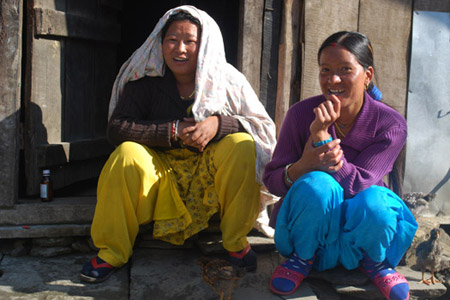
Nepali women feeding chickens in Tadapani village.
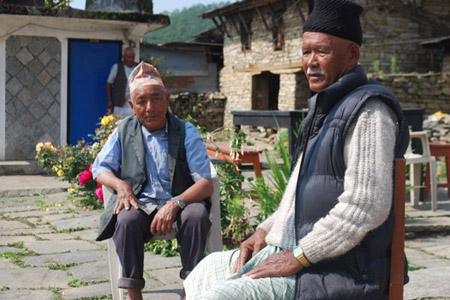
A retired Ghurkha enjoys the early morning mountain views in Ghandruk village.
© Andy Brown/2011/Nepal

Early one morning I spoke to two friendly women sat outside their house in contrasting blue and yellow trousers, feeding chickens. They smiled broadly as I complemented them on their style and asked if I could take their photo. The next morning, Joyce and I chatted to an ex-Ghurkha soldier, Ramatu Garung, who was sat on a stone terrace in a body warmer and traditional Nepali pointed hat, enjoying the view with a friend. “Where are you from?” he asked. “The UK, Hong Kong,” we replied. He seemed pleased. “I served as a Gurkha from 1945 to 1960,” he explained. “I went to the UK for a week’s training. After that, I was based in Hong Kong, Singapore and Borneo. Then I retired here to Ghandruk – this is my house.”

Nepal has a long history of supplying Gurkhas for the British army. Identified by their curved ‘khukuri’ blades, these fighters are famed for their strength, agility and endurance. Even today, Gurkhas make up some of the army’s elite troops in Afghanistan and elsewhere. For people in Nepal, it’s a prized job with the promise of a comfortable retirement. But it’s not without its risks. “My neighbour is also a Gurkha,” Kamala told us later. “He’s 80 years old. He fought for the British in World War II. There was a big battle and everyone in his regiment died except for him. He only survived by hiding under their bodies and pretending to be dead.”

We finished the trek by paragliding over the hills and lake at Pokhara. I was going to end this blog with a detailed description of the flight, but I’ve tried your patience long enough, so instead here’s a short video which includes the scariest moment: ‘the spiral’. The best part, not captured on film, was when I got to fly the glider myself on the way back down. It was like being a giant bird, soaring high above the lake and treetops, turning into the wind and feeling the tension in the strings as if my arms extended out to the tips of the kite. As we landed, dark clouds bearing monsoon rains rolled down from the mountainside behind us. It was a magnificent end to a memorable trip.

A passage to India: the two faces of Delhi

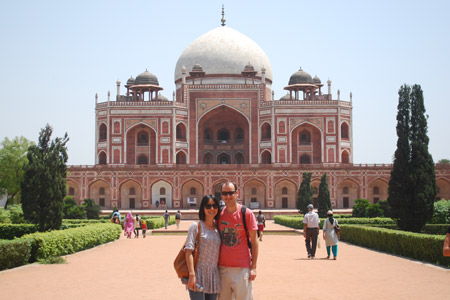
Me and Joyce at Humayun’s tomb, the precursor of the Taj Mahal.
© Andy Brown/2011/India

A few days after Songkran, I packed my bags once again and booked a ticket to Delhi, India. It’s a country I’ve always wanted to visit. I have several British-Indian friends in London and have watched countless movies about the country, from Richard Attenborough’s classic Ghandi to more recent art house fare like Earth and Water. I’ve always been intrigued by the country’s rich culture and history.

However, I also felt some trepidation. I’d heard about India’s extreme poverty, with slum dwellings lining the pavements of Mumbai, and had been warned to expect touts, scammers and hasslers. Joyce and I went to Morocco a few years ago and had an unhappy time. As soon as we stepped onto the street, we would be mobbed by aggressive and persistent fake guides, who would swear and spit at us when we refused their services. I was worried Delhi would be the same.

Happily, my time in India turned out to be neither quite like a movie, nor anywhere near as unfriendly as Morocco. However, there were two distinct sides to Delhi and its people. It was like a two-sided Venetian mask – one face smiling happily, the other angry and unsettling.


Happy face

I began in New Delhi, the former capital of British India. The city was built in 1931 on the ruins of seven previous capitals. Like them, it was supposed to last for ever but in less than two decades the British were gone, unable to sustain the costs of Empire after the Second World War. I arrived in Delhi late on Sunday night, got a taxi to my hotel and another to the office the next morning. Both drivers were very chatty so I didn’t have much chance to absorb the surroundings. One UNICEF office looks much like another and I got to 6:30pm without much of a feel for the country I was in. My map showed a route back to my hotel through a park, so I took some bearings and headed down a packed earth path towards Lodi Gardens.

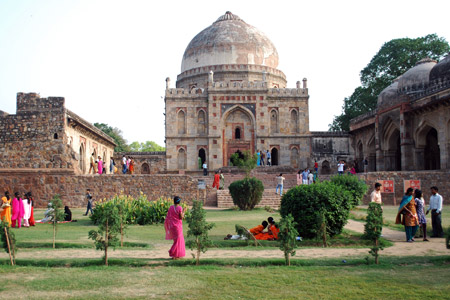
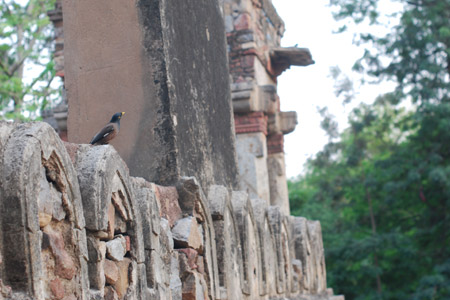
I was astonished by what I found. A series of landscaped lawns surrounded spectacular 600-year-old domed and crumbing sandstone ruins, which rose majestically against the orange-coloured sky. They had elaborate carvings on their walls and the remains of coloured tiles on their ceilings. The trees were full of exotic birdlife, with different species home to different types of birds, including several large eagles. They filled the airwaves with their calls and the sky with their circling flights. Small, striped squirrels scampered around the lawns and walls with a bouncing gait, or climbed up walls and disappeared into cracks between the slabs of masonry.

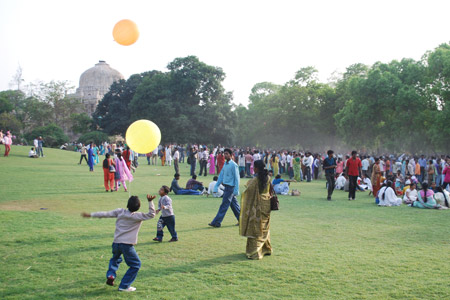
Local people strolled peacefully amongst this splendour or reclined on the manicured lawns. Most of them wore brightly coloured traditional Indian dress. It’s one of the few countries I’ve been to wear young people choose not to wear jeans and T-shirts. Many had come with picnics and children. Others played sport, with cricket the clear favourite. I spotted two young guys up on the roof of one building, smoking a joint. After an exchange of gestures, they pointed to a stone staircase in the corner of a wall, and I climbed up too. I sat on the edge of the roof, next to a group of large and evil-looking blue-grey birds, and got an aerial view of the sun going down behind a group of children throwing brightly coloured balloons into the air. The air smelt of dry, baked earth and the sounds of children’s voices mingled with bird song and the soft thwack of badminton racquets.

Lodi Gardens – an urban oasis in the heart of New Delhi.
© Andy Brown/2011/India

I felt like I’d somehow wandered onto the set of a Merchant Ivory production, an impression which was more than just a metaphor. “In fact, a lot of movies are filmed there,” my colleague Jyoti said when I described the feeling the next day. “There are often film crews shooting in the evenings.”

As I was leaving the park, a group of Indian boys fell into step alongside me. “Hello, how are you?” one asked. “I’m good, thank you,” I replied. “Do you like Delhi?” “Yes, it’s very nice.” “America is very nice too!” “Not American, British,” I clarified as they disappeared in the direction of a 1950s style ice cream van.

The road from the park back to my hotel was wide and tree lined, with vast colonial-era villas taking up half a block each. There were large birds in these trees too, or so I thought at first. In fact, they were huge, furry bats. They climbed awkwardly up branches, hung upside down, fixing me with stares from their demonic eyes, or glided between the tree tops, casting sinister and unnatural shapes against the dusky evening sky.

On another occasion, I was walking through the gardens on Easter Sunday. There was a huge crowd of people on the lawn, dancing in a circle to a tribal drumbeat. I asked my colleague Shweta what was going on. “These are tribal groups who have converted to Christianity to escape the caste system,” she explained. “In traditional Hindu culture they’re considered Untouchables. In the old days, if their shadow fell on you, you would have to go home and wash. But in Christianity they’re all equals.” This change in status is not always done with pure motives, however. “The church provides education and social services,” Shweta continued, “But they often force people to convert in order to get it.”

If I was surprised and delighted by the ambiance of New Delhi, I was equally captivated by its inhabitants. My colleagues at work were incredibly welcoming and immediately made me feel at home, plying me with samosas, taking me for lunch and picnics and helping me plan my weekend. They spoke English with a beautiful, musical accent, while smiling and waggling their heads in a uniquely Indian gesture. “We lived side by side with the British for 200 years,” said Shweta without a trace of resentment. “I’m going to London in June. I’m very excited because I’ve read so much about it. I want to have tea and scones for breakfast and visit the Queen in Buckingham Palace.”

In addition to their hospitality and generosity, my new colleagues also had a wicked sense of humour. After one training session, I put people in pairs and set them the task of building an HTML email from a template, using stories from the UNICEF India website. Priyanka and Shweta instead made up their own stories about the ‘Web Guru’, using pictures of a mustachioed Mike Myers and links to my personal website. As their work was technically correct, it was hard to mark them down for it.

Angry face

If New Delhi represented the happy side of my Venetian mask, Old Delhi was its evil twin. I was well aware that I was living in something of a bubble among the broad boulevards, whitewashed mansions and trimmed lawns of New Delhi, so when Joyce came out for the weekend, we decided to spend a day visiting the Red Fort, Chandni Chowk market and Jama Masjid mosque in the less salubrious old town.

The Red Fort is a huge Mughal-era building, with imposing walls made from red sandstone around white marble palaces and British army barracks. The Mughal Emperors ruled India for over three hundred years from 1526 to 1858. Originally descended from Genghis Khan (the word ‘Mughal’ is a corruption of ‘Mongol’), they soon adopted Indian culture and Islamic religion. The most famous Mughal Emperor was Akbar the Great, brought vividly to life in Salman Rushdie’s The Enchantress of Florence. Passing through Lahore Gate you enter a covered bazaar where shopkeepers used to sell silks and jewellery to the Mughal’s important guests. Their descendants still provide essentially the same service for modern tourists.

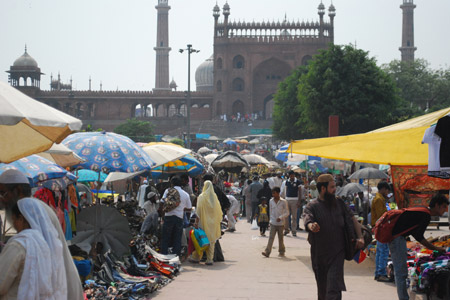
Outside Lahore Gate is Chandni Chowk, the heart of Old Delhi. Here, streets are narrow and buildings are dilapidated. The roads are lined with clothes and food stalls, the latter selling produce that is virtually guaranteed to bring on ‘Delhi belly’ in anyone not brought up on it. Between the stalls were a dense crowd of people and animals, including goats with full udders and carts drawn by large oxen, which battled tuk-tuks, cyclists and 1950s-style Hindustan Ambassador cars for command of the road. Disabled beggars limped between vehicles chasing a few rupees and a naked man with wild hair wandered down the middle of the street. It was hot, noisy, chaotic and bewildering.

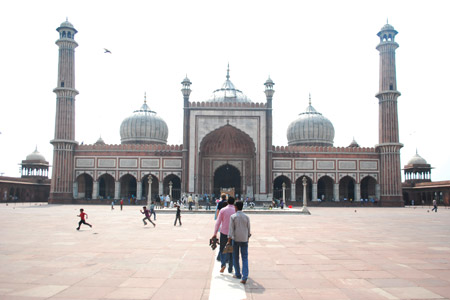
A rickshaw driver followed us for a while, pushing his services. “Where are you going?” he demanded, reeling off a list of tourist sites. “You cannot walk here, it is too dangerous.” We managed to shake him off among the stalls and skirted the side of the market, heading for the tall minarets of Jama Masjid mosque, which was built by Shah Jahan, grandson of Akbar, in 1656. We’d been warned to expect scams here, so I was alert when a brusque and aggressive doorman tried to charge us 200 rupees each to enter the free-of-charge mosque and, at another gate, someone demanded a highly improbable ‘exit fee’ to leave. “You’d think people would behave better in a mosque,” Joyce said.

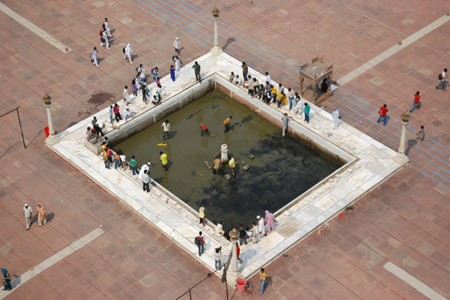
Jama Masjid mosque, the view from the minaret, and the marketplace outside.
© Andy Brown/2011/India

The mosque itself was an architectural marvel in red sandstone and white marble, with three large domes and two tall minaret towers. We had to take our shoes off and the hot stone ground scalded the bottom of our feet, except where a tatty, threadbare strip of carpet had been laid out. In the centre of the courtyard was a dried out pool of green sludge that was being raked by youths and put into small plastic bags, possibly for sale. A crowd of children watched this odd activity until a bearded mullah in a white robe came over and chased them off, shouting at them and threatening one with the back of his hand.

We were charged another 200 rupees to climb one of the minarets. It was a health and safety nightmare – a narrow stone staircase that emerged into a tiny, crowded turret with no railings. There were spectacular views out across the marketplaces of Old Delhi, to the Red Fort and the Yamuna River beyond it, and back down into the courtyard where foreshortened figures has resumed their sludge raking. There were around a dozen of us up there, all standing on narrow window ledges and clinging onto the metal grills. We quickly took a few photos and headed back down, squeezing past another dozen people coming up. Clearly, no one was counting.

We also skirted the edge of Delhi’s infamous railway station, travelling on its little brother the Metro. It was like a nightmare version of the London Underground at rush hour. Getting on or off the train was nothing short of warfare. As the train approached the platform, the ranks of ‘on’ and ‘off’ lined up, determined to give no quarter. As the doors opened, both sides surged forward. Elbows, shoulders and bags were the weapons of war and no prisoners were taken. Even women and children were not spared. There was nothing for it but to barge with the rest or never leave the train. The crazy thing was that as we emerged, beaten and bruised, onto the platform, we saw that the carriages on either side of us were half empty. The whole battle had been completely unnecessary.

Although I found Old Delhi fascinating, it was hardly a relaxing place to be. “I think I’m more of a New Delhi type,” I said to Joyce as we headed back to my comfort zone. “You’re such a colonialist,” she laughed.

Delhi Daredevils

The other thing I wanted to do while in India was go to a cricket match. I’d heard that these were very different to the stuffy, upper-class events at Lord’s Cricket Ground in London. In India, cricket is the game of the masses, like football in the UK. One of my new colleagues, Ashok, was a cricket blogger and he quickly found a match for us to go to – the Delhi Daredevils vs. Kings XI Punjab. It was a choice between this and a day trip to the Taj Mahal. Clement, head of the fundraising department, was incredulous at our choice. “What, you’re not going to the Taj!” he exclaimed. “Are you crazy? It’s a monument to love! It is so much more romantic than a cricket match. But then I am French,” he added with a shrug.

We caught a tuk-tuk to the stadium but as we approached it the traffic ground to a halt and we got out and walked with thousands of local fans in Delhi Daredevil colours and red plastic horns. It was like the time I went to a football match at Wembley Stadium (Southampton vs. Carlisle) but much more chaotic. The path to the ground went through a slum area with makeshift stores and street kids. The atmosphere inside the stadium was, for lack of a less-clichéd term, electric. People danced and sang and stood on their chairs to get a better view of the cheerleaders, who were wearing red hotpants and white vest tops. Joyce had been to a match in Mumbai where they were much less popular. “People booed and threw things at the cheerleaders,” she said. “They were scandalised by their outfits.”

The Delhi Daredevils in action (this is not my photo!)
© Delhi Daredevils/2011

The crowd was much less tribal than in the UK, where football fans are segregated to prevent violence. Our stand was mostly Delhi fans but there were a few Kings XI supporters, including an extended family a few rows in front of us who would go wild whenever their team won a point. Nobody seemed to mind. “In India, people are more interested in the stars than the teams,” Ashok explained to me. “When a famous player comes on, everyone will cheer for him until he’s bowled out. Then they’ll go back to supporting their own team.” Sometimes this hero worship gets out of hand, however. “When India won the World Cup, there were temples set up so people could worship the players,” Ashok said.

Not being cricket fans, we struggled to follow the match but it soon became clear that the Delhi Daredevils were on course for a major victory. Australian batsman David Warner hit a string of sixes, which sent the ball arching high into the air above the floodlit stadium, coming back down to Earth to land in the crowd. For more match information, see Ashok’s blog at Web Umpire.

On the way out, we gave our tickets to an excited group of street children who gazed wide-eyed at the floodlit stands, and listened to the roar of the crowd from inside. Sadly, a used Delhi Daredevils ticket was the closest they were ever likely to get to their country’s national sport.

On balance, despite its rough edges and occasional shady characters, I really liked Delhi. It also resisted easy generalisations. Although taxi and tuk-tuk drivers were often the worst scammers, we also met some charming and friendly exceptions. On Sunday we went to a place called ‘Olive Bar’ in the far south of Delhi with only the vaguest of directions. The driver, a jovial and chubby middle-aged man called Johar, had to keep getting out to ask people if they knew where it was. “No problem: your problem is my problem,” he said as he eased his bulk out of the small tuk-tuk and we tried to apologise.

On the way, Johar told us his family history. “My grandfather was friends with a British colonel during the Second World War,” he said. “After the war, he went with him to visit London. It took a month to get there on a ship but he only stayed for 15 days.” I asked what his grandfather did in the army. “He was a storekeeper,” Johar replied. “He was in the army but no fighting!” Joyce found him delightful. “He was like a big teddy bear,” she said. “I just wanted to hug him.”

‘Untouchables’ congregate in Lodi Gardens for their Easter Sunday celebratio.
© Andy Brown/2011/India

For more photos, see my Facebook photo gallery.

On the waterfront: Songkran in Thailand

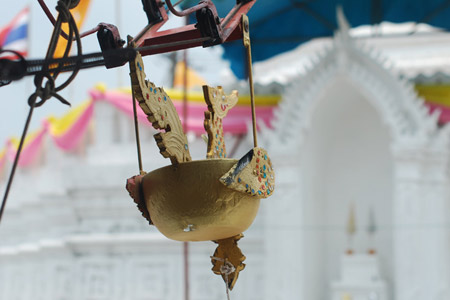
An ingenious variation on the traditional water ceremony at a temple on Koh Kred.
© Andy Brown/2011/Thailand

Water has many associations in Thailand at this time of year. It’s a symbol of devotion to elders and the Buddha. Yet it’s also a sign of youth and anarchy; of childhood and play. This week is Songkran, or Thai New Year, when the entire country marks the anniversary of the Buddha’s birth by staging the world’s largest water fight. According to the traditional Thai calendar, the year is now 2554.

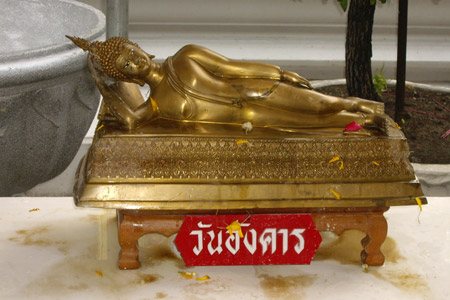
The word Songkran comes from the Sanskrit ‘saṃkrānti’ meaning astrological passage. It lasts for three days, from 13 to 15 April, and falls into two distinct parts. In the mornings, Thais go to visit their elders and pour water on their hands as a sign of respect. Then they go to the temple and wash Buddha statues with water and flower petals from golden bowls.

At work this week, we had a short ceremony where we poured water over Anupama and Tomoo’s hands – the heads of UNICEF’s regional and country offices respectively. We also saw temples where ritual washing was in progress. At one, on the island of Koh Kred in the Chao Praya river, an ingenious contraption had been set up. For a donation, you got a bowl of water that you attached to the claws of a golden bird. By turning a wheel, you activated a series of pulleys that hoisted the bird on a cable up to the top of a temple spire, where its bowl tipped over, pouring water and petals down the side of the building.


Originally, Songkran was all about these devotional activities but, like Christmas in the West, it’s taken on a more secular character over the centuries. Songkran is now primarily about celebrating, with street parties and water fights erupting across the country during the afternoons and evenings. We’d heard that the biggest fights in Bangkok took place on Khao San Road, which runs through the heart of the backpacker district near my office. So after lunch on Wednesday, Joyce and I changed into shorts and T-shirts, with dry clothes and a camera cocooned in layers of plastic bags in a backpack, filled up our super-soaker water pistols and headed out to do battle.

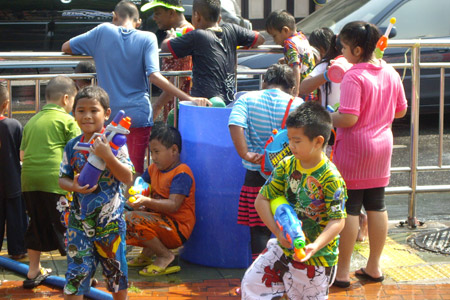
Children guard a water station by Phra Sumen Fort.
© Andy Brown/2011/Thailand

Game on

We didn’t get far before our first water fight. We arrived at the boat pier at Kiak Kai to catch a boat to Banglumphu. An extended family had set up a checkpoint at the entrance to the pier, with a large tank of water and a hosepipe. They weren’t paying attention when we arrived and there was only a small girl at the water tank. Her parents shouted at her to get us but she just looked at me, eyes wide with apprehension. If we thought we were safe, however, we were mistaken. A young man and a middle-aged woman pursued us onto the pier with bowls of water, which they tipped over us. In return, we shot as much water as we could at the young man. The woman made signs not to shoot her, presumably because of her age, but I felt this was a poor excuse given the drenching she’d just dealt out, so I gave her a modest squirt from my gun.

In Banglumphu, we made our way to a small park by Phra Sumen Fort, an old whitewashed fortress on the riverbank. This octagonal brick-and-stucco building was constructed in 1783 to defend against naval invasions and was one of 14 watchtowers that once lined Bangkok’s old city wall. Today, a music stage had been set up here and a band was practicing, with speakers covered in shrink-wrapped plastic. Children were running around with water pistols, shrieking with joy. We had a few fights but invariably ended up coming off worse – the kids had better guns than us and were already soaked, and hence fearless. We shot one small girl with her parents, however, who was so started that she dropped her gun.

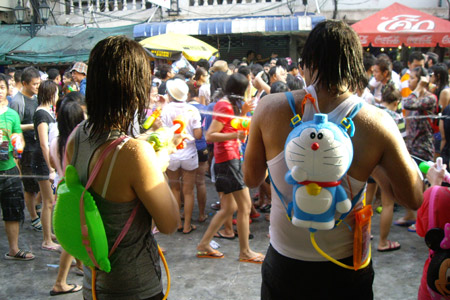
There was a small bridge set up on the pavement where you could fire at passing traffic. Occasionally, a pickup truck would come past with a gang of well-armed teenagers in the back and the fighting would intensify. Occasionally, we fought among ourselves. We got ambushed by a young Thai guy manning the nearby filling station (normally a drinking water fountain). He was wearing a motorcycle helmet and had a plastic backpack in the shape of a Japanese cartoon character, full of water with a hose connecting it to his gun. Afterwards, he raised his visor so we could shoot back, smiled broadly and filled up our guns for us. “Sawatdi pi mai,” he said (Thai for Happy New Year), as he handed them back.

Throughout the day, the atmosphere was incredibly friendly and good natured. We chatted to a Thai couple at the filling station. “You can shoot anyone you like,” the young man said. “But if they’re unwilling you should always apologise first.” Later in the week, when we were dressed up and on our way to the cinema, a teenager cornered us with a bowl of water. “Sorry, sorry,” he said before tipping it over us.

A reclining Buddha statue, still wet from his morning bath.
© Andy Brown/2011/Thailand

Band of brothers

At the park, we met our friends Michael and Kari, a Kiwi-Aussie couple who run a regular yoga and daal night on Tuesdays. They were wearing floral ‘Songkran’ shirts and Michael had two large guns on a strap around his neck, reminding me of a character from a John Woo movie. “It looks cool but they’re a pain to carry after a while,” he said. Both of them were already drenched. “We got a tuk-tuk here and the driver stopped at every water point so they could soak us,” Kari said. “He got wet too of course. It cost 400 baht but it was well worth it.”

Together, we made our way down Phra Athit and into the backpacker district. Some tourists were just arriving, fully dressed with wheelie suitcases, and were very upset about getting their stuff soaked. I felt sorry for them but Kari took a harder line. “They should have done their research properly,” she said. Other, better prepared travellers were indeed wearing waterproofs and had their backpacks wrapped in plastic.

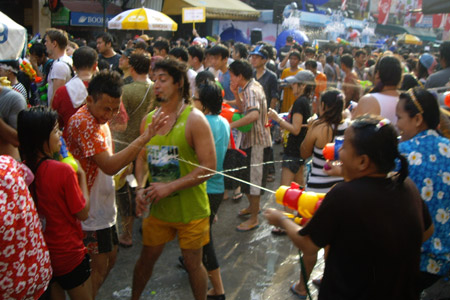
We took a short cut through a temple complex where orange-robed Buddhist monks live in traditional Thai-style wooden houses. Here the fighting eased off as people burned incense sticks and a line of golden Buddha statues stood glistening in the sun, still wet from their morning ablutions. We came out of the temple opposite Khao San Road, where the size of the crowds and intensity of the water battles exceeded anything we had seen so far. It was also a much more adult affair. The road was lined with bars and scantily clad girls danced on top of barrels holding up signs advertising beer prices. Sound systems pumped out dance music and occasional party classics like House of Pain’s ‘Jump Around’, which I remember well from indie discos in the 1990s.

The road was completely rammed and you had to push slowly through a crowd of revellers in varying degrees of drunkenness. The militias that lined the roadside here were more hardcore. They had a new weapon – massive ice blocks that melted to produce freezing cold water. We were already wet but it was like getting soaked all over again. It’s a bit like diving in a brackish lake you come to a point where you suddenly realise that there are two types of water. Water fights here often took the form of locals vs. backpackers but it was hard to say who was winning. We also encountered another feature of Songkran here – teenagers with pots of white clay which they plastered on your face, hair and clothes, usually with a ritual “sorry, sorry”. This practice originates from the chalk that monks use to mark blessings, but now it’s just another part of the general mayhem. At each end of Khao San Road was a mountain of discarded clay pots, and the water underfoot turned white with their run-off.

Locals and tourists face off amid the mayhem of Khao San Road.
The Khao San Road militia, armed with cartoon character water backpacks.
© Andy Brown/2011/Thailand

Time out

Half way down Khao San Road, we escaped down a side alley and ordered pizza and mojitos at a bar. A large, pale American came up to us with a cigarette and lighter. “Can anyone help me light this?” he asked. “I think you need dry hands, or at least a dry thumb.” His hands looked terrible – the fingers were white and puffy like a bloated corpse. Then I looked at my own hands, which were suffering from a milder form of the same condition. At the next table was a Thai nationalist, a rare exception to the civility and friendliness of the day. “America will be destroyed! Britain will be destroyed!” he ranted at an unfortunate pair of tourists. “In Thailand we have a great and powerful King.” The next minute he threw up down the front of his shirt and passed out on the table.

We finally emerged at the far end of Khao San Road by Democracy Monument – the scene of recent political protests by ‘red shirt’ demonstrators, where we jumped in a tuk-tuk and headed home. On the way back, I emptied my water pistol by shooting at passengers in other tuk-tuks whenever we stopped at traffic lights.

Later in the week, I explored our neighbourhood on foot to experience the local side of Songkran. By this point, Joyce had had enough so I headed out on my own with my trusty plastic pistol by my side. There’s a 7-Eleven store on virtually every corner and these were invariably manned by a small mob with a sound system, water tank and hosepipe. In some cases these were family groups, in others teenagers. On one corner there was a group of transvestites in coloured bras and wigs, dancing to kitsch disco music. At another corner a small boy stole my gun, then wrapped his arms around my leg and tried to stop me leaving, to laughter from the adults.

The group nearest our flat were having a street party that had lulled until I arrived. When they saw me coming with my super-soaker, they turned their music back on and began dancing excitedly in the street. After exchanging good-natured waterpower, they poured me a whiskey and ice and refilled my gun. I practiced my conversational Thai and chatted for a while to a young man who spoke broken English. He indicated three girls in the street. “Ladies no man,” he said several times. I didn’t get what he meant at first but when the girls competed to take a photo with me, giggling loudly, the truth dawned. “Sorry, I have lady already,” I apologised.

Songkran was probably the best time I’ve had in Thailand so far. It was a chance to meet local Thais from different social backgrounds, to understand more about their culture and national character, and to take part in one of the biggest and best-natured street parties I’ve ever been to. Perhaps most of all, it was a chance to get in touch with my inner child. As a boy, I’d always dreamed of being able to shoot water pistols indiscriminately at passers-by but it’s not something you can get away with in Britain’s more formal culture. Here, everyone is a child for three days. Adult Thais even talk about themselves as such. On Thursday I turned up for work in a T-shirt and shorts, with dry clothes in my bag as a precaution. “I see you’re ready to play today,” my colleague Pear said with a smile.

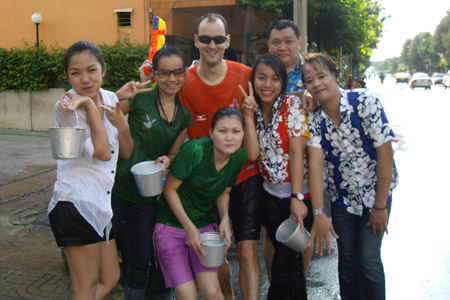
Friendly locals pose for a photo outside a nearby 7-Eleven store.
© Andy Brown/2011/Thailand