Movin' on up: Typhoon Ketsana one year on

I visited the town of San Pedro in Laguna, the Philippines, in December 2009 following Typhoon Ketsana. I went back in August 2010 to see how the situation of children had improved.  

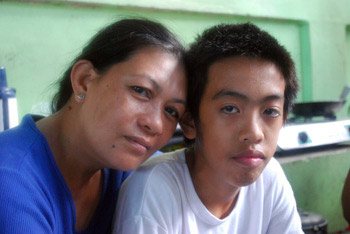
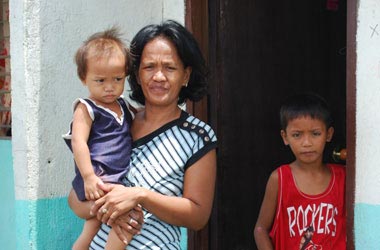
Lusminda and Danilo Morales outside their new home
© UNICEF Philippines/2010/Andy Brown

Ten-year-old Danilo Morales lives with his parents and eight brothers and sisters in a single room concrete house in South Ville resettlement community, San Pedro, Laguna. The family don’t have much but they’re grateful for it nonetheless. This time last year, the Morales family was among the 400,000 people forced to abandon their homes and seek shelter in evacuation centres as Typhoon Ketsana (known locally as Tropical Storm Ondoy) raged across the Laguna area. The storm pummelled the Morales’s shanty home in Landayan to pieces and the rising floodwaters swept away their possessions. They were lucky to escape with their lives.

“We were very afraid when the storm arrived,” Danilo’s mother Lusminda said. “It was raining hard and the flood waters were moving fast. My husband and I managed to get all the children safely to Landayan covered court, where we sheltered for the first few days.” The family were transferred to three different evacuation centres, before finally moving to their new home in South Ville. “It was a difficult time for us,” Lusminda recalled. “We had problems getting food, water, clothing and medicines when the children got sick.”

Things are much better now for the Morales. “We’re very happy to have our own home. It’s safe here and we don’t have to worry when it rains. The school is close by and we can go into town on the jeepney to buy food. My husband and I make a bit of money selling ‘taho’ but we’re looking for a better livelihood. I hope there are no more floods and we can live happily ever after”


Looking back

This was my second visit to the San Pedro area. The first time was in December 2009. Back then, Laguna lake was still overflowing and hundreds of families from the Landayan area were packed into a crowded covered court at San Pedro Elementary School. The situation was difficult, both for the evacuees who struggled to make ends meet and for the teachers and students who had to share their school with them.

I started off by revisiting the school and met up with Emily Ebreo, the teacher who showed me round last time. The school was at once familiar and utterly transformed. As we walked around the covered court, I could still picture the evacuation centre in my mind. “This is where people cooked and this is where they hung their clothes out to dry,” I said to Emily, pointing here and there. Now, the court was full of excited children running around and, once I’d got out my camera, posing for photos in ever growing crowds.

The covered court was still chaotic but in a very different way. The chaos of a normal schoolyard with children running around and shouting happily had replaced the desperate chaos of the evacuation centre. The classrooms that had formerly housed evacuees, forcing the school to cut lessons, were now refurbished, brightly decorated and full of young students. I’d visited on the day of a ‘readathon’ and children were engrossed in books of Filipino myths and legends. Later, they would be asked to explain the stories in their own words.

There had been some more recent storm damage to the school. In July, Typhoon Bashang had brought down a large tree in the schoolyard, damaging the roofs of two classrooms. “We were closed for a few days but it was nowhere near as bad as Ondoy,” Emily said.
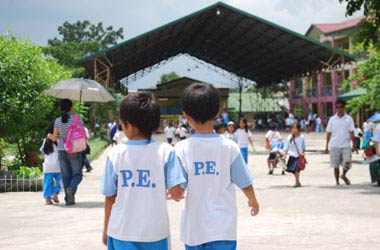
Children play in the covered court formerly used as an evacuation centre
© UNICEF Philippines/2010/Andy Brown

Settling down

I wanted to find out what had happened to the evacuees so we went to the local council office, where we met Marilou Balba in the urban development and housing department. “We moved the families out of the schools earlier this year so as not to disrupt the children’s education,” she explained. “Some went back to their provinces and others moved back to their old homes when the water level in the lake went back down.

“We’ve built new homes for the rest at South Ville resettlement community. This was originally intended for informal settlers living along the railway line but we’ve allocated one area for Ondoy evacuees. We’re planning an extension so that we can rehouse the people who went back to homes alongside the lake. They’re still at risk if there’s another flood.”

Marilou agreed to take us to South Ville to meet the families who had been rehoused there. We drove out along a rough road, past factories and an old dump site. The resettlement community itself was built along a regular grid, with blocks of small concrete houses laid out in meticulously straight lines, in marked contrast to the organic sprawl of urban slums. An elementary school was already up and running and a clinic was under construction. At the local office I was shown a map of the site, with the areas set aside for railway families highlighted in pink and those for the Ondoy evacuees in yellow.

We walked down to the Ondoy block. Most children were in school but a few were still at home. Outside one house, a group of boys played a game of pool using counters on an ingenious homemade table that they swivelled round to line up the best shot. Next to them, a group of girls was at work making flower garlands for sale. Stalls and shops had sprung up on street corners selling food, water and household supplies.

After meeting the Morales family, we went to see the new school and speak to some of the students and teachers. Here, I met 11-year-old Marilou Paderez, also from Landayan. She was living in South Ville with her parents and four siblings. Her father had got a job as a construction work. “Our house was destroyed by the storm and we were evacuated to a covered court,” Marilou remembered. “Life was hard. We lived in a very small space and I couldn’t go to school for several months. I’m happy to be living here in South Ville. We have our own house and we don’t have to worry. I like the school and my teacher is very good.”

I asked Marilou what her favourite subject was. “I like Maths because you can divide, subtract, multiply and add up,” she replied. “When I grow up I want to be an accountant so I can help support my family.”

Prepare for the worst

Now that life has returned to normal in San Pedro, the priority is preparing for future disasters. The local council has set up a disaster coordinating council and, when I visited, the provincial government was holding a summit on disaster preparedness. One of the reasons the council is resettling people from Landayan in South Ville is so that they’re on higher ground if there’s another flood.

UNICEF is also working with schools and local communities on disaster preparedness. “One thing we’ve been working on in the last few years is a building back better programme,” UNICEF Philippines Communication Chief Angela Travis explained. “So we’re building stronger schools that should withstand typhoons much better than the original buildings.

“We’re also educating children and communities about what to do in a disaster. For example, many of the books and schools supplies were swept away when the water rose. So we’re encouraging people to put these things on higher shelves in schools and homes. The children also learn an emergency drill in the event of a disaster, to make sure everyone is accounted for.”
Philippines diary: Home for Christmas

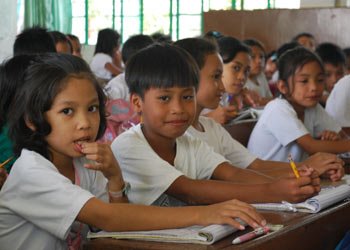
Children do their best to learn in an over-crowded classroom
© UNICEF Philippines/2009/Andy Brown

In my last week working for UNICEF Philippines, I returned to the evacuation centres to see how children and their families were coping in the run up to Christmas. In the two months since Tropical Storm Ondoy, many of the 400,000 displaced people had returned to their homes or to resettlement communities. However, around 70,000 were still living in evacuation centres, primarily in the Laguna region.

The focus of the trip was on schools being used as evacuation centres. I was travelling with Martijn, who was looking at the impact on children’s education, and Hirut, who was testing a new needs assessment form.

The first evacuation centre, in San Pedro Elementary School, was quite chaotic. The 200 families living there had been told that the military would be arriving the next day to transfer them to a ceramics warehouse. While the education team met local officials, I went with a teacher to interview evacuees. I was quickly surrounded by a large crowd of people demanding food, money and supplies. They were clearly desperate and I knew from my security training how these situations can turn ugly. With the teacher’s help, I explained that my job was to report on their situation, in order to try and raise more money, but that I couldn’t personally promise them anything. Eventually they calmed down but it was an unnerving experience.


The second school, Dela Paz Main Elementary, was much more organised and peaceful. We were shown round by Mrs Bennett Layngan, the teacher in charge of evacuees, who also teaches a Grade Four class in the afternoons. She was managing the situation as best she could. “The evacuees are in a separate extension wing, separated from the rest of the school,” she explained. “They have a water pump and cooking and cleaning areas. There are also education sessions for the children, run by Save the Children. To make room for the evacuees, some of our students have been transferred to another school nearby.”

Close family

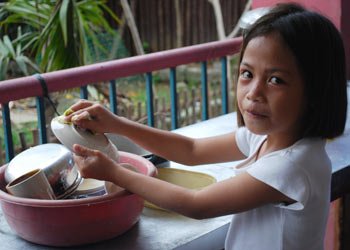
Mariel, 9, demonstrates her washing up skills at the evacuation centre
© UNICEF Philippines/2009/Andy Brown

We also met the Cervito family, who were living in the evacuation centre. The family of six were living in a two-metre square corner of a former classroom. Their tiny living area was marked by bedsheets hung from a clothes line, with their few remaining possessions neatly arranged on a small wooden table.

I spoke to Mariel Cervito, 9, who is in Grade One. She told me that she enjoys maths, reading and writing and wants to be doctor when she grows up. “I like having lots of play mates here but I miss my home,” she said of living in the evacuation centre. “I like helping my mum wash the dishes.”

After the storm struck, Mariel and her four siblings were carried to safety by their parents. “We just took the children and left all our possessions,” her mother Marlene recalled. “My husband and I waded here through the flood waters carrying the children.”

The Cervitos’ home is near Laguna lake and has been flooded since September. The waters are slowly subsiding but with no drainage channel from the lake, it will take until the end of January before it’s safe for families to move back in. As a result, they will have to spend Christmas in the evacuation centre. “I’ve been back to the house to clean it but the water’s still knee deep outside,” Marlene said. “When I open the doors, it just floods back in.”

There are nearly 150 families still living at Dela Paz Main Elementary School and life isn’t easy for them. “It’s uncomfortable and sometimes dangerous,” Marlene commented. “My one year old fell down the stairs and cracked her head open. She’s OK now but we had to rush her to hospital.” The family had no money so Bennett paid the hospital fees out of her own pocket.

The school was only a couple of blocks from the flooded area, so afterwards we drove down to take a look. The streets were still flooded and we had to be careful where we drove. We saw women and children wading to those houses that were still habitable and a few other vehicles driving slowly through the water. On one street, we unexpectedly saw three men carrying a fridge through the flood waters and into a house.

Training days

I spent the rest of the week training Marge, Pam and Gina in a range of web activities including audio and video editing, designing mass emails and producing ‘splash’ webpages. I also wrote a report for UNICEF’s regional headquarters in Bangkok about what we’d achieved over the two months, with recommendations for other offices in the region.

On the social side, I organised a trip to climb Taal Volcano with Martijn, Silje, Harout and others. A few hour’s drive south of Manila, Taal is an impressive sight, with a (geologically speaking) young volcano rising out of a lake inside the vast crater of an ancient volcano. On the way up, we passed hot vents exhaling sulphurous steam into the atmosphere. Back in Manila, I went to a gig with Marge to see my favourite Filipino band, Sinosikat?, at a small venue in a converted Spanish villa.

Martijn and I both finished work on 18 December, so we had a joint leaving party. Rather than going straight back to the UK, I’d taken the opportunity to spend my Christmas and New Year holiday in the Philippines. My girlfriend, Joyce, flew out to join me and together we travelled south to the Bacuit Archipelago, in Palawan, then north to Banaue rice terraces, in Luzon.

The Bacuit Archipelago is how I imagine Thailand must have been like before mass tourism arrived there. We stayed in a beachside cottage in a rural village on the mainland and took snorkelling trips out with local fisherman to the islands, where vertical limestone cliffs rose directly out of a still sea. On Christmas Day, we watched the sun set behind the islands from a boat in the bay, as giant turtles swam past.

Me and Joyce at the rice terraces in Banaue

The rice terraces at Banaue gave us a glimpse into Filipino life in past centuries. Now a UNESCO World Heritage Site, the mountain sides were first sculpted into stone walls terraces somewhere between two and four thousand years ago. Local farmers still maintain the terraces and elaborate irrigation system. They live in traditional wood and bamboo houses, although in many places the thatched roofs have been replaced by corrugated iron. At Batad, a vast amphitheatre-shaped terrace dominates a small village in the basin below. When we visited, farmers were just starting to plant the rice for next year and a few vivid patches of bright green stood out amongst the fallow fields.

In Manila I’d met Jacque, a friend of Angela’s, who works at the UN Food and Agriculture Organisation. She told us about a project she was managing in the area. Many of the rice terraces are declining in productivity and can no longer support the area’s growing population. They are also under attack from worms, accidently imported in pig feed, which eat the rice roots and weaken the terrace walls. “We’re working with local farmers to eradicate the worms and diversify their rice crops, enabling two harvests a year instead of just one,” Jacque said.

Eventually, my time in the Philippines drew to a close and I packed my bags with some reluctance. I’m looking forward to going home and returning to work at UNICEF UK but there are many things I’ll miss. It’s been an amazing experience to live and work in another country and I’ve gained a much deeper understanding of UNICEF’s work after seeing so many projects and meeting the children who are our ultimate beneficiaries. I’ve also been working with a great team of enthusiastic people, who have in many cases become good friends and introduced me to Filipino culture. Finally, I’ll miss the tropical weather and lush scenery as I head back to a country in the icy grip of its worst winter for thirty years.

Philippines diary: In the path of the storm

Arries Tejo, 15, at an evacuation centre in Cubao
© UNICEF Philippines/2009/Andy Brown

At the end of last week’s diary, I was heading home on Friday night with the tops of the tower blocks disappearing beneath a shroud of rain and cloud, the wind starting to whip up and a distinct sense of trepidation as Typhoon Santi stormed directly towards Manila.

I’d witnessed a hurricane before, in Cuba in 2005. That time, I remember spending half the night in a hotel bar in Havana, drinking rum and playing cards while the wind beat on the boarded up doors and windows. It was like something out of John Huston’s 1948 film noir classic, Key Largo. The next day, the street outside was flooded waist deep and you could see waves crashing over the sea wall and against the lighthouse in Havana bay.

This time, the storm was due to pass directly overhead in the early hours of the morning. As a precaution, I moved my bed from under the window to behind a wardrobe in the lounge area. I slept through most of the night but woke up at 6am, with the wind rattling the windows and the electricity out. I took a quick look out of the window to see trees bent almost double but still rooted to the ground. There was, thankfully, no sign of further flooding.


By 10am the storm was over and I was checking in with UN Security. I also spoke to Martijn, my colleague from the education department, who told me that the head of UNICEF Philippines, Vanessa Tobin, had already been on BBC News. Once the power was back on, I was able to do a bit of research and put together a news story for the website.

According to early reports, slum houses had been destroyed by strong winds Taytay, Rizal province, leaving around 5,000 people homeless. There were also reports on local radio that one man had died while crossing a river in Rizal, and another had drowned when his home was washed away in Manila.

“The reports from Manila are not as bad as had been expected,” Vanessa said. “But we are getting reports from the South, particularly around Bicol which was hit in 2006 by mudslides, that there has been heavy rain and significant damage there.”

After the flood

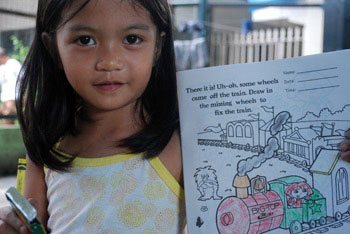
A young girl displays her colouring at the evacuation centre
© UNICEF Philippines/2009/Andy Brown

Next week, I’ll be visiting the province of Camarines Norte, partly to assess the damage caused by Santi, but in Manila the focus remains on the victims of Tropical Storm Ondoy.

On Wednesday, I visited an evacuation centre in a former basketball court in Cubao, Quezon City. The centre is currently home to around 40 families, down from 100 in the immediate aftermath of the floods. When we arrived, it was still hot, humid and crowded. The families live literally on top of their belongings with their clothes hanging to dry from the basketball hoops above. They are either waiting for new homes or for the Government to provide transport back to their home towns in the provinces.

For the last five weeks, Arries Tejo, 15, has been living with his mother, three brothers and two sisters in Barangay Bagumbayan evacuation centre. “After the storm came, we were trapped in our house by the flood water,” he said. “We had to wait until the next day for the water to go down enough for us to leave. Then we carried out our belongings and walked to the evacuation centre.”

In many ways, Arries had a lucky escape. “Our house was next to the concrete wall of a factory,” he explained. “After we left, the wall collapsed and destroyed all the houses on our road. Now we have to wait here for a new house.”

UNICEF is working with local charities to provide child-friendly spaces, education and psychosocial support to children like Arries in the evacuation centres. In Barangay Bagumbayan, we have partnered with Lingap Pangkabataan (Caring for Children), a faith-based organisation that was already working in the area with street children, indigenous communities and the victims of child trafficking.

Staff at Lingap saw firsthand the impact of the disaster on children in the area. “After the flood the children were traumatised,” Project Officer Rexan Dayad said. “Some of them are orphans; others have been left behind by their families. Many of the children have no access to healthcare and cannot go back to school because they have lost their school supplies and uniforms. There are children that sleep on the streets, even during the afternoon, because there are no activities for them. We are advocating for their rehabilitation.”

At the evacuation centre, Lingap outreach workers ran several sessions simultaneously. One group of girls got crayons and colouring books, while boys listened to a story, then learnt and sang songs. Older children took part in a more advanced music group with xylophones. A fourth group made birds out of coloured clay. “These activities allow children to rediscover their world in a protected and supervised environment,” Project Coordinator Cathyrine Eder commented.

There is still a lot of work to be done, particularly with children and families who were unable to get to the evacuation centres. “In those areas we haven’t yet reached, there are children who are afraid their community will be flooded again when it rains hard,” Cathyrine added. “Every time it rains they start putting their things on plastic bags. There are also children who wake up in the middle of the night because they’re having nightmares.”

Pied Piper of Manila

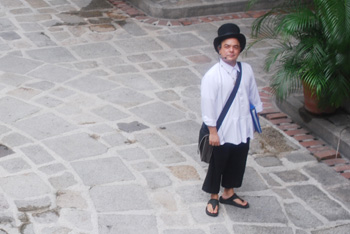
Carlos stands in the courtyard of Casa Manila, a reconstructed
Spanish colonial house. © UNICEF Philippines/2009/Andy Brown

The next weekend, I got a chance to do a bit of sightseeing. I met up with Martijn and Silje, my colleagues from Holland and Norway respectively, to go on a walking tour of Intramuros, the old Spanish fort at the centre of Manila. Our guide was Carlos Celdran, the self-styled ‘Pied Piper of Manila’, famous for his irreverent and theatrical take on Filipino history. Lonely Planet describes him as “the best thing to happen to Manila tourism in decades”.

Carlos arrives outside Manila Cathedral at 9am in shorts, an immaculate white shirt and top hat, with a stereo playing patriotic music. He’s small man with a larger than life character. Martijn says there’s a Dutch word that translates as ‘pleasantly insane’ which sums him up, however I’m sure it’s at least partly an act. The tour is as much stand up comedy as anything else, with Carlos changing characters for different periods, swapping his top hat for a military cap and glasses or Uncle Sam hat, as befits the narrative.

Carlos takes frequent pops at Catholicism, a potentially controversial approach in such a devout country. He tells us that in Tagalog, the word for ‘heaven’ comes from the Malay for ‘sky’, while the word for Hell is the Spanish ‘Inferno’. “This tells us that there was always Heaven in the Philippines, but Hell arrived with the Spanish.” he jokes.

Nothing is sacred. US General McArthur, who ‘liberated’ Manila from the Japanese at the end of the civil war by carpet bombing the city, contributing to the deaths of 150,000 civilians, comes in for a particularly savage mauling.

Even the Philippines’ national hero, Jose Rizal, whose 20 foot statue dominates the lobby of my office, his giant quill poised in mid air, gets a gentle ribbing. Carlos says Rizal was chosen as national hero by the Americans because he was a writer, not a revolutionary, and above all safely dead – having been executed by the Spanish in 1896 for writing two subversive novels Touch Me Not and The Reign of Greed. This is true but only in the same sense that Karl Marx was a writer not a revolutionary. After all, Rizal’s ideas and subsequent execution were the trigger for the first nationalist uprising against the Spanish.

Rizal remained an intellectual to the very end. “I am most anxious for liberties for our country,” he wrote on the eve of his execution. “But I place as a prior condition the education of the people so that our country may have an individuality of its own and make it worthy of liberties.” Inspired by our history tour, I later bought a copy of ‘The Noli’, as Rizal’s first novel is popularly known by Filipinos, to read on the road next week.

During the tour, Carlos sums up Filipino culture with the metaphor of the ubiquitous jeepney. These are clapped-out American jeeps, covered with Catholic slogans and Chinese good luck symbols. Like the Filipinos themselves, they’ve taken something from every culture they’ve come into contact with but combined it to make something uniquely their own.

Philippines diary: Learning the hard way

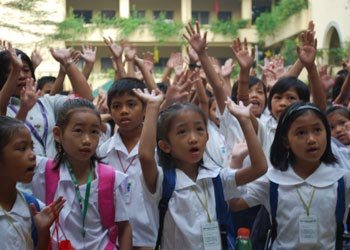
Children wave at a morning assembly on their first day back after the floods
© UNICEF Philippines/2009/Andy Brown

If my first week in the Philippines could be described as relatively uneventful, the same certainly can’t be said for the second. I saw a school reopening for the first time since the floods, I met street children in Chinatown, watched the government being held to account over child rights and ended the week barricaded in my flat in the path of an oncoming typhoon.

My week started at 5:30am on Monday. I was up, not necessarily bright but certainly early, to go to Pinagbuhatan Elementary School, which was opening for the first time following the devastation caused by Typhoon Ketsana. For children who had been through the stress of losing their homes and in some cases loved ones to the floodwaters, it was to be a welcome return to normality.

It took us a while to find the school and by the time we arrived the assembly had already started. Hundreds of children in clean and pressed uniforms thronged a large courtyard in the middle of the school. I was summoned to the stage and made my way through a press of small bodies to the front.


Again, perhaps by virtue of my status as a celebrity foreigner, I was asked to address the school. Feeling a bit of a fraud, I complied. I haven’t had to speak in front of so many children since I ran as the Labour candidate in my own school’s mock election back in 1990. This time, my speech was far shorter and much less political.

Towards the end of the assembly, the children were presented with school kits in UNICEF backpacks. Finally, my colleague Arnaldo from the education department, universally known as Ar-ar, led a puppet show for the children, with four puppets in the style of Sesame Street. It was great fun but there was also a serious point to the exercise, as Ar-ar explained to me later.

“Children love puppetry and are very receptive to it,” he said. “So this morning, before the assembly, we talked to the children about their experiences and how they felt. We put all of that into the story of today’s puppet show. We also talked to the teachers about using the puppets later on to tackle health, nutrition, water and sanitation issues.”

After the assembly, I interviewed the Principal, Iluminado Leno. “All our classrooms were damaged in the flood, along with the canteen and the clinic, and all the equipment was swept away,” she said. “We sent teachers to the evacuation centres to continue lessons wherever possible. We are happy and surprised by how many pupils came back today and hope even more will come tomorrow. This will help them forget their distressing experiences.”

Finally, I tried to talk to some of the children but they were too shy to say much. I think I need to work on my interviewing technique. Ar-ar recommends using puppets! One thing that strikes me is the contrast between the UK, where a lot of children take school for granted and can’t wait for a chance to skip it. Here the opposite is true. Filipino children really value education and will overcome great barriers to get it, as I was to see even more starkly the next day.

“After a disaster, children are sent to evacuation centres and often they’re just sitting there all day with nothing to do,” Ar-ar said. “When we asked them how they feel, the children would say ‘I miss my teachers; I miss my classmates; I lost my school bag; I want to go back to school.’.”

Under pressure

Butch with Mary. He hopes to get her back into school soon
© UNICEF Philippines/2009/Andy Brown

On Tuesday, I hooked up with Jes from UNICEF’s child protection department and went to see an amazing project that’s bringing education and life skills counselling to Manila’s most vulnerable people: the street children.

The project is run by a local charity called Childhope Asia Philippines, which operates out of an old Spanish colonial villa. The Spanish ran the Philippines for over 300 years, from 1571 to 1898, and are not remembered fondly for it. Much of their architectural legacy was destroyed in the battle for Manila between the US and Japan at the end of the Second World War but a few building like this survived.

At the villa, we met one of the charity’s outreach workers. Butch, 47, is a real character. In combat shorts and t-shirt, he still retains some of the style and attitude of the street child he used to be. Butch never knew his parents and ran away from home after his grandmother died. He ended up on the streets, where he led a gang, sold drugs and acted as a pimp for other boys. By the time he was 17, he realised his life had to change.

“We were a group of eight kids and I was the leader,” Butch said. “I was street smart and didn’t trust anyone. But these people, the social workers, they were persistent and really got to know the group. So I said ‘I’m going to try this. Why not? I have nothing to lose’.”

While other street workers educate the children with regular classes, where they learn things like basic maths and literacy, Butch concentrates on counselling, helping individual children work through their problems.

“There is a lot of abuse on the streets,” he says. “In my area there are a lot of market vendors who think that street children are the dregs of society. So they don’t think these kids have rights. Every day, the kids get sick from pneumonia, skin disease and tuberculosis. They are hungry and have to look for food all the time. They don’t have good friends and there are lots of vices around them.”

Butch is strongly motivated to do this kind of work. “It’s more than payback,” he says. “I feel an obligation and responsibility to take care of other people. Certain kids have the inner strength but they need some support from the outside.”

As the light started to fade, we headed into town to the square outside Binondo Church in Chinatown where the street children congregate. We got out of the car into a busy square, surrounded by the hustle and bustle of Manila street life. We’re immediately surrounded by a crowd of excited children who clearly know Butch. They make us press our hands to their foreheads, which is a form of blessing.

Despite their blackened bare feet and ragged clothes, the children seem happy and outgoing. There’s none of the shyness I saw at the school. Several of the kids want me to take their photos and strike up tough street poses. This attitude is belied, however, by their child-like enthusiasm to see the pictures.

Street children play an educational game at a street learning session
© UNICEF Philippines/2009/Andy Brown

One of the other street educators starts a class right there in the street and the children’s attention is diverted. If anything, they’re even keener to learn than the children at Pinagbuhatan Elementary School. As the class starts, other children race across the square to join in.

Afterwards, I talk to Mary (not her real name), 12, who lives and works with her family on the streets of Manila. She helps her mother sell cigarettes outside Starbucks in Binondo (Chinatown) and looks after her younger brothers and sisters. She has been out of school for two years and is under pressure from her peers to sniff solvents. “I don’t want to sleep on the streets anymore,” she says.

After counselling from Butch, Mary is attending the alternative learning sessions, where she is showing academic promise. She’s now decided that she wants to go back to school. “I like learning maths, Filipino and how to take care of my body,” she says. “I want to be a nurse and help people who are sick, like the people who got ill after the last typhoon.”

We’re just round the corner from Starbucks, so afterwards we go and meet Mary’s family. I tell her mother how smart Mary is and show her some of the photos. Later on, I get prints made which I’ll give to Butch to pass on to the children.

This is without a doubt the highlight of my visit so far. I feel overwhelmed by a jumble of conflicting emotions. I’m upset for the children and what they have to go through but inspired by their resilience and by the work that Butch and the other street educators do. Also in the mix is the slightly selfish thrill of getting a really strong story. This is what I love most about my job: finding and telling the stories of these kids, hopefully to inspire others to take action, whether by donating, campaigning or fundraising for UNICEF.

Could do better

On Wednesday morning, I went to a forum to see the Philippines Government and a coalition of non-governmental organisations present their reports on how the UN Convention on the Rights of the Child has been implemented in the Philippines. The consensus seems to be that although the Government has made progress on passing laws to protect children’s rights, it has failed to implement many of them effectively. One particularly shocking practice that is still going on is executing children in some parts of the country for being ‘communists’.

The forum was held in Club Filipino, another colonial era building. Our event is somewhat overshadowed, and at one point literally drowned out, by an event held by Senator Francis ‘Chiz’ Escudero, who plans to run for President next May. He gave a statement to journalists that he was leaving the Nationalist People’s Coalition. In the Philippines, politicians are only loosely aligned to political parties and it’s not unusual for them to jump ship ahead of an election.

On a personal level, my major triumph this week is mastering the jeepneys. I needed a bit of local help to start with but I now know the main routes around Makati and roughly where to get on and off (it’s an inexact science). I also discovered that if you sit towards the front, you’re expected to pass money back and forth between the driver and other passengers. In the Philippines, everyone’s a bus conductor.

I’m already over my word length so I will tell you about the typhoon next week. Suffice to say that I went home on Friday night with the tops of the tower blocks disappearing beneath a shroud of rain and cloud, the wind starting to whip up and a distinct sense of trepidation as Typhoon Santi stormed directly towards Manila.