Francisca Martinez lives in Suku (village) Estado, high in the mountains of Ermera district in Timor-Leste. She doesn’t know her age exactly but guesses around 30. She has two teenage children of her own and helps look after her sister’s young children. “All the families round here are coffee farmers,” she says. “We earn up to $500 a year selling sacks of beans to an American company. We also keep pigs and chickens and grow corn to eat.”
Ten-year-old Crizelle Joy lives with her grandfather, sister, two aunts and uncles, and nephew in a small one-room hut at an evacuation centre in Barangay (village) Mandulog in Iligan, the Philippines. The village is right next to the river and was one of the worst affected by the flash floods that followed Tropical Storm Washi in December.
“We were asleep in our house when the flood came,” Joy remembers. “The Barangay Captain woke us up. He was going from house to house in a bamboo boat. We had to leave immediately. My grandfather brought blankets for me and my sister but we left everything else behind. I was very scared. It was dark and the water was rising, and I could hear people crying out for help.
I was in the Philippines recently to see how UNICEF was helping children in the aftermath of Tropical Storm Sendong, which hit the southern island of Mindanao last December. This was the worst storm in the area in modern history, dropping the equivalent of a month’s rainfall in just one day and causing flash floods which left thousands of families homeless.
After my morning visit to Barangay Carmen evacuation centre (see part one of this blog), we returned to ‘Alpha Base’, the temporary UNICEF office in Cagayan de Oro (CdO). In fact it was a rented house in a residential compound, with a UNICEF banner hung from an upstairs balcony. Here I met Phil, a bubbly communications specialist from New Zealand who was my main contact for the trip, as well as Love, a friend of mine from the Manila office who had volunteered to work in CdO, and Rohannie, a child protection officer who I was due to accompany on her afternoon rounds.
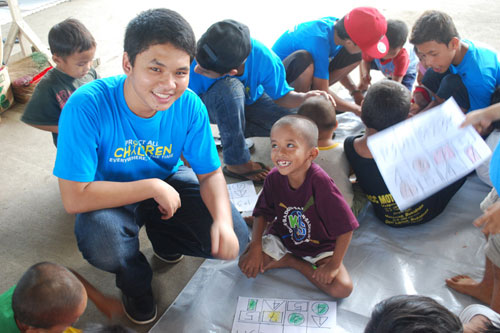
Seventeen year old Kim sits with a group of young children in a child-friendly space at an evacuation centre in Cagayan de Oro, the Philippines, one of the towns worst hit by Tropical Storm Sendong last December. The centre is in a barangay (village) covered court. It’s crowded and humid, with the smell of sweat. Over 130 families live on top of each other with little comfort or privacy – sleeping, cooking and washing in the open.
But this morning an area has been cleared for children, marked out by a UNICEF tarpaulin mat. Here, Kim and other young volunteers are teaching math. “What does five plus two equal?” Kim asks in English, holding up a piece of paper with numbers drawn on it inside different shapes. “Seven!” the children shout happily in unison, before colouring in the right number with a yellow crayon.
Seven-year-old Ratnasunder lives with her grandparents and pet dogs in a former classroom at an evacuation centre at Bang Krai Nok Temple, in Bangkok. The ground floor of the building is flooded and the only way in or out is by boat. For a child who had to flee her home in the face of rising floodwaters, Ratnasunder seems happy and carefree. She smiles broadly and lifts up one of the dogs, squeezing it tightly.
Her grandmother Tongploen is more sombre. “We used to live in a single story house alongside the canal at Wat Po Ain,” she says. “We went back once and rescued some clothes but it’s now flooded up to the roof so we can’t get in. We’re comfortable living here but it’s hard to get out. We used to have our own boat but it’s broken so now we use the public boat.”
Twelve-year-old Tang sits with his sister Ice, 13, in a ‘child-friendly space’ at Laksi Temple evacuation centre, in Bangkok. The children are making necklaces from beads and thread. They are surrounded by a mixture of squalor and beauty. Dozens of families sleep on mats on the floor of the temple, surrounded by their few possessions, while the stench of contaminated water drifts in through the windows. Yet above them, ornate pillars rise up with elaborate designs etched in green, red and orange, while golden Buddha statues look down from their pedestals, smiling enigmatically.
Tired mother Gaew is one of the thousands of people made homeless by Thailand’s devastating floods. She waits with her chubby five-month-old baby, Peem, outside a makeshift health clinic at Bangkok’s Phranakhon Rajabhat University. “Peem has a stomach ache so we’re waiting to see the doctor,” she says anxiously, holding the boy on her lap. “We’ve been here three days. We left our house in Pathum Thani when the water got waist high.”
Last week, we took a group of popular Thai bloggers to see projects for marginalised children in Thailand’s Chiang Mai district. After two days visiting orchard schools in Fang (see part two of this blog), we returned to Chiang Mai itself to visit a drop-in centre for street children. Run by the Volunteers for Children Development Foundation, the centre focuses on preventing and supporting the victims of sexual abuse. Many of the street children in Chiang Mai were sold to child traffickers at the Burmese border and brought into Thailand to work in the sex industry. Once in Thailand, these children are considered ‘stateless people’ and are not entitled to identity cards. This denies them the right to education, healthcare and – when they grow up – to legal work.
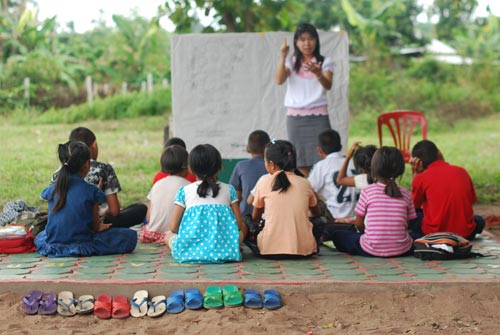
I was in Chiang Mai district last week, introducing a group of Thai bloggers to UNICEF-supported projects for marginalised children. After our visit to the orchard night school (see part one of this blog), we went to see a day school in the same area. We got up early and set off in our vans for an orange orchard outside Fang town. We drove through wide paddy fields, criss-crossed by irrigation canals and filled with a host of yellow grass blades glistening in the morning sun. Here and there, women in straw hats were working in the fields, breaking the earth with wooden hoes. The landscape was layered: beyond the rice fields was a line of low trees that marked the start of the orchards. Behind them, craggy mountains rose up with forested flanks. It was a beautiful scene, but Fang is not a tourist destination. Instead, it’s the centre of a sometimes harsh agricultural industry.
Thailand is rightly famous for the quality of its fruit. The sois (small streets) where I live in Bangkok’s Aree neighbourhood are lined with stalls selling oranges, dragon fruit, mangos and whatever else is in season. The brightly coloured fruit is piled up on mobile trailers: fresh, plentiful and cheap. But this abundance comes at a price. As we discovered during a trip to Chiang Mai province in the north of the country, many of Thailand’s fruit orchards are staffed by low-paid migrant workers, whose children rarely get to go to school.