Chiang Rai: bamboo forests and hill tribes

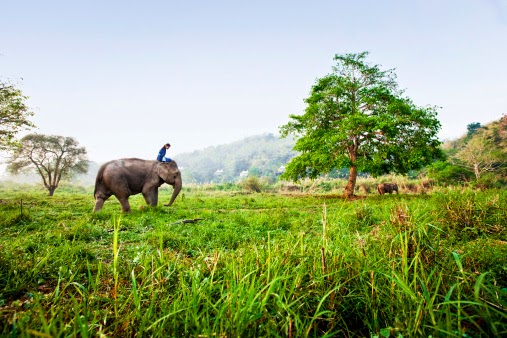
Elephant trekking in Chiang Rai province. Sadly, having lost a memory card
during the trip, this photo is from Lonely Planet

Where Bangkok is concrete grey, Chiang Rai is red, yellow and green. We landed at sunset at a small airport surrounded by dusty red earth and fields of tall yellow grass translucent in the evening sun. Beyond the fields, green forested hills curved out of the plains like the backs of whales from the ocean. This was the first stop on Joyce and my adventure honeymoon through Laos and Cambodia  – the adventure being admittedly more my idea than hers and obtained against the promise of a future beach holiday. We were in Chiang Rai primarily to reach starting point for our overground journey through Laos, but while we were here we decided to take a few days to see the sights.

Continue reading “Chiang Rai: bamboo forests and hill tribes”

Movement of the masses: the Filipino jeepney

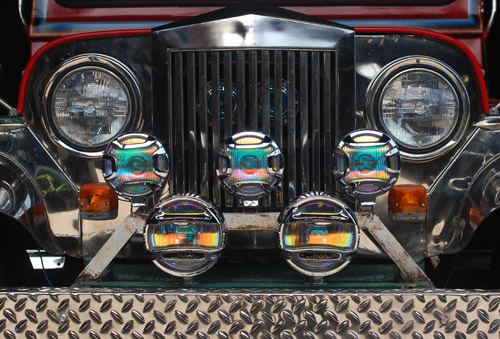
A newly-built jeepney at Sarao Motors, complete with five extra headlights.
Photo © Andy Brown/2011/Philippines

I’ve been fascinated by jeepneys since the first time I first visited Manila in 2009. The psychedelic, graffiti-style artwork mixing religion and pop culture. The names and slogans emblazoned on the front, like ‘Evangeline’ or ‘God is Love’, dwarfing the actual destination. The myriad of coloured streamers and extra, false headlights that serve no practical purpose whatsoever. Decked out in all this finery, they speed up and down the main roads of Manila, picking people up and dropping them off apparently at random. They pile up at traffic lights, sounding their horns in a continuous cacophony and pumping black exhaust fumes into the already polluted atmosphere.

Continue reading “Movement of the masses: the Filipino jeepney”

Filipino history and the 'Pied Piper of Manila'

Carlos holds a portrait of Filipino ‘national hero’, Jose Rizal
Photo © Andy Brown/2011/Philippines

When I think of the great histories of the world – the Roman civil war of the First Century BC, the ‘Three Kingdoms’ of Imperial China, the British Raj and the partition of India – the Philippines doesn’t get much of a look in. But this oft-neglected corner of the world has a fascinating heritage that occasionally places it at the heart of global events in surprising ways.

I was first introduced to Filipino history in 2009 by Carlos Celdran, the self-styled ‘Pied Piper of Manila’, his diminutive figure and larger-than-life character dressed up in Nineteenth Century top hat and tails. Every week, Carlos takes tourists and locals around Manila’s handful of historic buildings – those that survived World War II – and treats them to, not so much a tour, as a piece of stand-up political theatre.

Continue reading “Filipino history and the 'Pied Piper of Manila'”

Delivering mosquito nets in flood-hit Bangkok

Ratnasunder plays with her pet dogs at Bang Krai Nok Temple evacuation centre
© UNICEF Thailand/2011/Piyanun Kiatnaruyuth

Seven-year-old Ratnasunder lives with her grandparents and pet dogs in a former classroom at an evacuation centre at Bang Krai Nok Temple, in Bangkok. The ground floor of the building is flooded and the only way in or out is by boat. For a child who had to flee her home in the face of rising floodwaters, Ratnasunder seems happy and carefree. She smiles broadly and lifts up one of the dogs, squeezing it tightly.

Her grandmother Tongploen is more sombre. “We used to live in a single story house alongside the canal at Wat Po Ain,” she says. “We went back once and rescued some clothes but it’s now flooded up to the roof so we can’t get in. We’re comfortable living here but it’s hard to get out. We used to have our own boat but it’s broken so now we use the public boat.”

Continue reading “Delivering mosquito nets in flood-hit Bangkok”

Escaping the Thai floods at a Buddhist temple

Twelve-year-old Tang with his sister Ice at Laksi Temple evacuation centre
© UNICEF Thailand/2011/Athit Perawongmetha

Twelve-year-old Tang sits with his sister Ice, 13, in a ‘child-friendly space’ at Laksi Temple evacuation centre, in Bangkok. The children are making necklaces from beads and thread. They are surrounded by a mixture of squalor and beauty. Dozens of families sleep on mats on the floor of the temple, surrounded by their few possessions, while the stench of contaminated water drifts in through the windows. Yet above them, ornate pillars rise up with elaborate designs etched in green, red and orange, while golden Buddha statues look down from their pedestals, smiling enigmatically.

Continue reading “Escaping the Thai floods at a Buddhist temple”

A Bangkok university rises to flood challenge

A doctor checks Peem’s stomach at a health clinic at Phranakhon Rajabhat University
© UNICEF Thailand/2011/Athit Perawongmetha

Tired mother Gaew is one of the thousands of people made homeless by Thailand’s devastating floods. She waits with her chubby five-month-old baby, Peem, outside a makeshift health clinic at Bangkok’s Phranakhon Rajabhat University. “Peem has a stomach ache so we’re waiting to see the doctor,” she says anxiously, holding the boy on her lap. “We’ve been here three days. We left our house in Pathum Thani when the water got waist high.”

Continue reading “A Bangkok university rises to flood challenge”

Exile on main street: Chiang Mai street children

Four-year-old Tong makes a tie-dye t-shirt for sale in the centre’s gift shop.
Photo © Andy Brown/2011/Thailand

Last week, we took a group of popular Thai bloggers to see projects for marginalised children in Thailand’s Chiang Mai district. After two days visiting orchard schools in Fang (see part two of this blog), we returned to Chiang Mai itself to visit a drop-in centre for street children. Run by the Volunteers for Children Development Foundation, the centre focuses on preventing and supporting the victims of sexual abuse. Many of the street children in Chiang Mai were sold to child traffickers at the Burmese border and brought into Thailand to work in the sex industry. Once in Thailand, these children are considered ‘stateless people’ and are not entitled to identity cards. This denies them the right to education, healthcare and – when they grow up – to legal work.

Continue reading “Exile on main street: Chiang Mai street children”

Fruits of labour: schools for migrant children

A boy holds up an orange during a maths class at the orchard day school.
Photo © Andy Brown/2011/Thailand

I was in Chiang Mai district last week, introducing a group of Thai bloggers to UNICEF-supported projects for marginalised children. After our visit to the orchard night school (see part one of this blog), we went to see a day school in the same area. We got up early and set off in our vans for an orange orchard outside Fang town. We drove through wide paddy fields, criss-crossed by irrigation canals and filled with a host of yellow grass blades glistening in the morning sun. Here and there, women in straw hats were working in the fields, breaking the earth with wooden hoes. The landscape was layered: beyond the rice fields was a line of low trees that marked the start of the orchards. Behind them, craggy mountains rose up with forested flanks. It was a beautiful scene, but Fang is not a tourist destination. Instead, it’s the centre of a sometimes harsh agricultural industry.

Continue reading “Fruits of labour: schools for migrant children”

Evening class: visiting Thailand's orchard schools

Children at the orchard day school in Fang, Chiang Ma.
Photo © Andy Brown/2011/Thailand

Thailand is rightly famous for the quality of its fruit. The sois (small streets) where I live in Bangkok’s Aree neighbourhood are lined with stalls selling oranges, dragon fruit, mangos and whatever else is in season. The brightly coloured fruit is piled up on mobile trailers: fresh, plentiful and cheap. But this abundance comes at a price. As we discovered during a trip to Chiang Mai province in the north of the country, many of Thailand’s fruit orchards are staffed by low-paid migrant workers, whose children rarely get to go to school.

Continue reading “Evening class: visiting Thailand's orchard schools”

Treasure island: exploring Jakarta's boat docks

A market trader displays his scaly wares at Jakarta’s fish market.
© Andy Brown/2011/Indonesia

I was warned about Jakarta. ‘It’s polluted, dangerous and characterless,’ everyone said. Even the Lonely Planet calls it “a hard city to love”, noting the “relentless urban sprawl”. Yet now that I’m here I find myself liking the place, somewhat to my own surprise. It’s true that the traffic is terrible. In the mornings it takes me 15 minutes to get to the UNICEF office on foot – or 30 minutes in a ‘taksi’. The roads are solid with cars, although a tide of motorbikes makes its way through, flowing between the cars or racing along pavements three abreast. Travelling by foot, you have to dodge these same motorbikes and breathe in their exhaust. You also have to cope with the intense heat, which I managed by staying in the shade of the skyscrapers.

Continue reading “Treasure island: exploring Jakarta's boat docks”