Meria Maulana is a small, shrunken old lady sitting on a mat outside a mudbrick house. Behind her, a makeshift football field has been set up on a cleared square of bare earth, with goal posts made from bamboo poles. A group of small children kick around a homemade football, ingeniously made from plastic bags wrapped in elastic bands.
It is early morning at Namera Primary School, in the countryside outside Blantyre. The school perches on an outcrop part way down a steep hillside between a mountain ridge and the plain below. The school yard is lit up in splashes of yellow sunlight. Some children are already gathered noisily here, while others make their way carefully up or down the hillside from nearby villages. This morning is special — every child carries with them a bundle of long grass stems, creating a moving sea of grass that sways above the heads of its small bearers.
Thipa village in Kasungu Province is typical of rural Malawi. It’s a group of small mud brick houses nestled in the shade beneath tall trees and surrounded by maize and tobacco fields. The village is 6km from the nearest road down narrow, bumpy earth tracks. Long brown tobacco leaves hang in drying sheds, waiting collection by the tobacco companies based in this area. Chickens and goats wander through the central clearing, located around the dead trunk of a once large Baobab tree, a traditional meeting point for the community.
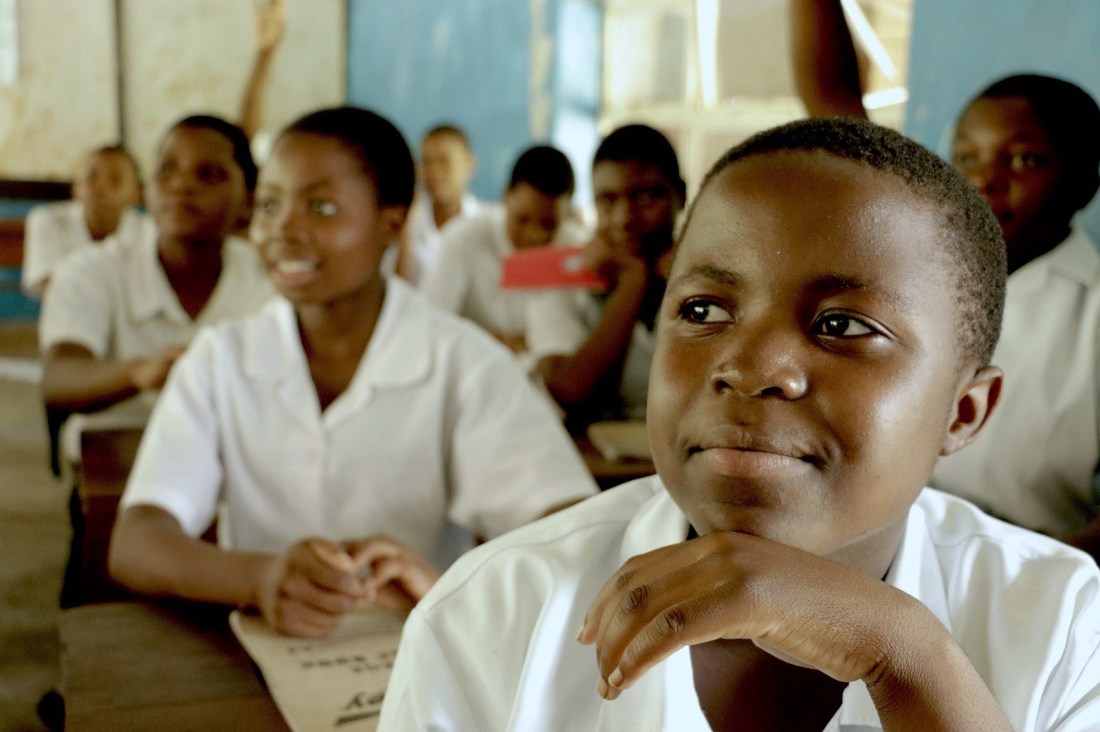
St Michael’s Girls School in Mangochi is one of the better secondary schools in Malawi, although by international standards it doesn’t look like much. The buildings are run down with broken windows here and there. Goats from the local village roam freely across the campus, butting heads or lying on stone benches in the shade. But the students are smartly dressed, happy, and keen to learn. The teachers are skilled and motivated.
Makankhula Full Primary School in Dedza is typical of Malawi’s rural schools. A row of brick and concrete buildings front onto a wide playing field between a range of low hills and the main road from Lilongwe to Blantyre. While older children learn in the classrooms, their younger counterparts sit in the shade beneath giant trees, watching teachers write on portable blackboards leant against the trunks.
It is the start of the rainy season on the shores of Lake Malawi, and the landscape which until recently was yellow and brown is now a lush green. Streams and rivers flow where before there were dry, dusty river beds. People have planted crops. There are fields of maize, as tall in places as the mud huts of farmers, and towering over children who run past them.
A rough earth track leads 30km from Zomba, the former capital of Malawi, to Nyangu village, on the shores of Lake Chilwa. It is an idyllic scene of rice fields and fishing boats, beyond which the lake — Malawi’s second largest — stretches an equal distance to mountains on the border with Mozambique. The water is clear and the surface sparkles in the sun.
Zau Seng, 11, is a student at Nam Ya Middle School, in Moe Nyin District, Kachin State, Myanmar. Kachin has been affected by conflict since 2011, following the collapse of a 17-year ceasefire. The recent violence has resulted in thousands of deaths and the displacement of around 100,000 civilians, half of them children. Despite ongoing peace talks, a final deal has proved elusive and the fighting continues.
Baum with her family at a camp for displaced people near Myitkyina UNICEF Myanmar/2016/Khine Zar Mon
Baum Myaw, 12, lives with her family at a camp for displaced people near Myitkyina, capital of Kachin State, Myanmar. Kachin has been affected by conflict since 2011, following the collapse of a 17-year ceasefire. The recent violence has resulted in thousands of deaths and the displacement of around 100,000 civilians, including children. Despite ongoing peace talks, a final deal has proved elusive and the fighting continues.
Every twenty minutes, a busy ferry crosses the river from downtown Yangon, Myanmar’s largest city, to the rural village of Dala on the opposite bank. On a recent morning, the ferry was packed with local commuters wearing Burmese ‘longyi’ skirts, vendors selling speckled eggs and cigarettes, and a handful of adventurous tourists.
As soon as I disembarked at Dala pier, I was approached by a thick-set young man with a pony tail and baseball cap. He introduced himself as Meh Meh, 28, and offered me a tour of the area by rickshaw. “What’s your name, where you from, you want trishaw tour?” he asked. “I take you to pagoda, fishing village, Cyclone village, orphanage. 15,000 Kyats.