Kenya year two: a shot in the arm

At Dandora Health Centre, where we filmed teachers getting their COVID-19 vaccine shots
© UNICEF Kenya/2021/Lameck Orina

In September 2021, after a delay of almost two years caused by COVID-19, I finally made it to the peak of Mount Longonot. This is a 2,780 metre dormant volcano one and a half hour’s drive north of Nairobi, in Kenya. I was hiking with my friends Matthias and Sheila, who I first met in Malawi five years before. It was an overcast day, which kept the temperatures mercifully mild as we followed the steep path up the mountainside. Our first goal was to reach the rim. From here, we could see across the crater, which – unusually for a volcano – was filled with a dense forest, cut off from the outside world by steep cliffs. Its was unclear what wildlife was living down there, although we did see the occasional giraffe on our way up. Great gashes down the mountainsides traced the routes where lava had previously flowed and we found pieces of brittle pumice stone scattered amongst the ash around the crater.

Continue reading “Kenya year two: a shot in the arm”

Photos: Amboseli National Park

Pink flamingos wade through a reflection of Mount Kilimanjaro in Amboseli National Park.
© Andrew Brown/2022/Kenya

Every safari in Kenya has its own distinctive feature. Amboseli National Park is characterized by the dramatic views of snow-capped Mount Kilimanjaro, the highest mountain in Africa, which lies just over the border in Tanzania. It’s a photographer’s dream – you can capture a wide array of wildlife with the mountain rising out of the clouds in the background. Near the airstrip is the seasonal Amboseli Lake, which in rainy season also provides reflections. The park is just a 40 minute flight from Wilson Airport in Nairobi. Flying towards the mountain just after sunrise in a 12-seater plane is an experience in itself.

Continue reading “Photos: Amboseli National Park”

Health volunteers persuade mothers to get vaccinated

Community health volunteer Daniel Akothee talks to market vendor Prisca in Kaego informal settlement, Kisumu
© UNICEF Kenya/2022/Lameck Orina

This story first appeared in The Star newspaper.

The focal point of Kaego informal settlement, in Kisumu town, is the boda boda (motorbike taxi) stop at the junction of the tarmac road and the earth track that leads through the settlement. Young men sit on their bikes under the shade of a wooden roof, waiting for customers. Washing hangs on clotheslines, criss-crossing the narrow side streets with bright colours. Schools are out and young children run between the houses, rolling old car tyres or playing with homemade balls made from plastic bags and string. Their cries and laughter mingle with the rumbling of motorbike engines.

Continue reading “Health volunteers persuade mothers to get vaccinated”

Combating COVID-19 vaccine hesitancy in Garissa

Halima prepares a vaccine dose for a patient at Garissa Referral Hospital
© UNICEF Kenya/2021/Lameck Orina

This story first appeared in The Star newspaper.

It is early Friday morning at Garissa Referral Hospital, the main COVID-19 vaccination centre in Garissa town, where infection rates have recently been increasing. In an open-air shelter, with a wooden roof to provide shade from the harsh sun, two masked health workers set up a cool box full of vaccine vials and syringes, and a laptop to register people coming for vaccination. There is a long bench for people to sit while waiting for their shots, but it is mostly empty.

Continue reading “Combating COVID-19 vaccine hesitancy in Garissa”

Bouncing back: helping children affected by drought in Garissa

Kaha plays with her son Sudeys, 1, who is recovering from malnutrition in Garissa
© UNICEF Kenya/2021/Lameck Orina.

This story first appeared in The Star newspaper.

It is a brutally hot, dry and dusty day in Garissa town, in the arid region of North-Eastern Kenya, when Kaha Hassan brings her one-year-old son Sudeys to Medina Health Centre. Two consecutive rains have failed in the region and only a few scrubby bushes and skinny animals have survived. Goats with visible ribcages roam the grounds of the health centre, searching for something to eat. The morning sun beats down on the sandy ground, drying it out even more.

Continue reading “Bouncing back: helping children affected by drought in Garissa”

Helping children with disabilities return to school

Ezra playing football with friends after school in Lodwar, Turkana
© UNICEF Kenya/2021/Lameck Orina

As the school day finishes in Lodwar, Turkana, a group of boys runs out onto a sandy football pitch between their classrooms. There is a flash of colour beneath their pink school shirts, which some of them peel off to reveal international football club shirts beneath. They run up and down the pitch with tremendous energy, gesturing at each other. Finally, 13-year-old Ezra, wearing an Atletico Madrid t-shirt, gets a clear shot at the goal. He lines it up and shoots. The ball swerves past the goalkeeper and lands behind the goalpost, kicking up a small cloud of dust as it lands. Ezra throws up his arms in celebration. But there is little or no sound from the players, all of whom are fully or partially deaf.

Continue reading “Helping children with disabilities return to school”

Top of the class: helping adolescent girls return to school

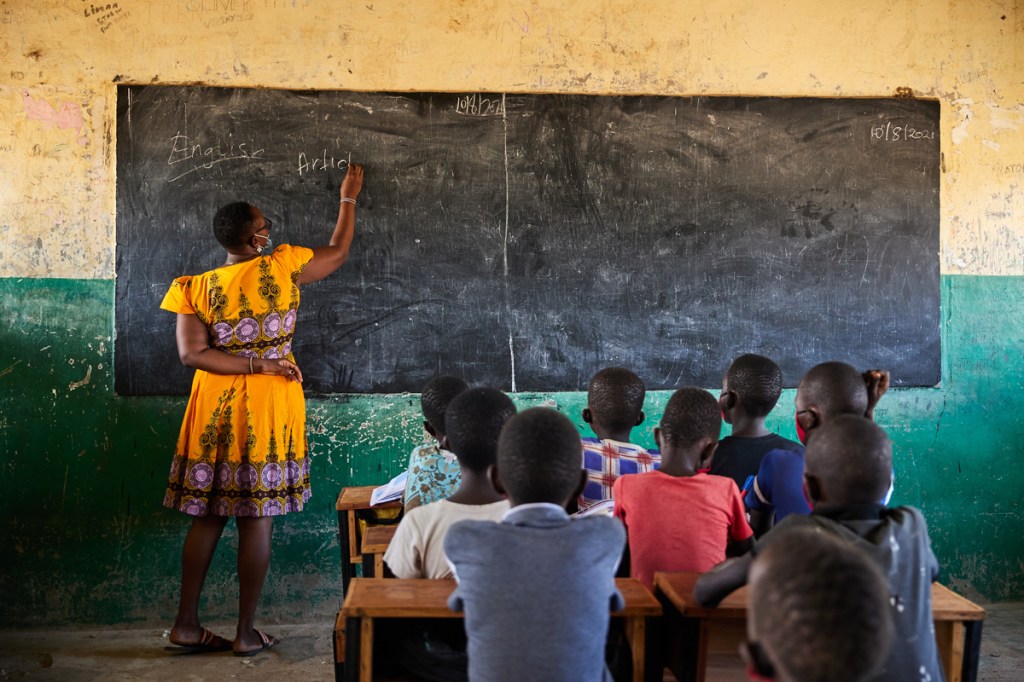
Teacher Hellen starts an English language class at Namoruputh Primary School
© UNICEF Kenya/2021/Lameck Orina

This story first appeared in The Star newspaper.

Sixteen-year-old Christine Aleper sits in a Grade 4 English class at Namoruputh Primary School, in Turkana County. It is a hot, dry afternoon and a sudden gust of wind blows dust through the open windows. Christine is much taller than the other children in the class, who range from 9 to 11-years old, and the only one wearing a blue and white school uniform. But the fact that she is learning English at all is remarkable, given her background. Standing by the board, her teacher, Hellen, explains the different types of articles – a, an, the – and when to use them. She asks for examples and Christina stands and reads out: “a ball, an apple, the sun.”

Continue reading “Top of the class: helping adolescent girls return to school”

Born to run: chasing the great wildebeest migration

A herd of wildebeest contemplating making the river crossing to the Serengeti
© Andrew Brown/2021/Kenya

In August each year, 2.2 million wildebeest, along with hundreds of thousands of zebra and antelope, migrate from the Serengeti in Tanzania to the Maasai Mara in Kenya, in search of greener pastures. Along the way, they cross the Sand River and then the wide, crocodile infested Mara River. As the rains change, they do the same journey in reverse. These crossings are one of the greatest wildlife spectacles on Earth, as desperate animals fight for survival. After each crossing, there are a few less wildebeest.

This was something my whole family wanted to see while we were living in Kenya. But finding 2.2 million wildebeest in the Maasai Mara was harder than I thought. At 1,500 square kilometres, the Mara is vast, and the Serengeti is even larger. Finding the wildebeest at the exact moment that they decide to cross a river is almost impossible. But not quite.

Continue reading “Born to run: chasing the great wildebeest migration”

Linked In: connecting schools to the Internet in Turkana

Teacher Mwangangi guides a student using a tablet connected to the Internet at Namoruputh Primary School
© UNICEF Kenya/2021/Lameck Orina

This story first appeared in The Star newspaper.

It is late morning in Namoruputh Primary School in Turkana, hot and dusty despite the wintertime. The school is close to the border with Uganda, which is lined by a ridge of high mountains on the horizon where rainclouds gather. Behind a classroom, a large satellite dish has been installed, surrounded by a makeshift fence of thorny branches, gathered from the bushes that punctuate the sandy ground.

Inside, teacher Mwangangi begins an unusual science lesson. He draws a diagram of a flower on the blackboard, but instead of telling the children the names of the parts of the flower, or handing out a textbook, he asks them to Google it. The children bend over their distinctive lime-coloured tablets, searching for images with the right information. Cecilia Akai, 13, raises her arm “Teacher, teacher,” she says. He gives her a chalk and she walks to the board, where she writes ‘stigma’ on the correct part of the flower. After naming all the parts of the flower, the teacher asks the children to research their functions and they break into groups, searching and discussing the results.

Continue reading “Linked In: connecting schools to the Internet in Turkana”

Photos: Wildlife of Maasai Mara

Naserian the cheetah, looking for prey from the vantage point of a termite mound
© Andrew Brown/2021/Kenya

I’ve visited the Maasai Mara three times so far during my time in Kenya, and been blown away by the experience each time. It’s the only place where I’ve seen a cheetah kill, watched the great wildebeest migration or had a sunset beer a few metres away from a sleeping crocodile. On two trips, we benefitted from a genuine Maasai guide, Moses, who grew up in the area and knows the landscape and wildlife intimately. And one of the very few up sides of the COVID-19 pandemic is that the animals were thriving and there were very few visitors, aside from a few Nairobi residents like us, so it often felt like we had the whole national park to ourselves.

Continue reading “Photos: Wildlife of Maasai Mara”