
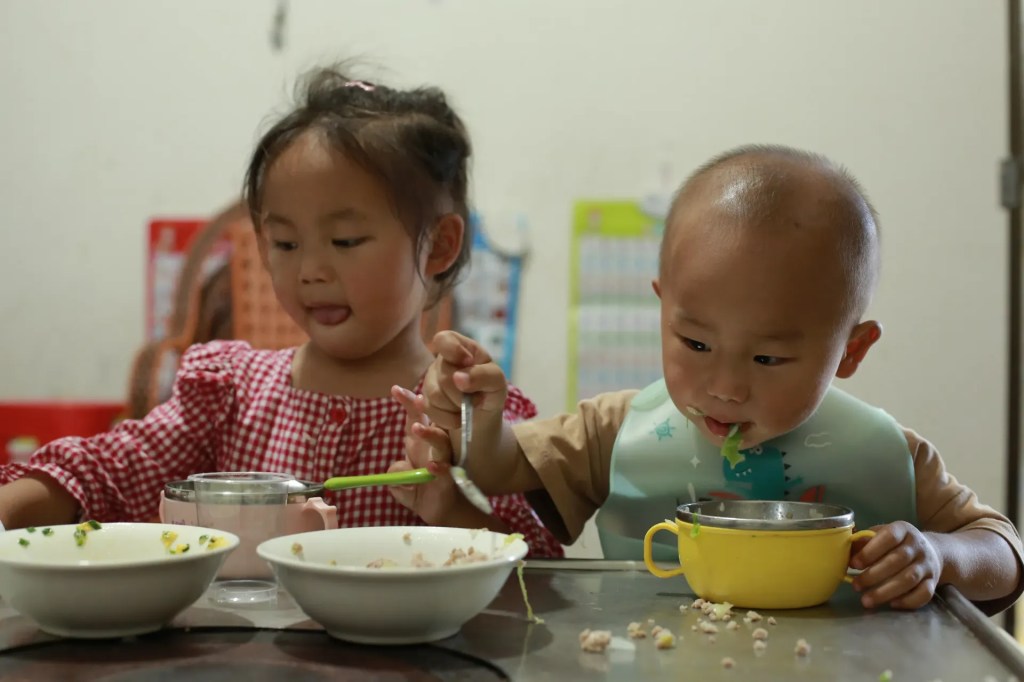
Early in the morning, Yang Xianxian, 25, heads out from her family home in rural Zhijin County, Guizhou Province, to visit the local market. It is in an agricultural area with valleys of maize fields surrounded by forested, cone-shaped karst hills. Red tuk-tuks putter up and down the steep mountain roads, while old women sit outside their houses chatting. On the hillside above town, tall white wind turbines turn lazily in the breeze.
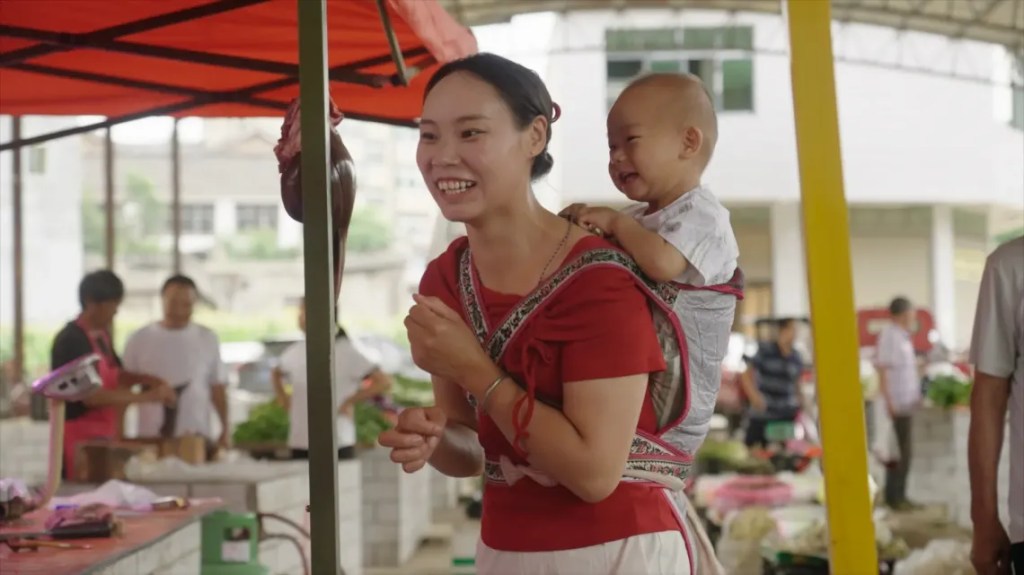
Xianxian arrives at the market early, to avoid the morning crowds and buy nutritious food for her son, Shuoshuo, 1 year and 9 months old. She carries him in a basket on her back while his older brother walks. The market is full of the mingled aromas of meat, tofu, fruit and aromatic spices, alongside the sounds of vendors chopping produce, customers haggling and live chickens squawking. Shuoshuo looks around the bustling market with interest. Xianxian stops at a butcher’s stall. “What do you recommend today?” she asks. “It’s for my son.”
Shuoshuo is now a healthy and active boy, but it wasn’t always this way. When he was five months old, Xianxian took him for a check-up at the township hospital. The doctors found he was underweight, giving them cause for concern. Xianxian had stopped breastfeeding him at 1.5 months due to a medical condition. Instead, she relied on infant formula. In general, children who are breastfed are healthier and get sick less often than those who are fed infant formula.
A doctor advised Xianxian to introduce complementary solid food, alongside milk, when her son reached six months old. The doctor taught her about the different food groups and showed her how to prepare nutritious food to her child. Gradually, his weight improved.
“When the doctors told me Shuoshuo was underweight, I felt really bad,” Xianxian says. “I thought I had given him the best care I could, but I felt guilty for stopping breastfeeding. I became worried about the impact on his health. I started feeding him a balanced diet and brought him to the hospital for regular check-ups.”
© UNICEF China/2025/Li Feifei
Rural-urban divide
Zhijin County is in rural western China, where child malnutrition rates are higher than in central or eastern China. This is due to multiple factors including f traditional feeding practices, that focus on a single food such as rice, and lack of knowledge among caregivers. In response, UNICEF, the National Health Commission and partners are supporting at-risk families with nutrition skills through the Early Childhood Development (ECD) programme.
“The first three years of a child’s life are the most crucial for their physical and brain development,” UNICEF China ECD Programme Officer Niu Hongfeng explains. “They need appropriate nurturing care and support from caregivers in order to reach their full potential. This includes good health, adequate nutrition, early stimulation and responsive caregiving.”
The ECD programme provides an effective way to improve children’s nutrition status. “We do this by conducting nutrition assessments of young children to identify problems,” Hongfeng continues. “Then we improve caregivers’ knowledge and skills through counselling and care group activities and even outreach to them in their homes if needed. Through this, we aim to improve the practice of breastfeeding and complementary feeding, including food diversity and frequency of feeding.”
Ms Lei Ying, Deputy Director of Zhijin County Maternal and Child Health Hospital, says that the UNICEF programme has been a big help with their work. “Before we joined the programme, our parenting guidance was a gap,” she says. “UNICEF helped to fill that gap. By teaching parenting skills, we can also help prevent diseases and improve child nutrition and feeding.”
© UNICEF China/2025/Li Feifei
Back on track
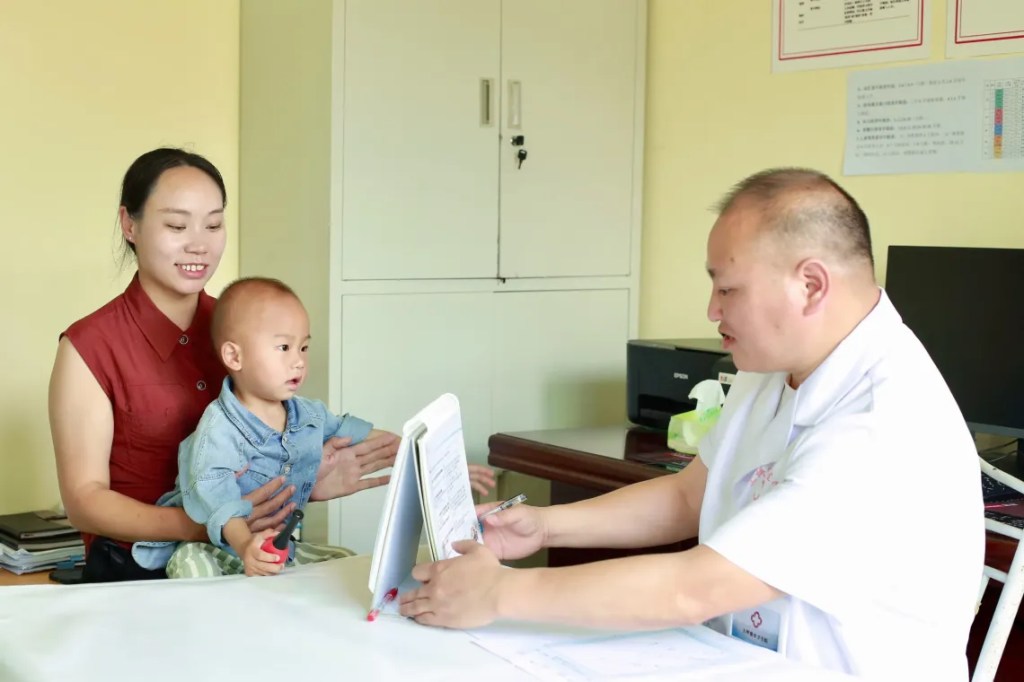
Shuoshou is now 1 year and 9 months old. He is an active and inquisitive child. Xianxian brings him back to Shangpingzhai Township Hospital for a check-up. He’s wearing striped trousers and an oversized denim shirt with the sleeves rolled up. The child cries as Dr Zhang Bo measures and weighs him, but quickly calms down afterwards as his mother comforts him. She hugs him and gives him a red rattle to play with. He laughs and points at a cartoon chicken on the wall height ruler.
In the consultation room, Dr Zhang shows Xianxian her son’s growth against a chart showing the healthy height and weight range. There is an obvious dip in his curve around five to seven months, but now it is back within the acceptable range. “Look, your son is back on track and doing well,” Dr Zhang says. “According to our guidance, he is within the medium standard height for his age. You should keep feeding him a range of different foods. Give him at least four of the seven food groups each day.”
Xianxian says that she pays attention to the advice from doctors and has varied Shuoshuo’s diet. “I change my cooking methods to keep food interesting for him,” she says. “For example, he has an egg every day. Sometimes I boil it, sometimes I scramble it. I give him the Ying Yang Bao nutrition package, mixed in with rice or noodles. He also has seasonal fruit.”
UNICEF China/2025/Li Feifei
Playing games
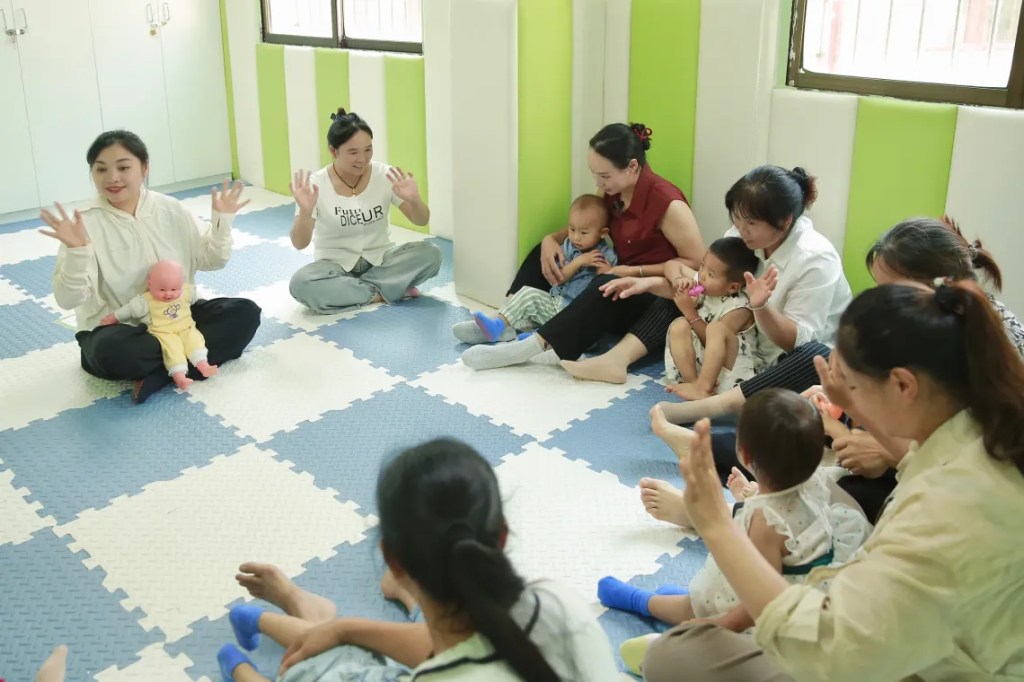
After the check-up, Shuoshuo and Xianxian join five other children and caregivers for a care group session at the township hospital in a soft playroom, decorated with pictures of children, animals and shapes. “What’s your name?” the care group facilitator Zheng Leling asks him. “Shuoshuo!” he replies happily. “Hello, Shuoshuo,” the others reply.
Leling leads a health education session for the caregivers on how to feed young children when they’re sick, then she guides the caregivers to play an interactive game for the children where they have put different coloured balls in a basket. Shuoshuo picks up a yellow ball and throws it in. “Well done!” she says. “That’s the right colour.” His mother adds: “Wow!”
Back at home in the late afternoon, Xianxian plays with Shuoshuo while doing the laundry. They sit on a concrete terrace outside the family home overlooking a maizefield. There is a clothesline, red lanterns and a basketball hoop. Xianxian fetches a small bowl for Shuoshuo and gives him a t-shirt to wash, making the household chore a game. “Now use this hose to add water to your clothes,” she says to Shuoshuo. He plays with the water happily, laughing.
Xianxian says that she has seen a big improvement in her son since getting ECD counselling, nutrition advice and joining the care group. “Compared to other children, he is more active and less likely to get sick,” she says. “He has improved both physically and mentally. I am so happy and have much less worries about him. I hope he can grow up healthy and happy, and have a wonderful childhood.”
© UNICEF China/2025/Li Feifei


